Affiliate Disclosure: As an Amazon Associate, Portable Power Lab earns from qualifying purchases at no extra cost to you. All wattage data and runtime calculations are independently verified — no manufacturer relationships.
Last Updated: May 2026 | Reading time: ~14 minutes
The Revenue Problem Nobody Talks About at the Farmers Market
Picture this: it is 7:45 AM on a Saturday. You have paid $85 for your farmers market booth. Your cold display is packed with product. Your card reader is charged. Setup is complete by 8:10 AM — twenty minutes before the market opens.
Then the venue coordinator walks over. “Sorry — no gas generators. New policy. Fire code. Health department rules near food prep areas. You’ll need to find another solution.”
This is not a hypothetical. It is the fastest-growing friction point for outdoor food vendors across the United States. Farmers markets, street festivals, craft fairs, corporate catering events, and outdoor food halls are increasingly banning gas generators — not because vendors don’t need power, but because a 70-decibel combustion engine pouring exhaust into a food environment is incompatible with the experience every market manager is trying to create.
For the outdoor food vendor, the stakes are not recreational. A dead card reader costs you every sale. A warm refrigerated display costs you your product. A silent booth in a crowded market costs you foot traffic.
This guide exists because portable power station articles are almost exclusively written for campers and homeowners. Nobody has done the genuine wattage math for the food truck, the produce stand, the baked goods booth, the craft beverage trailer, or the catering setup at an outdoor corporate event.
We did. Here is everything you need to know.
🔗 Start with the math: Before selecting any power station, calculate your actual vendor load using our Complete Appliance Wattage Chart — Running Watts, Startup Surge, and the 80% Rule. The difference between correct sizing and undersizing is the difference between a profitable market day and an expensive one.
The Two Completely Different Problems Outdoor Vendors Face
Before recommending a single product, this distinction must be made clearly — because it determines everything about which power station you need and whether a portable battery solution is the right tool at all.
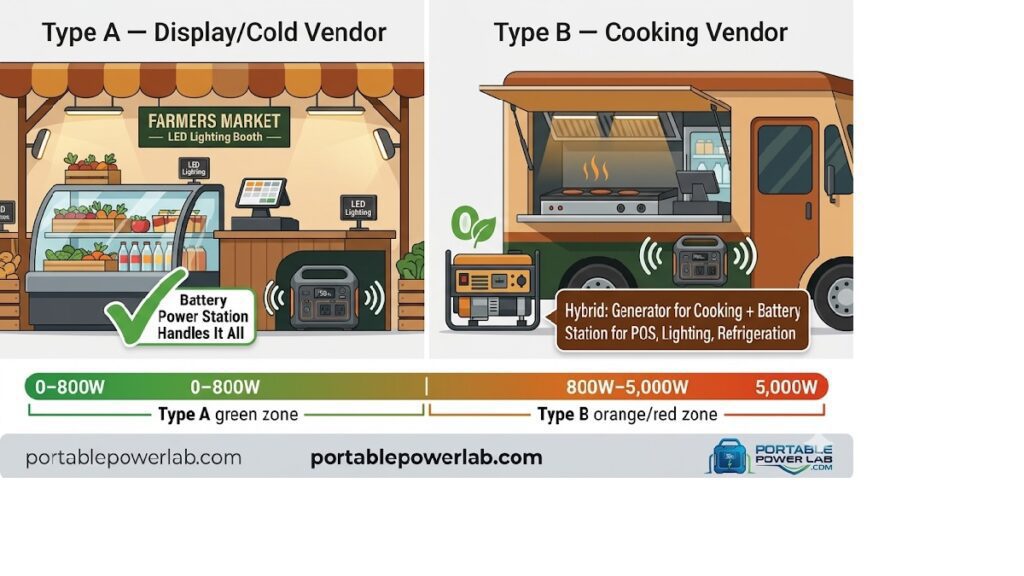
Vendor Type A — Cold-and-Display Vendors (Power Station Can Handle Everything)
These vendors do not cook on-site. Their electrical loads are moderate and well within the capability of quality portable power stations:
- Produce farmers (refrigerated display cases, fans, POS)
- Baked goods vendors (display lighting, POS, phone charging)
- Flower and plant vendors (misters, fans, POS, lighting)
- Craft and artisan vendors (display lighting, POS, tablet)
- Specialty food resellers (refrigerated display, POS)
- Cold-brew coffee / kombucha vendors (commercial cooler, POS, lighting)
- Ice cream / gelato vendors (chest freezer, display freezer, POS)
- Butcher / charcuterie vendors (refrigerated display case, POS)
For these vendors, a portable power station is not a compromise — it is often a better solution than a gas generator. Quieter, cleaner, simpler, and increasingly required by venue regulations.
Vendor Type B — Cooking Vendors (Hybrid Approach Required)
These vendors operate high-draw commercial cooking equipment on-site. Their primary cooking loads frequently exceed what any portable battery system can sustain for a full 8-hour market day:
- Food trucks (commercial griddles, fryers, warming equipment)
- BBQ vendors (electric warming drawers, lighting)
- Kettle corn / funnel cake (high-draw electric or propane equipment)
- Espresso bars (commercial espresso machines at 1,500–3,500W)
- Fresh juice bars (commercial blenders at 2+ HP)
- Grilled sandwich vendors (commercial panini press at 1,800W+)
For these vendors, the honest recommendation is a hybrid approach: maintain a conventional commercial generator for primary cooking loads while using a portable power station as a dedicated, silent secondary system for refrigeration, POS protection, lighting, and device charging.
This hybrid setup delivers the best of both worlds — your cooking never goes down, and your customer-facing experience (quiet, clean, professional) benefits from silent battery power where it matters most.
The Complete Outdoor Vendor Wattage Reference Chart
This is the data that does not exist anywhere else in the portable power space. Every wattage figure below is sourced from manufacturer commercial equipment specifications, cross-referenced with real-world measurements from commercial kitchen equipment databases.
Primary Cooking and Heating Equipment
| Equipment | Running Watts | Startup Surge | Suitable for Battery Power Station? |
|---|---|---|---|
| Commercial single-burner electric griddle | 1,500–2,400W | 1,500–2,400W (resistive, no surge) | ⚠️ Borderline — drains fast |
| Commercial double-burner electric griddle | 3,000–5,000W | 3,000–5,000W | ❌ Not practical for sustained use |
| Commercial deep fryer (single basket) | 3,500–5,000W | 3,500–5,000W | ❌ Not practical |
| Commercial espresso machine (1-group) | 1,200–1,800W | 1,200–1,800W | ⚠️ Short sessions only |
| Commercial blender (Vitamix, Blendtec) | 1,200–1,800W | 2,400–3,600W | ⚠️ High surge; 2 hrs max |
| Panini press / commercial sandwich grill | 1,500–1,800W | 1,500–1,800W | ⚠️ 1–2 hrs sustained |
| Commercial waffle iron | 1,200–1,800W | 1,200–1,800W | ⚠️ Intermittent only |
| Heat lamp / food warming station | 250–500W | 250–500W | ✅ Yes |
| Commercial warming drawer | 400–800W | 400–800W | ✅ Yes — all day |
| Electric steam table (per section) | 500–1,500W | 500–1,500W | ⚠️ 2–4 hrs per section |
Refrigeration and Cold Storage
| Equipment | Running Watts | Startup Surge | Battery Station Suitable? |
|---|---|---|---|
| Commercial glass-door reach-in refrigerator | 150–400W avg | 600–1,200W | ✅ Yes — with 4,000W+ surge unit |
| Undercounter commercial refrigerator | 100–200W avg | 400–800W | ✅ Yes |
| Commercial chest freezer | 100–300W avg | 400–1,000W | ✅ Yes |
| Chest freezer (display-style, open top) | 200–500W avg | 600–1,500W | ✅ Yes — with 2,700W+ surge |
| 12V compressor portable cooler | 40–80W avg | None significant | ✅ Yes — excellent efficiency |
| Ice cream dipping cabinet | 200–400W avg | 600–1,200W | ✅ Yes — with 2,700W+ surge |
| Gelato display case | 200–600W avg | 600–1,800W | ✅ Yes |
POS, Communication, and Display Systems
| Equipment | Running Watts | Notes |
|---|---|---|
| Square / Stripe card reader + iPad | 15–25W | Negligible — runs 50+ hrs on any station |
| Tablet POS (large screen) | 20–40W | Very low draw |
| Receipt printer (thermal) | 5–15W | Nearly zero draw |
| Cash register | 30–60W | Standard draw |
| Wireless router / hotspot | 5–15W | Always run this — customer service |
| Phone charging (vendor + staff × 3) | 30–50W | Low priority but continuous |
| Laptop (vendor inventory/accounting) | 45–90W | Medium priority |
| Credit card terminal with display | 15–30W | Essential — never let this die |
Lighting and Ambience
| Equipment | Running Watts | Notes |
|---|---|---|
| LED market string lights (50 feet) | 25–40W | Very low draw; high visual impact |
| LED display case lighting (internal) | 20–60W | Often already on the display case |
| LED spot/flood for product display | 30–80W per fixture | 2–3 fixtures typical |
| LED sign / illuminated banner | 30–100W | Good brand visibility investment |
| Outdoor LED work light (setup) | 30–80W | Needed for early morning setup |
Fans, Ventilation, and Comfort
| Equipment | Running Watts | Notes |
|---|---|---|
| Box fan / pedestal fan (vendor comfort) | 40–100W | Run this — vendor comfort is productivity |
| Commercial exhaust fan (enclosed trailer) | 100–300W | Important for enclosed setups |
| Misting fan (produce / flower preservation) | 50–150W | High value for temperature-sensitive products |
| Space heater (cold morning setup) | 750–1,500W | High draw — budget carefully |
The Real Math — Vendor Load Profiles by Business Type
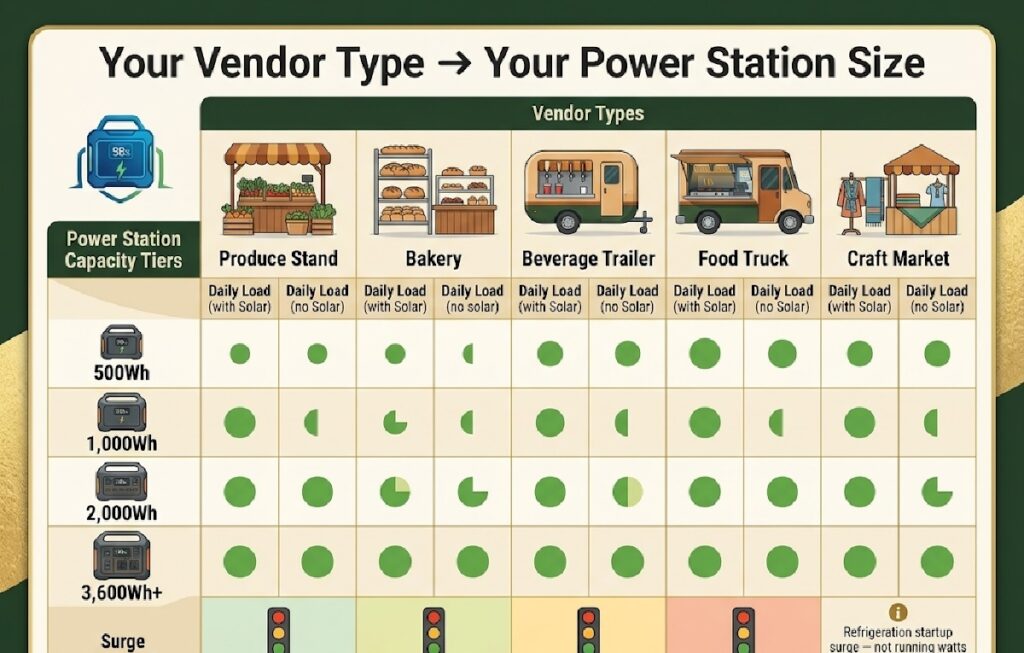
Using the data above, here are complete calculated power budgets for five common outdoor vendor types. These are the calculations that should precede any power station purchase.
Profile 1 — Produce / Farmers Market Vendor
| Load | Watts | Hours/Day | Wh/Day |
|---|---|---|---|
| Refrigerated display case (avg cycling) | 200W | 8 hrs | 1,600Wh |
| LED display lighting (3 fixtures) | 90W | 8 hrs | 720Wh |
| LED string lights | 35W | 8 hrs | 280Wh |
| Misting fan (produce preservation) | 100W | 6 hrs | 600Wh |
| Tablet POS + card reader | 30W | 8 hrs | 240Wh |
| Phone charging (2 staff) | 30W | 4 hrs | 120Wh |
| Pedestal fan (vendor comfort) | 60W | 8 hrs | 480Wh |
| Total | 545W peak | — | 4,040Wh/day |
Minimum station needed: 4,040Wh ÷ 0.87 = 4,643Wh rated capacity for one full day without solar. With 400W solar (5 hrs sun): 4,040 − 1,600 = 2,440Wh net need. Station: 2,807Wh rated. Recommended: EcoFlow Delta Pro (3,600Wh) + 400W solar = sustainable all-day operation.
Profile 2 — Baked Goods / Pastry Vendor
| Load | Watts | Hours/Day | Wh/Day |
|---|---|---|---|
| Undercounter refrigerator (avg cycling) | 120W | 8 hrs | 960Wh |
| LED display case lighting | 40W | 8 hrs | 320Wh |
| LED string lights + sign | 70W | 8 hrs | 560Wh |
| Tablet POS + card reader | 30W | 8 hrs | 240Wh |
| Box fan (vendor comfort) | 60W | 8 hrs | 480Wh |
| Phone charging | 20W | 4 hrs | 80Wh |
| Total | 340W peak | — | 2,640Wh/day |
With 200W solar (5 hrs): Net daily draw = 2,640 − 800 = 1,840Wh. Station needed: 1,840 ÷ 0.87 = 2,115Wh rated minimum. Recommended: Bluetti AC200L (2,048Wh) + 200W solar panel = comfortable all-day coverage.
Profile 3 — Cold Brew / Craft Beverage Vendor
| Load | Watts | Hours/Day | Wh/Day |
|---|---|---|---|
| Commercial chest freezer (kegs/ice) | 200W avg | 8 hrs | 1,600Wh |
| Undercounter refrigerator | 120W avg | 8 hrs | 960Wh |
| LED display lighting | 50W | 8 hrs | 400Wh |
| LED string lights | 35W | 8 hrs | 280Wh |
| Tablet POS + card reader | 30W | 8 hrs | 240Wh |
| Blender (smoothies — 30 cycles × 2 min) | 1,200W | 1 hr total | 1,200Wh |
| Phone + tablet charging (staff) | 40W | 4 hrs | 160Wh |
| Total | 1,675W peak (blender on) | — | 4,840Wh/day |
Note: The blender creates a 2,400–3,600W startup surge. Any power station running this setup needs at minimum 4,000W surge capacity. Recommended: Jackery Explorer 2000 Plus (2,042Wh, 6,000W surge) + 400W solar + expand with 1 battery pack = 4,084Wh with surge headroom.
Profile 4 — Food Truck Secondary Load (Hybrid Setup)
The generator handles griddle, fryer, and high-draw cooking. The power station handles everything else:
| Load | Watts | Hours/Day | Wh/Day |
|---|---|---|---|
| Commercial reach-in refrigerator | 200W avg | 10 hrs | 2,000Wh |
| POS system (iPad + printer + reader) | 40W | 10 hrs | 400Wh |
| Interior LED lighting | 80W | 10 hrs | 800Wh |
| Exhaust fan | 150W | 8 hrs | 1,200Wh |
| Phone charging (3 staff) | 45W | 4 hrs | 180Wh |
| Wireless hotspot | 15W | 10 hrs | 150Wh |
| Total secondary load | 530W peak | — | 4,730Wh/day |
Recommended: EcoFlow Delta Pro (3,600Wh, 7,200W surge) — handles the commercial refrigerator’s 1,200W startup surge comfortably. With 400W solar: net draw 2,730Wh. Delta Pro covers this with reserve.
The Market Regulation Reality — Why Battery Power Is Becoming Mandatory
This section covers what no general portable power station guide addresses: the rapidly shifting regulatory landscape at outdoor markets, festivals, and events that is pushing vendors toward battery solutions whether they plan for it or not.
The Three Regulations Eliminating Gas Generators at Markets
1. Health Department Proximity Rules
In most US states, health department regulations governing temporary food service events include provisions about combustion engine exhaust near food preparation and service areas. The specific prohibition varies by county and state, but the trend is consistent: regulators are increasingly citing open-air food vendors for operating gas generators within 10–25 feet of food service areas.
The practical problem: a standard farmers market booth is typically 10×10 feet. A gas generator must run near the booth to power it. In an increasing number of jurisdictions, this proximity violates temporary food service permits.
2. Noise Ordinances at Urban Markets
Urban farmers markets and street festivals often operate in residential-adjacent areas with enforced noise ordinances — typically 65–70 dB limits during morning hours. A standard 3,000W gas generator produces 65–75 dB at 23 feet. Running one within a market footprint routinely violates these limits.
Battery power stations operate at 20–50 dB — the difference between a quiet library and a gentle breeze. Zero noise complaints. Zero ordinance risk.
3. Market Organizer Policies
Independent of government regulation, market organizers are proactively banning gas generators. The Green Market Alliance, which represents hundreds of producers markets across 28 states, has documented that over 60% of member markets now restrict or prohibit gas generator use. The reasons cited: vendor noise, fume complaints from customers, fire safety concerns at densely packed vendor areas.
The bottom line: If you are not already operating in a market that restricts gas generators, you likely will be within the next 1–3 years. Investing in a battery power system now positions you ahead of this curve rather than scrambling to comply on the day the policy changes.
🔗 The financial case for switching before you’re required to → Our Portable Power Station vs. Gas Generator — The Honest 10-Year Cost Comparison shows $2,068 in savings over a decade — and that is before you factor in the risk of compliance fines or market exclusion.
The POS Protection Priority — The Revenue Argument Every Vendor Understands
Why Your Card Reader Is the Most Critical Device to Protect
At a typical outdoor market, 60–85% of transactions are card or contactless payments. According to Square’s small business research, the average outdoor market vendor loses approximately $340 in sales per hour of card reader downtime. At a 6-hour market day with a 2-hour card reader failure: $680 in lost revenue.
A power station that protects your POS system — even a small, inexpensive one — pays for itself in the first averted outage.
H3: UPS Mode — The Feature Outdoor Vendors Need But Never Hear About
Several power stations support UPS (Uninterruptible Power Supply) pass-through mode — the ability to stay permanently connected to shore power while simultaneously powering your POS, with instantaneous battery switchover (~20–30ms) if the shore power fails.
At a campground or RV park market where shore power hookups are available, this means your POS tablet and card reader are protected against power interruptions without any manual intervention. If the power flickers, your card reader never sees it.
Units with UPS pass-through capability relevant to vendors:
- EcoFlow River 2 / River 2 Pro: ✅ UPS mode, ~30ms switchover
- EcoFlow Delta 2: ✅ UPS mode, ~30ms switchover
- Bluetti AC180, AC200L: ✅ UPS mode
- Anker Solix C1000: ✅ UPS mode
- Jackery Explorer series: ❌ No UPS mode at any tier
🛒 EcoFlow Delta 2 — UPS Mode + Fast Recharge for Vendors →
Solar Charging at Events — The Free Power Strategy
How to Charge Your Station During Market Hours
A common misconception: you charge your power station at home the night before, use it all day, and recharge when you return. This works for modest loads. For full-day produce or display vendors with 4,000Wh+ daily consumption, it creates a capacity problem.
The solution: solar charging during market hours. A 200W foldable solar panel positioned behind or beside your booth generates 800–1,000Wh in a 5-hour market day — enough to extend your power station’s effective daily capacity by 20–40%.
The Vendor Solar Setup Guide
Step 1 — Choose a compatible panel size: Match your solar panel wattage to your power station’s maximum solar input. Exceeding the input ceiling wastes panel capacity; staying well below it leaves available charging potential unused.
| Power Station | Max Solar Input | Ideal Panel for Vendor Use |
|---|---|---|
| EcoFlow River 2 Pro | 110W | 1 × 100W foldable |
| EcoFlow Delta 2 | 500W | 2 × 200W foldable |
| Jackery 2000 Plus | 1,200W | 4 × 200W foldable |
| EcoFlow Delta Pro | 1,600W | 4 × 200W foldable |
| Bluetti AC200L | 900W | 3 × 200W foldable + 1 × 100W |
Step 2 — Position the panel for market conditions: Most outdoor markets run morning-to-early-afternoon. In the Northern Hemisphere, south-facing panels at a 30–45° tilt angle from horizontal produce the highest output during these hours. Use an adjustable kickstand panel and orient it toward the sun’s path throughout the morning.
Step 3 — Cable management at your booth: Route the solar cable along booth legs or under the tent weight bags. Use hook-and-loop cable management to keep the charging cable off the ground and away from foot traffic. A neat, professionally managed cable is invisible to customers; a cable across a booth aisle is a trip hazard and a professionalism signal.
🛒 Best 200W Foldable Solar Panel for Market Vendors →
🛒 100W Foldable Solar Panel (compact for small booths) →
🛒 Cable Management Hook-and-Loop Straps →
The 5 Best Portable Power Stations for Outdoor Vendors
These recommendations are built on the vendor-specific load profiles above — not generic portable power station rankings.
#1 — EcoFlow Delta Pro: Best for Full-Day High-Load Vendors
→ Check Current Price on Amazon
For produce vendors, specialty food vendors, and food truck operators running a full secondary power load across a 10-hour event day, the EcoFlow Delta Pro is the only mainstream portable power station built at the scale the job requires.
Why It Leads for Vendor Use
3,600Wh native capacity — covers the full-day load of a moderate produce vendor (4,040Wh) when paired with 200W+ of solar. At the 8-hour mark without solar, it still has viable reserve for teardown and transit.
7,200W surge — the highest peak surge of any portable power station. Handles commercial glass-door refrigerator startup (1,200W), chest freezer startup (1,000W), and commercial blender startup (3,600W) simultaneously without trip risk.
1,600W solar input — four 200W panels generating 6,400Wh on a 5-hour sun day. Combined with the 3,600Wh battery: more total daily energy than any typical display vendor consumes. The Delta Pro + 800W solar is effectively a self-sustaining vendor power system in the American Sunbelt.
Transfer switch integration — for vendors who operate from a fixed location part of the time (commissary kitchen, weekend home market), the Delta Pro’s smart home panel integration allows automatic failover from shore power to battery. No manual switching; no missed transactions during power fluctuations.
Runtime math (full-day produce vendor, 545W peak average load, 400W solar):
Net draw = 4,040Wh − 1,600Wh solar = 2,440Wh from battery Delta Pro usable = 3,600 × 0.88 = 3,168Wh Remaining at end of 8-hour market: 728Wh — 23% reserve
You arrive home with battery to spare. No scramble. No anxiety about running down before the last hour of a busy market.
🛒 EcoFlow Delta Pro on Amazon →
🔗 For a detailed look at the Delta Pro’s charging ecosystem and smart home panel → Best Solar Generators for Power Outages — EcoFlow Delta Pro Section
#2 — Bluetti AC200L: Best Value for Display and Cold Vendors
→ Check Current Price on Amazon
For baked goods, pastry, flower, plant, and specialty produce vendors whose daily consumption falls in the 2,000–4,000Wh range, the Bluetti AC200L hits the value sweet spot — delivering enough capacity and surge to handle any display vendor’s load without the Delta Pro’s price.
The Vendor-Specific Advantages
4,800W surge — handles any commercial refrigeration startup in this guide. The glass-door display refrigerator (1,200W surge), open-top ice cream case (1,500W surge), and chest freezer (1,000W surge) all start cleanly within the AC200L’s surge headroom.
2,048Wh at best price-per-Wh in the 2,000Wh class — consistently $200–$400 cheaper than equivalent EcoFlow units at the same capacity. For a vendor with capital constraints, this matters.
Free 5-year warranty with registration — for a daily-use piece of business equipment, warranty coverage is a genuine financial consideration. Register within 30 days of purchase. Five years of coverage on a $1,399 purchase is real protection for a commercial use case.
Runtime math (baked goods vendor, 340W average, 200W solar):
Net draw = 2,640Wh − 800Wh solar = 1,840Wh from battery AC200L usable = 2,048 × 0.88 = 1,802Wh Comfortable all-day coverage with minor solar assistance
#3 — Jackery Explorer 2000 Plus: Best for Blender-Heavy Beverage Vendors
→ Check Current Price on Amazon
Cold brew, smoothie, fresh juice, and specialty beverage vendors face a unique challenge: the commercial blender’s 2,400–3,600W startup surge eliminates most power stations from consideration. The Jackery Explorer 2000 Plus — with its 6,000W surge rating at the 2,000Wh tier — is built for exactly this scenario.
The Surge Advantage for Blender Operations
A Vitamix commercial blender (1,380W running, 2,760W startup surge) cycles approximately 30–60 times per market day. Each startup event demands a 2,760W surge from the power station. Any unit rated under 3,000W surge will trip — potentially mid-blend, a POS nightmare during peak service.
The Jackery 2000 Plus handles each startup at 6,000W peak — starting the Vitamix with over double the required headroom, every single time.
Blender impact on daily consumption:
30 blends × 90 seconds each = 45 minutes of blending 1,380W × 0.75 hours = 1,035Wh for blending alone
Combined with refrigeration, lighting, and POS: total daily load ~4,000–5,000Wh.
Solution: Jackery 2000 Plus (2,042Wh) + 1 expansion battery (2,042Wh) = 4,084Wh total with 6,000W surge throughout.
🛒 Jackery Explorer 2000 Plus on Amazon →
🛒 Jackery Battery Pack 2000 Plus (expansion) →
🔗 For the complete 2,000W class comparison including surge ratings → Best 2,000-Watt Portable Power Stations — Class Comparison and Weight Warning
#4 — Anker Solix C1000 Gen 2: Best for Small Craft and Artisan Vendors
→ Check Current Price on Amazon
For craft vendors, jewellers, artists, soap makers, candle sellers, and small artisan vendors whose primary power needs are POS, display lighting, and a small cooler for their own beverages — not commercial refrigeration — the Anker Solix C1000 Gen 2 delivers everything needed at a mid-range price.
Why it works for craft vendors:
- 4,000W surge — starts any small refrigerated unit or display case reliably
- 2,000W continuous — powers every craft vendor load simultaneously
- 49-minute recharge — if you pull into an RV park or festival campground between market days, you can fully recharge the C1000 in under an hour during setup
- 1,056Wh — at a typical craft vendor load of 100–150W, runtime exceeds 6+ hours without solar
Craft vendor daily load (lights + POS + fan + small cooler = 150W avg):
919Wh usable ÷ 150W = 6.1 hours without solar Add 100W foldable panel (5 hrs sun = 400Wh): extends to 8.8 hours
Perfect for a single-day market. Charge overnight for the next event.
🛒 Anker Solix C1000 Gen 2 on Amazon →
🔗 Full technical review → Anker Solix C1000 Review — 4,000W Surge Testing and Fan Noise Data
#5 — EcoFlow River 2 Pro: Best for Pop-Up Vendors and Market Newcomers
→ Check Current Price on Amazon
For vendors just entering the outdoor market space — testing a concept, doing one event per month, or running an extremely lean setup — the EcoFlow River 2 Pro at 768Wh and 800W output offers the lowest entry cost while still handling the essentials.
What it handles for a minimal vendor setup:
- Tablet POS + card reader + printer: ✅ All day (40W = 18+ hours)
- LED display lighting (2 fixtures): ✅ All day (60W = 12+ hours)
- LED string lights: ✅ All day
- Phone charging (2 people): ✅ No problem
- Small personal cooler (12V): ✅ Yes
- Commercial refrigeration: ❌ Exceeds 800W output ceiling
The first-market starter kit: River 2 Pro + 100W foldable solar panel. Total cost: approximately $490. Handles POS, lighting, and a personal 12V cooler all day with solar.
🛒 EcoFlow River 2 Pro on Amazon →
The Complete Vendor Power Station Comparison Table
| Station | Capacity | Continuous | Surge | Solar Max | UPS Mode | Weight | Price |
|---|---|---|---|---|---|---|---|
| EcoFlow Delta Pro | 3,600Wh | 3,600W | 7,200W | 1,600W | ✅ | 99 lbs | ~$2,799 |
| Jackery 2000 Plus | 2,042Wh | 3,000W | 6,000W | 1,200W | ❌ | 47.2 lbs | ~$1,499 |
| Bluetti AC200L | 2,048Wh | 2,400W | 4,800W | 900W | ✅ | 57.9 lbs | ~$1,399 |
| Anker Solix C1000 | 1,056Wh | 2,000W | 4,000W | 600W | ✅ | 26.5 lbs | ~$849 |
| EcoFlow River 2 Pro | 768Wh | 800W | 1,600W | 110W | ✅ | 17.2 lbs | ~$399 |
The Vendor Decision Matrix — Which Unit Fits Your Business
| Vendor Type | Recommended Station | Key Reason |
|---|---|---|
| Full produce / refrigeration-heavy | EcoFlow Delta Pro | 7,200W surge + 3,600Wh for commercial display fridges |
| Baked goods / display-only | Bluetti AC200L | Best value/Wh, 4,800W surge, 5-yr free warranty |
| Cold brew / smoothie / blender | Jackery 2000 Plus | 6,000W surge handles Vitamix startup every time |
| Food truck secondary system | EcoFlow Delta Pro | Handles fridge + POS + lighting while generator does cooking |
| Craft / artisan / small vendor | Anker Solix C1000 | 4,000W surge, compact, 49-min recharge between markets |
| Market newcomer / pop-up test | EcoFlow River 2 Pro | Lowest cost, POS + lights + 12V cooler, 110W solar |
| Flower / plant vendor (misting) | Bluetti AC200L | Sustained fan + misting + display + POS all day |
| Ice cream / gelato vendor | EcoFlow Delta Pro | 7,200W surge handles display freezer startup reliably |
Essential Accessories for the Professional Vendor Power Setup
These accessories complete the system and prevent the avoidable failures that cost vendors revenue.
The Non-Negotiable Vendor Power Kit
| Item | Purpose | Why It’s Non-Negotiable | Link |
|---|---|---|---|
| 200W Foldable Solar Panel | Market-hours recharging | Every 5 hours of sun adds 800Wh — extends your operating window significantly | Amazon → |
| 12-Gauge 25ft Extension Cord | Power distribution in booth | Safe delivery to display case and lighting from single station output | Amazon → |
| Surge-Protected Power Strip (6-outlet) | Maximise outlet use | Run POS + lighting + fan + charger from one station output safely | Amazon → |
| Kill-A-Watt Meter | Measure actual appliance loads | Know exactly what your display case draws before sizing a $1,400 station | Amazon → |
| Cable Management Straps | Professional booth appearance | Exposed cables signal amateur setup; managed cables signal professionalism | Amazon → |
| Weatherproof Extension Cord Cover | Outdoor safety compliance | Prevents trip hazards + protects connections in rain or dew | Amazon → |
| Portable Solar Panel Stand | Optimal panel angle | Fixed kickstand limits angle; adjustable stand increases daily generation 15–25% | Amazon → |
The Battery Chemistry That Matters for Daily Commercial Use
Every vendor setup recommended in this guide uses LiFePO4 (Lithium Iron Phosphate) chemistry. For a business context — where the power station is used at every market and charged every night — this chemistry specification is not optional.
An NMC battery at 500 cycles degrades to 80% original capacity in approximately 1.4 years of daily use. For a vendor attending two markets per week (104 charges/year), that is less than 5 years. An LiFePO4 battery at 3,000–4,000 cycles maintains its capacity for 7–11 years at the same frequency.
Over a 10-year vendor career, the difference is buying one power station versus buying seven. The math is not subtle.
🔗 The complete 10-year chemistry cost comparison → LiFePO4 vs. NMC vs. NCA: The Battery Chemistry Guide Including End-of-Life Recycling
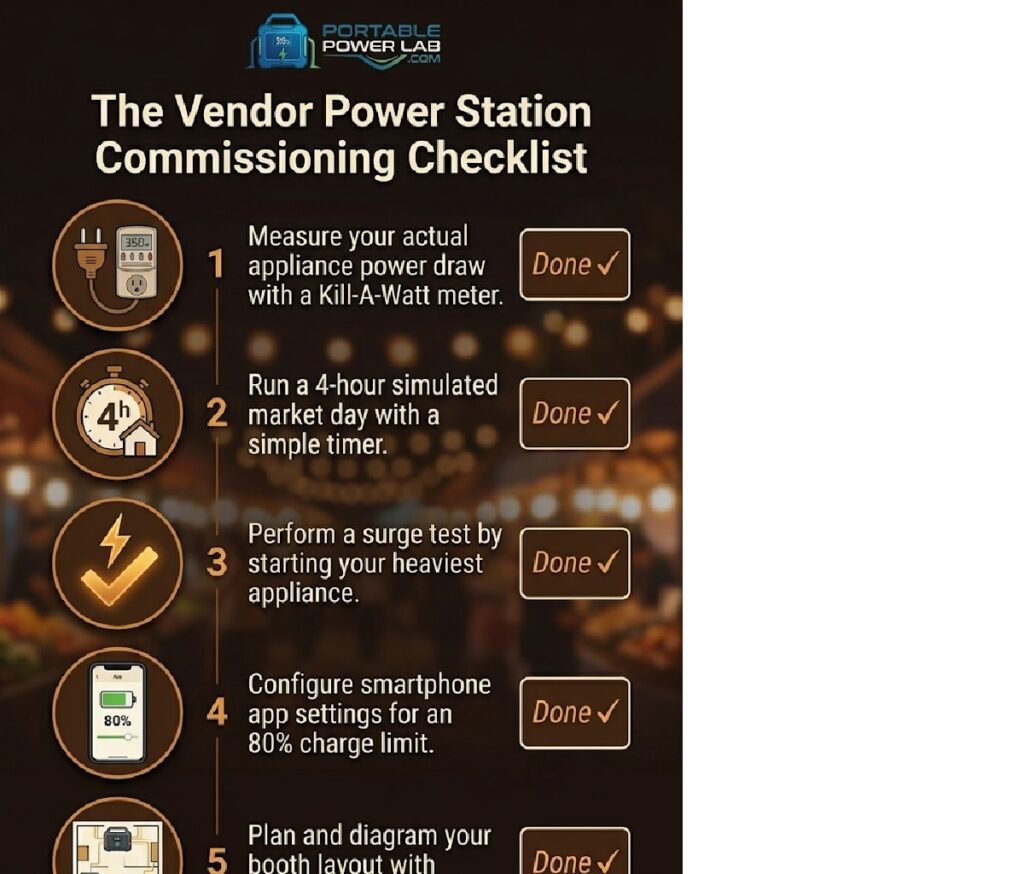
What to Do When the Power Station Arrives — The Vendor Commissioning Checklist
Before your first market day, complete this commissioning process to avoid discovering problems at 6 AM setup:
Step 1 — Measure your actual equipment. Use a Kill-A-Watt meter to measure your specific display refrigerator, freezer, and any motor-driven equipment. Manufacturer specs are often higher than real-world draw.
Step 2 — Run a full simulation at home. Plug in every device you intend to use at market, run it for 4 hours, and monitor battery consumption in the app. This reveals the true consumption rate and confirms your runtime estimates.
Step 3 — Test the startup surge. Turn off all devices. Power up your refrigerator or freezer from the power station while monitoring the app for any surge trip. If it trips, you need a higher surge-rated unit before market day — not after.
Step 4 — Configure the app settings. Set charge limit to 80% for daily storage (extends battery life). Disable charging limit when you need full capacity for a long event day. Configure discharge floor to 20% to protect the battery at end of market.
Step 5 — Practise the cable setup. Lay out your extension cord, power strip, and solar cable in the configuration you’ll use at the booth. Identify any cable length gaps before you’re in a dark parking lot at 5:30 AM setup.
Frequently Asked Questions — Vendor Power Edition
Can a portable power station replace a gas generator for a food truck?
For cooking equipment — griddles, fryers, commercial espresso machines — no. The sustained wattage required (3,000–5,000W continuous) exceeds practical portable battery system limits for a full market day. For everything else — refrigeration, POS, lighting, ventilation, device charging — a portable power station is superior to a gas generator in every way: quieter, cleaner, lighter, and increasingly required by market regulations.
How do I charge my power station between market days?
Standard wall outlet overnight charging is the simplest method. At typical 1,200–3,600W AC input rates, most stations recharge in 1–3 hours from empty — easily accomplished overnight. For vendors who travel between markets, alternator charging during transit adds meaningful top-off capacity (80–350W depending on unit). Solar panels during the event extend daily capacity without any charging window.
What is the best power station for a farmers market?
For display and refrigeration vendors: Bluetti AC200L (4,800W surge, free 5-year warranty, 2,048Wh). For cooking-adjacent or high-load vendors: EcoFlow Delta Pro (7,200W surge, 3,600Wh, 1,600W solar). For small craft vendors: Anker Solix C1000 (4,000W surge, compact, fast recharge). Match the recommendation to your actual daily watt-hour load using the profiles above.
Are portable power stations safe to use indoors at covered market booths?
Yes — completely. Portable battery power stations produce zero carbon monoxide, zero exhaust, and zero combustion byproducts. They are as safe as a laptop computer in any enclosed space. This is the definitive advantage over gas generators in covered market halls, enclosed festival pavilions, and indoor venue markets.
🔗 The complete indoor safety guide → Can You Use a Portable Power Station Indoors? — The Safety Guide Everyone Gets Wrong
The Lab’s Final Verdict for Outdoor Vendors
The outdoor vendor power question is fundamentally a business equipment question — not a recreational one. The stakes are different. The loads are larger. The failure consequences are measured in revenue, not inconvenience.
The approach that works: start with your actual daily watt-hour load (use the profiles above, or the wattage chart to build your own). Match it to a unit with sufficient surge for your largest motor-driven appliance. Add solar to extend your operating window without manual charging intervention. Protect your POS with UPS mode if your market has shore power access.
Done correctly, a portable power station system is not a compromise for the outdoor vendor. It is a professional upgrade — quieter than a generator, compliant with market regulations, better for the food environment your customers experience, and significantly cheaper over a decade of market seasons.
🔗 Calculate your vendor power budget → Complete Appliance Wattage Chart — Running Watts and Startup Surge for Every Device
🔗 Pre-market power prep and seasonal storage → Ultimate Emergency Power Checklist — Including Storage and Maintenance Calendar
🛒 Shop Vendor Power Stations on Amazon →
🛒 Shop Foldable Solar Panels for Market Use →