Affiliate Disclosure: As an Amazon Associate, Portable Power Lab earns from qualifying purchases at no extra cost to you. Our analysis is math-based and independent — no sponsored placements.
Last Updated: May 2026 | Reading time: ~15 minutes
The One Mistake That Kills Every RV Power Setup
You pull into a dry-camping spot in Zion at 6 PM. Perfect site, no hookups, three days planned. You open the fridge — cold. Fire up the coffee maker the next morning — fine. Then on night two, you flick on the rooftop AC as temperatures climb past 85°F at 9 PM.
Dead. The power station trips. The inverter shuts off. Everyone is hot and the fridge starts warming.
This is the single most common RV and van life power failure — and it almost never happens because someone bought a bad power station. It happens because someone bought a camping power station and used it in an RV.
RV and van life power is a completely different engineering problem from backpacking or weekend camping. The loads are larger, the runtime expectations are longer, the charging ecosystem is richer, and the consequences of undersizing are far more serious than a dead phone.
This guide treats RV power as what it actually is: a mobile home energy system. It ranks the best portable power station for RV and van life. Every recommendation is built on real math for real RV appliances — not the optimistic runtimes on product packaging.
🔗 Before reading the product recommendations: Run your specific appliance loads through our Complete Appliance Wattage Chart — Running Watts, Startup Surge, and the 80% Rule to calculate your actual daily consumption.
How RV and Van Life Power Is Fundamentally Different From Camping
Understanding this distinction is what separates a power setup that works from one that fails on night two.
The Load Profile Is Completely Different
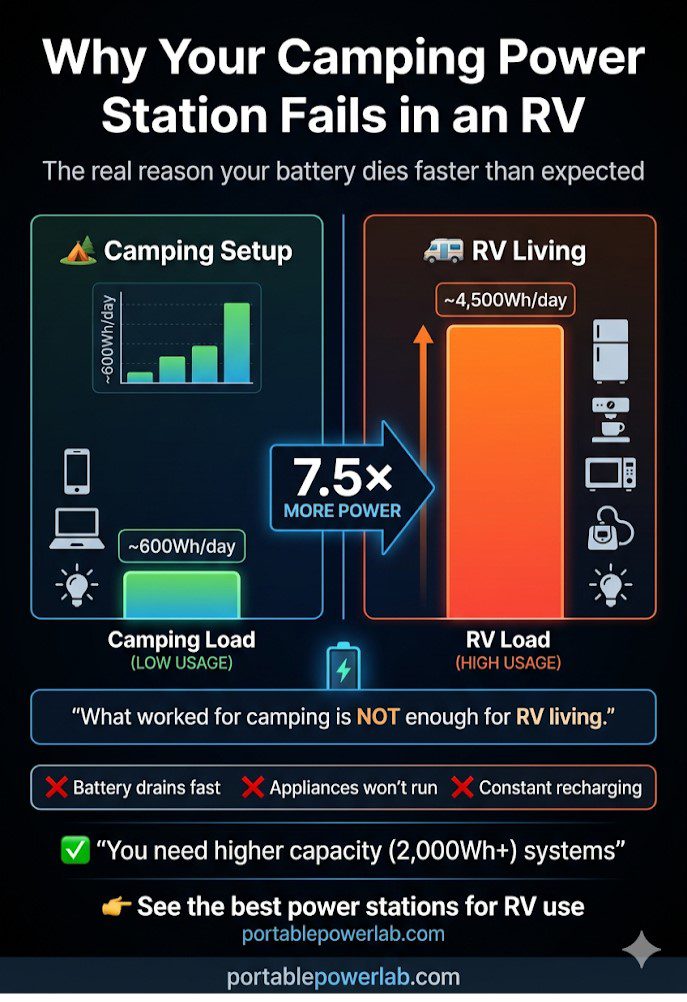
A camping power station needs to handle phones, a laptop, LED lights, and maybe a CPAP. Total daily consumption: 400–800Wh. Even a 500Wh unit with a 100W solar panel can sustain that indefinitely.
An RV or van life setup needs to handle:
| Appliance | Running Watts | Startup Surge | Typical Daily Wh |
|---|---|---|---|
| Residential refrigerator (12V or AC) | 40–80W avg | 200–800W | 960–1,920Wh |
| Rooftop RV air conditioner (13,500 BTU) | 1,200–1,500W | 2,800–3,500W | Depends on use |
| Residential microwave | 900–1,200W | 900–1,200W | 50–150Wh/use |
| Coffee maker | 900–1,200W | None | 100–200Wh/morning |
| CPAP with humidifier | 90–130W | None | 720–1,040Wh/night |
| LED lighting (full RV) | 80–150W | None | 320–600Wh |
| Laptop + devices (2 people) | 120–180W | None | 480–720Wh |
| Water pump | 60–120W | 180–360W | 60–150Wh |
| Phone × 4 | 60W | None | 120Wh |
Typical daily consumption for a live-aboard van or Class B RV (no AC): 3,000–5,500Wh/day With rooftop AC running 4 hours/evening: 8,000–11,000Wh/day
This is why a 1,000Wh camping power station — perfectly adequate for a weekend trip — runs an RV setup for approximately 6–8 hours and then goes silent.
You Have Three Charging Sources, Not One
Campers charge from solar and occasionally a wall outlet. RV and van life operators have access to:
- Shore power (30A or 50A hookup) — When parked at an RV park or campground with electrical
- Rooftop or portable solar panels — Primary off-grid charging source
- Vehicle alternator (DC charging while driving) — Often overlooked, highly valuable
- Generator (if carried) — Emergency backup or heavy-load support
A properly chosen power station must integrate with all four sources — accepting high-wattage shore power when available, maximum solar input when parked off-grid, and DC alternator charging while traveling. Units that limit solar input to 200–300W or don’t support DC alternator input are engineering compromises that punish RV users specifically.
The AC vs. 12V Appliance Decision Changes Everything
This is the most important architectural decision in an RV power setup. Most RV appliances are designed to run on one of two systems:
12V DC appliances (designed for vehicle/RV electrical systems):
- 12V compressor refrigerators (BougeRV, Alpicool, Iceco)
- 12V water pumps
- 12V lighting systems
- Charge directly from the battery bank with ~95% efficiency
120V AC appliances (residential, run through an inverter):
- Standard home refrigerators
- Microwave ovens
- Coffee makers
- Air conditioners
- Induction cooktops
Every time you run an AC appliance through your power station’s inverter, you lose approximately 10–15% of the energy to heat. Over a full day of heavy use, this adds up to hundreds of watt-hours of waste.
The Lab Rule for RV Power: Run 12V DC whenever possible (refrigeration, water, lighting). Use the inverter only for genuinely AC-native appliances (microwave, coffee maker, induction cooktop). This single discipline extends your effective battery capacity by 15–25% without buying a single additional watt-hour.
🔗 Want to understand the efficiency loss in detail? Our LiFePO4 vs. NMC Chemistry Guide covers battery efficiency rates and how different chemistries handle sustained high-load discharge cycles — directly relevant to RV full-time use.
Sizing Your RV Power Station: The Right Math for Every Rig Type
Different rigs have radically different power architectures. Here is how to calculate what you actually need before spending $700–$3,500 on a system.
The 3-Step RV Power Sizing Formula
Step 1 — Calculate your daily watt-hour budget
List every device you use daily. Multiply watts × hours of use = daily Wh for that device. Sum everything.
Step 2 — Determine your solar input
Daily solar generation (Wh) = Panel wattage × Peak sun hours × 0.80
In most of the continental US, plan for 4.5–5.5 peak sun hours daily. In the Pacific Northwest or during winter travel: 2.5–3.5 hours.
Step 3 — Calculate required battery capacity
Required battery (Wh) = (Daily consumption − Daily solar generation) × Days of autonomy desired ÷ 0.87 (LiFePO4 efficiency)
Example: Full-time van couple, no rooftop AC, 400W solar roof
- Daily consumption: 3,200Wh
- Solar generation (5 hrs, Southwest): 400 × 5 × 0.80 = 1,600Wh
- Net daily battery draw: 3,200 − 1,600 = 1,600Wh
- 2 days autonomy: 1,600 × 2 ÷ 0.87 = 3,678Wh minimum battery capacity
This tells you immediately why a 1,000Wh unit is inadequate and a 2,000Wh unit covers only a single day without solar. You need 3,600–4,000Wh of storage minimum.
Power Requirements by Rig Type
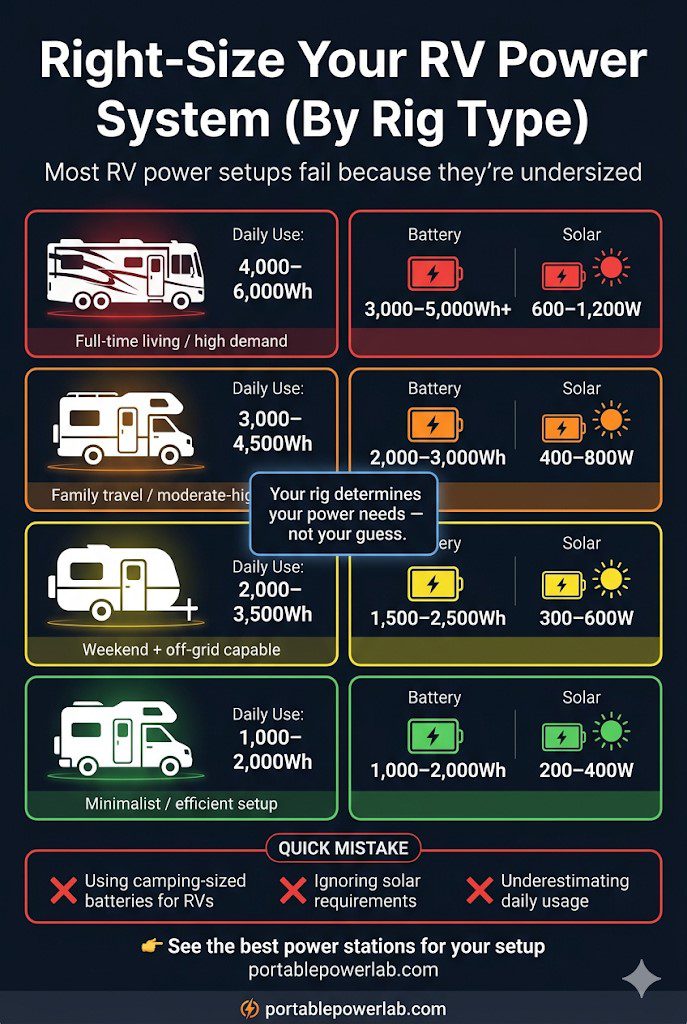
Class A Motorhome
Power profile: Large living space, often residential appliances, rooftop AC (sometimes two units), full kitchen.
- Daily consumption without AC: 5,000–8,000Wh
- Daily consumption with AC (4 hrs): 10,000–15,000Wh
- Minimum battery for overnight without hookup: 6,000–10,000Wh
- Realistic solar array needed: 800–1,600W
Verdict: Class A motorhomes are generally served better by a permanent installed lithium bank (Battle Born, Victron, Renogy) than by portable power stations. Portable stations can supplement, but aren’t the right primary solution at this scale.
Class B and Class C Motorhome
Power profile: Smaller living space, often 12V fridge, limited AC use, moderate kitchen.
- Daily consumption without AC: 2,500–4,500Wh
- With occasional AC use: 4,500–7,000Wh
- Minimum battery for 2-night dry camping: 4,000–6,000Wh
- Realistic solar needed: 400–800W
Verdict: The sweet spot for high-capacity portable stations like the EcoFlow Delta Pro or Jackery Explorer 2000 Plus — especially for owners who want flexibility to remove the power station when using the vehicle for other purposes.
Travel Trailer / Fifth Wheel
Power profile: Similar to Class B/C, but with no engine alternator charging advantage while stationary.
- Daily consumption: 2,000–5,000Wh depending on appliances
- No alternator charging advantage — solar and shore power are the only inputs
- Minimum battery for weekend without hookup: 3,000–5,000Wh
Verdict: High-capacity stations with strong solar input work well. The lack of alternator charging makes 800W+ solar input a must for extended stays without hookups.
Van Life (Converted Cargo or Sprinter Van)
Power profile: Highly variable. From minimalist solo traveler to full off-grid family. No rooftop AC in most builds (roof too low for RV AC, window AC impractical while moving).
- Minimalist daily consumption (fridge + lights + devices + CPAP): 2,000–3,500Wh
- Heavy use (induction cooking, multiple devices, fan): 3,500–5,500Wh
- No rooftop AC means lower peak load but longer sustained run time
- Alternator charging is a major advantage — driving 2 hours adds 300–800Wh
Verdict: Van life is the single best use case for high-capacity portable power stations because the loads are manageable, the rig is sized appropriately, and the multi-source charging (solar + alternator + shore) enables sustainable off-grid living without a permanent installation.
The Alternator Charging Advantage — Van and Motorhome’s Secret Weapon
Most portable power station reviews completely ignore alternator charging. For van lifers and motorhome owners, this is the most underutilized power source in any mobile setup.
How Alternator Charging Works
When your vehicle engine is running, the alternator generates electricity to charge your starter battery. With the right connection, you can route that excess alternator power to your portable power station, effectively charging your battery bank while you drive.
Alternator charging rates for portable power stations:
Most portable stations accept 12V car charging input via a cigarette lighter plug or direct DC connection. The rate varies significantly:
| Power Station | Car/DC Charging Input | Estimated Alternator Charge Rate | 100-Mile Drive Adds |
|---|---|---|---|
| EcoFlow Delta 2 | 12V/8A = 96W | 70–85W real-world | ~250Wh |
| Jackery Explorer 1000 Plus | 12V/10A = 120W | 90–110W real-world | ~330Wh |
| EcoFlow Delta Pro | 12.6V/30A = 378W | 300–350W real-world | ~950Wh |
| EcoFlow Delta Pro Ultra | DC 12-150V input | Up to 1,500W (with EcoFlow alternator cable) | Up to 3,750Wh on 2.5-hr drive |
| Bluetti AC200L | 12V/10A = 120W | 90–110W real-world | ~330Wh |
| Anker Solix F3800 | 12V/30A = 360W | 280–330W real-world | ~900Wh |
The Delta Pro revelation: A family driving 3 hours between campsites with an EcoFlow Delta Pro charging at 350W = 1,050Wh recovered — essentially a free solar panel’s worth of energy just from the drive. For full-time RVers, this changes the math entirely on battery sizing.
The EcoFlow EV X-Stream Technology
EcoFlow’s proprietary EV X-Stream feature (available on the Delta Pro Ultra) allows the power station to charge at up to 1,500W directly from the vehicle’s alternator through a special high-current cable. On a 3-hour drive, this recovers approximately 3,750Wh — more than full capacity on a standard 3,600Wh unit.
This is genuinely transformative for van life. It means your daily driving habit — which you’re doing anyway to get to the next destination — becomes a meaningful charging session that reduces your dependence on campsite hookups and reduces the solar array size you need.
🛒 EcoFlow Delta Pro on Amazon →
The 5 Best Portable Power Stations for RV and Van Life
These recommendations are built on the RV-specific requirements above — not generic power station rankings. Each unit is evaluated on shore power input, solar ceiling, alternator charging capability, surge capacity for RV appliances, and realistic daily runtime in a mobile living scenario.
#1 — EcoFlow Delta Pro: Best Overall for RV and Van Life
→ Check Current Price on Amazon
The EcoFlow Delta Pro is the only mainstream portable power station that was clearly engineered with residential and RV use in mind — not just as an extension of a camping product line. Every specification tells the same story: this unit is built for people who live with it daily.
Why It Wins for RV Use
Shore power integration: The Delta Pro accepts up to 1,800W of AC input from a 30A RV shore power hookup, charging to full in approximately 1.8 hours. No other unit in this class recharges this fast from shore power — critical when you pull into a campground with hookups for one night and want to top up before leaving.
Solar ceiling: 1,600W of solar input. Two 200W rigid roof panels + a 200W portable panel = 600W of solar that charges the Delta Pro in approximately 4.5 hours of good Arizona sun, or sustains a full day’s consumption without any battery draw in ideal conditions.
Alternator charging: 12.6V at 30A = up to 378W from your vehicle alternator. Real-world: approximately 300–350W over a 2-hour drive adds roughly 600–700Wh — enough to power your 12V fridge for 8–10 hours the next night.
Surge capacity: 7,200W peak surge handles the two appliances that trip every other power station in an RV:
- Rooftop RV air conditioner (13,500 BTU): 2,800–3,500W startup surge ✅
- Residential microwave (1,200W, no surge): ✅ Comfortably within 3,600W continuous
The transfer switch option: EcoFlow sells a smart home panel that integrates the Delta Pro with your RV’s or home’s breaker panel, enabling automatic failover from shore power to battery with zero manual switching. For full-time RVers, this is genuinely life-changing.
Expandability: Add up to two B300 expansion batteries (3,072Wh each) to reach 9,744Wh total — enough to run a moderate RV for a full day without solar input.
Real-World RV Runtime Math
Van life scenario (couple, no AC, 400W roof solar, 5 sun hours):
- Daily consumption: 3,200Wh
- Solar generation: 400W × 5 × 0.80 = 1,600Wh
- Net battery draw: 1,600Wh
- Delta Pro usable (3,600 × 0.88): 3,168Wh
- Battery-only runtime at this draw: ~47.5 hours (nearly 2 nights)
- With solar: Indefinitely sustainable — solar covers 50% of daily load; Delta Pro handles the rest while being continuously topped up
🛒 EcoFlow Delta Pro on Amazon →
🛒 EcoFlow B300 Expansion Battery →
#2 — Jackery Explorer 2000 Plus: Best for Travel Trailers and Weekend Warriors
→ Check Current Price on Amazon
For travel trailer owners and weekend RVers who don’t need the full $2,800 commitment of the Delta Pro, the Jackery Explorer 2000 Plus delivers the critical RV specifications at a meaningfully lower price point.
Why it works for RV use:
- 3,000W continuous / 6,000W peak surge — handles rooftop RV AC startup (tested on 13,500 BTU units by multiple users; works with 25% surge headroom)
- 1,200W solar input — the highest of any Jackery unit; two 200W panels recharge fully in approximately 6 hours
- 2,042Wh at 0.88 efficiency = 1,797Wh usable; add 1–2 expansion batteries to reach 6,126Wh
- LiFePO4, 4,000 cycles — the longest cycle life in the 2,000Wh class; built for the daily charging that RV life demands
Travel trailer scenario (weekend, no hookup, 400W portable solar):
| Day | Activity | Battery State |
|---|---|---|
| Friday arrival | Run fridge + lights + coffee = 200W avg | Depletes 1,200Wh overnight |
| Saturday | 5 hours solar + camping use | Solar adds 1,600Wh; net: battery at 70% |
| Saturday evening | Run AC 2 hrs + dinner + evening | Depletes ~2,800Wh with AC |
| Sunday morning | Pack up, 2-hour drive home | Alternator adds ~200Wh |
Result with base unit only: Running out of battery Saturday evening if AC is used heavily. Add one expansion battery (2,042Wh) → total 4,084Wh: comfortable 2-night trip with AC.
🛒 Jackery Explorer 2000 Plus on Amazon →
🛒 Jackery Battery Pack 2000 Plus Expansion →
🔗 See our complete Jackery Explorer 1000 Plus review for the same brand’s 1,000Wh unit — useful for van lifers with lighter loads: Jackery Explorer 1000 Plus Review — 4,000 Cycles, 4,000W Surge
#3 — Anker Solix F3800: Best for Full-Time Van Life and Class B Motorhomes
→ Check Current Price on Amazon
The Anker Solix F3800 is the most capable portable power station for serious full-time van lifers and Class B motorhome residents who have outgrown 2,000Wh solutions.
At 3,840Wh with 6,000W surge, 2,400W solar input, and expandability to 26.9kWh, the F3800 occupies a category between “portable power station” and “home battery storage system.”
What makes it exceptional for full-time RV use:
2,400W solar input — the highest of any unit in this roundup. Four 200W roof panels (800W) plus a portable 200W panel (total 1,000W input) recharges 3,840Wh in approximately 4.5 hours of solid sun. In the Sonoran Desert or Gulf Coast in May: this is a single morning.
Built-in wheels and telescoping handle — at 83.8 lbs, the F3800 is not a one-hand-carry unit. But it rolls easily on its integrated wheel system, which matters when you’re loading it in and out of a Sprinter cargo door or positioning it at a campsite.
EV charging capability — a feature unique to the F3800 at this price point. The unit can charge Level 1 electric vehicles and e-bikes directly, which matters for an emerging category of van lifers combining solar camping with electric vehicle travel.
30A DC input — high-speed alternator charging at up to 360W. On a 3-hour interstate drive at 350W real-world: 1,050Wh recovered — enough to run your 12V fridge and overnight lighting the next night without touching the main battery bank.
Expandability to 26.9kWh — the ceiling for full-time off-grid living. At 26kWh with 2,400W of roof solar, a dedicated van lifer in the American Southwest has essentially unlimited power.
🛒 Anker Solix F3800 on Amazon →
#4 — Bluetti AC200L: Best Value for RV Use
→ Check Current Price on Amazon
For RVers who need serious capacity but can’t stretch to the Delta Pro’s price, the Bluetti AC200L is the value champion — delivering 2,048Wh, 4,800W surge, and 900W solar input at consistently lower prices than equivalent competitors.
Why it works specifically for RV:
The 4,800W surge handles rooftop RV AC startup (13,500 BTU units peak at 3,200–3,500W startup — within the AC200L’s capability with 37% headroom). This is the critical differentiation from the EcoFlow Delta 2 (2,700W surge) and Bluetti AC180 (3,600W surge), which cannot reliably start an RV air conditioner.
The 5-year free warranty (registered within 30 days) is especially valuable for RV use, where the unit experiences daily charging cycles, temperature extremes, and vibration from road travel. On a $1,300–$1,499 purchase, 5 years of coverage is genuine financial protection.
900W solar input — three 200W panels fully charge the AC200L in approximately 3.5 hours of good sun. For seasonal RVers in the Sunbelt, this provides all-day sustainability on a moderate load.
RV-specific runtime math (moderate use, no AC):
- 2,048Wh × 0.88 = 1,802Wh usable
- Daily van life load (no AC): 2,500Wh
- Battery-only: covers 17+ hours
- With 600W solar (3 panels, 5 sun hours = 2,400Wh generated): Net positive — solar covers 96% of daily load
#5 — EcoFlow Delta 2 Max: Best for Minimalist Van Life and Solo Travelers
→ Check Current Price on Amazon
For solo van lifers, digital nomads in a small conversion van, or couples with disciplined power habits and no AC, the EcoFlow Delta 2 Max hits a sweet spot of capacity, weight, and recharge speed that no other unit matches at its price point.
At 2,048Wh with a 100-minute full recharge, 1,000W solar input, and 43 lbs body weight, it is the most portable serious-capacity unit on this list.
The 43-lb advantage in van life: A Delta Pro weighs 99 lbs. The F3800 weighs 83.8 lbs. If you’re loading and unloading your power station from a cargo van’s side door daily — positioning it at a picnic table for solar access, then back inside for driving — 43 lbs is manageable for one person. 99 lbs is a two-person job.
Solo van life math (1 person, no AC, 300W portable solar):
- Daily consumption: 1,800Wh (12V fridge + CPAP + lights + devices)
- Solar (300W × 5 hrs × 0.80): 1,200Wh generated
- Net battery draw: 600Wh/day
- Delta 2 Max usable (2,048 × 0.88): 1,802Wh
- Days without sun before depletion: 3 days — a full cloudy weekend with reserves
🔗 See the EcoFlow Delta 2 review for the 1,024Wh base model — useful comparison point for understanding the Max’s upgrade value: EcoFlow Delta 2 Review — Fan Noise, 6-Month Durability, Delta 2 vs. Max
🛒 EcoFlow Delta 2 Max on Amazon →
The Complete RV Power Station Comparison Table
| Station | Capacity | Continuous | Surge | Solar Max | Shore Power | Alternator | Weight | Expandable | Price |
|---|---|---|---|---|---|---|---|---|---|
| EcoFlow Delta Pro | 3,600Wh | 3,600W | 7,200W | 1,600W | 1,800W | ~350W | 99 lbs | ✅ to 9.7kWh | ~$2,799 |
| Jackery 2000 Plus | 2,042Wh | 3,000W | 6,000W | 1,200W | 1,200W | ~110W | 47.2 lbs | ✅ to 6.1kWh | ~$1,499 |
| Anker Solix F3800 | 3,840Wh | 3,800W | 6,000W | 2,400W | 3,000W | ~350W | 83.8 lbs | ✅ to 26.9kWh | ~$2,499 |
| Bluetti AC200L | 2,048Wh | 2,400W | 4,800W | 900W | 1,500W | ~110W | 57.9 lbs | ✅ to 6.1kWh | ~$1,399 |
| EcoFlow Delta 2 Max | 2,048Wh | 2,400W | 2,700W | 1,000W | 2,400W | ~85W | 43 lbs | ✅ to 6.1kWh | ~$1,099 |
Note: Prices fluctuate. Always check Amazon for current pricing. Surge capacity is the most important RV specification — see the AC section below.
The RV Air Conditioner Question — Which Stations Can Actually Run It?
This deserves its own section because it is the question that causes the most expensive RV power mistakes.
H3: The Three Types of RV Air Conditioners
Type 1 — Traditional RV Rooftop AC (Coleman Mach, Dometic, Advent Air)
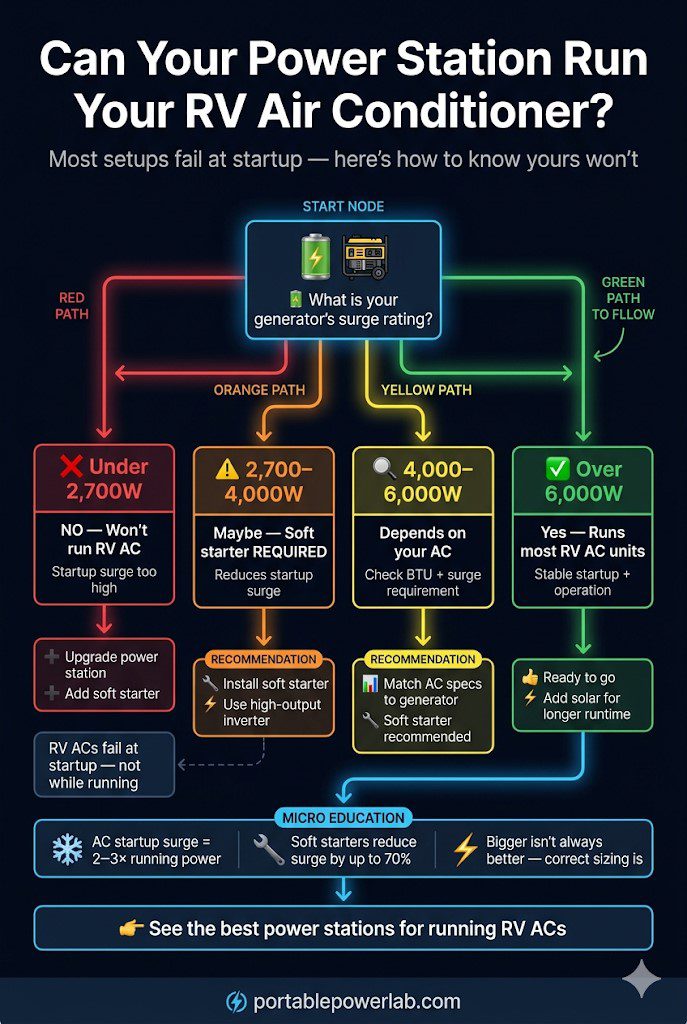
- 13,500 BTU rating: 1,200–1,500W running, 2,800–3,500W startup surge
- 15,000 BTU rating: 1,400–1,800W running, 3,200–4,000W startup surge
- Requires: Minimum 4,000W surge generator for reliable starting
Type 2 — Zero-Breeze or Portable AC Units (van life favorite)
- 2,300 BTU: 240W running, 600W startup
- Much lower surge — works with any 1,000Wh+ unit
- Cools a small van or one sleeping space; not a Class A or trailer solution
Type 3 — Soft-Starter Equipped Traditional AC
- Any traditional rooftop unit with a soft starter installed (Micro-Air EasyStart: ~$300)
- Reduces startup surge by 50–70%: 2,800W → approximately 1,100–1,500W
- Enables the EcoFlow Delta 2 (2,700W surge) and Bluetti AC200L (4,800W surge) to start a 13,500 BTU AC
🔗 For the complete soft starter explanation including installation cost and surge reduction math → Can a Solar Generator Run an Air Conditioner? — Soft Starter Guide
H3: Which Units Handle Each AC Type Without Modification
| AC Type | EcoFlow Delta 2 (2,700W surge) | Jackery 2000+ / Anker F3800 (6,000W surge) | EcoFlow Delta Pro (7,200W surge) | With Soft Starter |
|---|---|---|---|---|
| Traditional 13,500 BTU rooftop | ❌ Trip | ✅ Yes | ✅ Yes | ✅ All units |
| Traditional 15,000 BTU rooftop | ❌ Trip | ⚠️ Borderline | ✅ Yes | ✅ Most units |
| Zero-Breeze / portable van AC | ✅ Yes | ✅ Yes | ✅ Yes | Not needed |
| Mini-split (9,000 BTU) | ⚠️ Borderline | ✅ Yes | ✅ Yes | ✅ All units |
🛒 Micro-Air EasyStart Soft Starter for RV AC →
At approximately $300, a soft starter is the highest-ROI RV power accessory available. It can turn a $1,399 Bluetti AC200L into a unit capable of running your rooftop AC — saving you $1,400 over buying the EcoFlow Delta Pro instead.
The RV Charging Ecosystem — Connecting Everything Together
Shore Power (30A and 50A): What Actually Happens at an RV Park
When you pull into an RV park and connect shore power, you’re connecting to either a 30A or 50A electrical service:
- 30A service: 120V × 30A = 3,600W maximum draw
- 50A service: 120V × 50A = 6,000W maximum draw (often two 30A legs)
For portable power stations at a 30A hookup:
The ideal workflow: plug the power station into a standard 15A or 20A outlet (available at most sites in addition to the 30A connection), let it recharge overnight. Most units accept 1,200–1,800W of AC input, fully recharging a 2,048Wh unit in 1.5–2 hours without drawing significantly from your shore power allocation.
The shore power charging priority order:
- Let the power station recharge in 1–2 hours during arrival setup
- Run high-draw appliances (AC, microwave, coffee) from shore power directly — not from the battery
- Leave the power station at 80% charge limit for overnight battery storage health
Solar Panel Strategy for RV and Van Life
The solar panel setup for RV and van life differs from camping in one critical way: you want permanent roof-mounted panels supplemented by portable ground-deploy panels — not solely portable panels.
Recommended solar configuration by rig size:
| Rig Type | Roof Panels | Portable Addition | Total | Links |
|---|---|---|---|---|
| Cargo van | 2 × 200W rigid | 1 × 200W foldable | 600W | 200W Rigid → / 200W Foldable → |
| Sprinter / Transit | 3 × 200W rigid | 1 × 200W foldable | 800W | 200W Rigid → |
| Class B / C | 4 × 200W rigid | 1 × 200W portable | 1,000W | 400W Set → |
| Travel Trailer | 2–4 × 200W rigid | 2 × 200W portable | 600–1,200W | 200W Foldable ×2 → |
🛒 Best-Rated 200W Rigid Solar Panel for RV Roof →
🛒 Best 200W Foldable Solar Panel for Ground Deployment →
The Complete RV Power Station Accessories You Actually Need
These are not optional — they are the difference between a system that works and one that fails at an inconvenient moment.
Non-Negotiable Accessories
| Accessory | Why It’s Essential for RV | Link |
|---|---|---|
| 12-gauge 25ft RV extension cord | Safe power transfer from hookup; protects against voltage drop on long runs | Amazon → |
| Soft starter for RV AC | Reduces startup surge 60% — enables smaller station to run rooftop AC | Amazon → |
| DC-to-DC alternator charger (B2B) | Safely routes alternator power to station without overloading vehicle electrical system | Amazon → |
| 12V compressor fridge (separate) | The single highest-impact efficiency upgrade — replaces AC fridge with 60–80% more efficient 12V unit | Amazon → |
| Shore power EMS/surge protector | Protects your expensive power station from campground voltage spikes and wiring faults | Amazon → |
| Kill-A-Watt meter | Measure your actual RV appliance loads before sizing your system | Amazon → |
| Battery voltage monitor | Real-time voltage display mounted inside rig — instant state-of-charge visibility | Amazon → |
The RV Buying Decision Matrix — Which Unit Is Right for Your Rig
| Your Situation | Best Unit | Why |
|---|---|---|
| Full-time van life, no rooftop AC | EcoFlow Delta Pro | 7,200W surge, best alternator charging, Transfer Switch option |
| Weekend travel trailer, want to run rooftop AC | Jackery 2000 Plus | 6,000W surge handles RV AC; add expansion battery for 2 nights |
| Budget van life, solo traveler, no AC | EcoFlow Delta 2 Max | 43 lbs, 2,048Wh, 1,000W solar, easiest to handle solo |
| Full-time RV, Sunbelt, max solar priority | Anker Solix F3800 | 2,400W solar input is unmatched; 26kWh expandable ceiling |
| Seasonal RVer, value priority | Bluetti AC200L | Best $/Wh, free 5-yr warranty, 4,800W surge runs RV AC with soft starter |
| Class A with generator already | Any 2,000Wh unit for bedside/laptop | Supplement only; Class A needs permanent installed bank |
What You Should NOT Do — Common RV Power Mistakes
Mistake 1: Buying a 1,000Wh unit for RV use. The math simply doesn’t work for any rig with a residential fridge. A 1,000Wh unit depletes overnight from fridge alone. Save 1,000Wh units for supplemental use (bedside charging, secondary location) — not as your primary RV power system.
Mistake 2: Running a rooftop AC from a station rated under 4,000W surge. The 13,500 BTU AC’s 2,800–3,500W startup surge will trip any unit rated below that ceiling. Add a soft starter or choose a station rated 4,000W+ peak.
Mistake 3: Ignoring the 12V fridge opportunity. Replacing a residential or RV compressor fridge running on 120V AC through an inverter (100–200W average) with a dedicated 12V compressor unit (40–60W average) reduces your largest single daily load by 50–60%. This single change adds 480–840Wh of effective daily capacity — equivalent to buying a whole additional battery module.
Mistake 4: Not using the alternator charging input while driving. Every hour of driving with a compatible power station plugged into your vehicle’s electrical system adds 80–350W of free charging. Over a typical RV travel day (4–6 driving hours), this is 320–2,100Wh of recovered energy. Always plug in before you drive.
Mistake 5: Storing the power station at 100% for the off-season. RV power stations often sit in storage for 3–6 months during the off-season. Storing at 100% charge accelerates LiFePO4 degradation. Set the app charge limit to 80%, check every 3 months, and top off to 80% if below 60%.
🔗 For the complete battery storage guide including quarterly maintenance calendar → Ultimate Emergency Power Checklist — Storage & Seasonal Maintenance
What size power station do I need for full-time van life?
For a solo or couple van life setup without rooftop AC, a minimum of 2,000Wh with 400W+ of solar input. If you use any induction cooking or have two people with heavy device use: 3,000–4,000Wh. The EcoFlow Delta Pro (3,600Wh) or Anker Solix F3800 (3,840Wh) are the two units built for genuine full-time van life.
Can a portable power station run an RV rooftop air conditioner?
Yes — if it has sufficient surge capacity. A 13,500 BTU rooftop AC requires a 2,800–3,500W startup surge. The Jackery 2000 Plus (6,000W surge), Anker F3800 (6,000W surge), and EcoFlow Delta Pro (7,200W surge) all start a standard RV rooftop AC without modification. With a soft starter installed, even the Bluetti AC200L (4,800W surge) handles it.
How long can an RV power station run a residential refrigerator?
A modern residential refrigerator averages 60–100W with cycling. On the EcoFlow Delta Pro (3,600Wh × 0.88 = 3,168Wh usable) at 80W average: 39 hours. In practice — with 400W of solar generating 1,600Wh/day — the Delta Pro can sustain a residential refrigerator indefinitely in moderate sunlight conditions.
Is it better to have one large power station or two smaller ones?
For RV use, one large unit is almost always better. Two 1,000Wh units are more expensive than one 2,000Wh unit, have fewer solar and shore power input options when run separately, and create cable management complexity inside a small space. The exception: keeping one small unit (EcoFlow River 2, 256Wh) at the bedside for CPAP and phones, leaving the main unit in a storage bay or external location where it can accept solar input without occupying living space.
Should I choose a portable power station or a permanent lithium bank for RV use?
Portable power station advantages: No installation, removable for use outside the RV (campsite, hotel), easier to replace or upgrade, maintains manufacturer warranty.
Permanent lithium bank advantages: Can be much larger (200Ah, 400Ah), better integrated with existing RV electrical system, often lower cost per Wh at larger capacities.
The Lab recommendation: Portable for Class B, van life, and travel trailers up to 4,000Wh total capacity. Permanent installed bank for Class A or any setup requiring more than 5,000Wh of daily storage.
🔗 For off-grid cabin power — the most comparable fixed-location sizing challenge → Best Solar Generator for Off-Grid Cabin — 4-Step Sizing Framework
The Lab’s Final Verdict
RV and van life power is not a scaled-up version of camping power. It is a mobile home energy system with real appliance loads, multiple charging inputs, and consequences that go beyond a dead phone — including spoiled food, no climate control, and potential safety issues for medical device users.
The five units reviewed here represent the only mainstream portable power stations we would recommend for genuine RV use. Everything below them on the spec sheet — every 1,000Wh camping station sold with orange handles and lifestyle photography — will leave you in the dark by night two.
Start with the math. Calculate your daily watt-hour need. Match it to a unit with sufficient surge for your air conditioner. Add solar to make the system sustainable. Add alternator charging to make driving productive.
Do those four things, and your RV power system will outlast your wanderlust.
🛒 Browse All RV Power Stations on Amazon →
🛒 Browse RV Solar Panels on Amazon →
⚡ Portable Power Lab — Real Math. No Fluff. Independent since 2025.