Affiliate Disclosure: As an Amazon Associate, Portable Power Lab earns from qualifying purchases at no extra cost to you.
The Direct Answer: Yes, Battery Power Stations Are 100% Safe Indoors
A battery power station (EcoFlow, Jackery, Bluetti, Anker, Goal Zero) produces zero carbon monoxide. No combustion. No fumes. No noise beyond a quiet fan. Completely safe to run in your living room, bedroom, or kitchen.
This is the fundamental difference from gas generators — which are lethal indoors.
| Feature | Battery Power Station | Gas Generator |
|---|---|---|
| Carbon monoxide output | Zero | Up to 3,200 ppm — lethal |
| Can be used indoors? | ✅ Yes, completely safe | ❌ No — CO kills |
| Noise level | ~20–50 dB (library quiet) | 65–85 dB |
| Fumes | None | Exhaust gases |
| Fire risk | Very low (LiFePO4) | Higher (gasoline is flammable) |
⚡ Interactive Power Calculator Suite
Real math tools to find exactly what you need — before you spend a dollar on Amazon.
⛽ Gas Generator
🔋 Battery Power Station
Even on overcast days, panels produce 10–30% of rated output. A 200W panel in a storm might produce 20–60W — still meaningful for extending runtime.
For critical backup (sump pump, medical devices), always design for the minimum sun scenario.
⚠️ Extension Cord Safety: The Indoor Risk Nobody Talks About
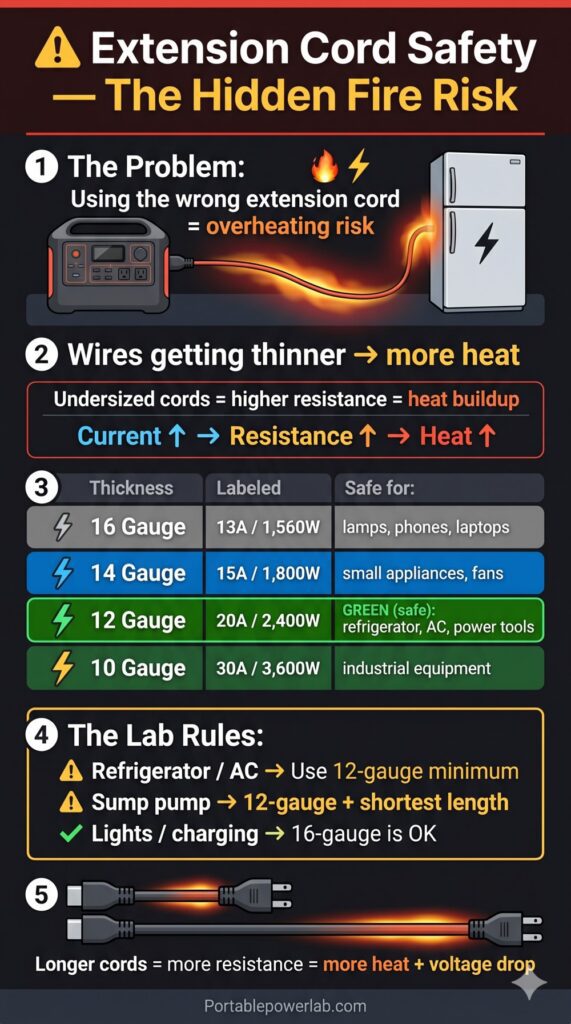
Here’s the gap that most indoor safety guides skip entirely — and it’s the one that creates real fire risk for power station users.
When running a power station indoors for a refrigerator, sump pump, or high-draw appliance, many people grab whatever extension cord is nearby. That thin white 16-gauge lamp cord is a genuine hazard for high-current applications.
The science: Extension cords have amperage ratings based on their wire gauge. An undersized cord carrying more current than its rating develops resistance, generates heat, and in severe cases, can ignite.
Extension cord selection guide:
| Cord Gauge | Max Amps | Max Watts at 120V | Safe For |
|---|---|---|---|
| 16 gauge (typical lamp cord) | 13A | 1,560W | Lamps, phone chargers, laptops |
| 14 gauge (medium duty) | 15A | 1,800W | Most kitchen appliances, fans |
| 12 gauge (heavy duty) | 20A | 2,400W | Refrigerators, AC units, power tools |
| 10 gauge (industrial) | 30A | 3,600W | Large motors, commercial equipment |
The Lab Rule for Power Stations:
- Running a refrigerator or AC through an extension cord? Use 12-gauge minimum.
- Running a sump pump? Use 12-gauge, shortest length possible. Longer cords increase resistance and voltage drop — exactly what worsens startup surge problems.
- Charging devices or running lights? 16-gauge is fine.
🛒 12-Gauge Heavy-Duty Extension Cord (25 ft) on Amazon →
🛒 12-Gauge Heavy-Duty Extension Cord (50 ft) on Amazon →
Pro Tip: Never coil an extension cord while in use under heavy load. A coiled cord concentrates the heat generated by resistance. Lay cords straight or loosely draped during use.
What Happens Inside a Portable Power Station
A portable power station contains:
- Battery bank — LiFePO4 or NMC cells (similar to a large phone battery)
- Battery Management System (BMS) — monitors temperature, prevents overcharging, manages discharge
- Inverter — converts DC battery power to AC
- Small cooling fan — manages heat under heavy load
None of these involve combustion, fuel, or emission production.
🔥 Emergency Fire Safety: What to Do in a Rare Battery Failure
LiFePO4 batteries are exceptionally safe — far safer than NMC or older lithium-ion chemistries. However, no electrical device is completely immune to failure. Here is what to do in the extremely rare event of a power station emergency:
Warning signs of a battery issue:
- Unusual smell (burning plastic, chemical odor)
- Swelling or deformation of the case
- Excessive heat that doesn’t dissipate
- Sparking from any port
- Unit not responding to power-off commands
Immediate response:
- Unplug all connected devices immediately
- Move the unit outdoors if possible without touching hot surfaces
- Do not use water — water and lithium batteries can react violently
- Call 911 if you see flames, smoke, or the unit is too hot to approach safely
- Use a Class D or ABC dry chemical extinguisher if the fire is small and you can safely reach it
Preventive storage practices:
- Never store a power station at 100% charge for extended periods (use app to set 80% limit)
- Store in a cool, dry location — avoid temperatures above 95°F (35°C)
- Do not block ventilation slots
- Never leave a visibly damaged unit plugged in
The statistical reality: LiFePO4 power station fires are extremely rare compared to older lithium-ion technology. The chemistry’s iron-phosphate bond makes it inherently more stable. In millions of units deployed, reported thermal events are measured in single digits per year industry-wide.
🌡️ Seasonal Outage Priority Planner
Your outage priorities change completely between a winter ice storm and a summer heat wave. Select your season and appliances to get a personalized triage plan with real watt-hour math.
🔴 CO Detector Recommendation: For Hybrid Households
If you have both a battery power station AND a gas generator (or gas appliances), a quality CO detector is essential. Battery power stations don’t generate CO — but the gas generator you might use during a multi-day extended outage absolutely does.
What to look for:
- Hardwired with battery backup (doesn’t lose protection during outages)
- Electrochemical sensor (more accurate than biomimetic sensors)
- Digital display showing CO levels in ppm (not just alarm/no-alarm)
- UL Listed certification
🛒 Best-Rated CO Detector with Digital Display on Amazon →
🛒 Battery-Powered CO Detector (backup option) on Amazon →
Where to place CO detectors:
- Within 10 feet of every sleeping area
- On every level of the home
- Near any gas appliance (furnace, water heater, range)
- NEVER inside the garage where generators may be used — detectors in this location may sense normal exhaust and alarm, leading homeowners to dismiss real CO events
This is also why apartments can use battery power legally
Room-by-Room Indoor Use Guide
| Room | Safety Rating | Notes |
|---|---|---|
| Living Room | ✅ Perfect | Good airflow, outlet access, easily monitored |
| Bedroom | ✅ Yes | Near-silent at light loads; no CO risk |
| Kitchen | ✅ Ideal | Hard surfaces, good ventilation, easy outlet access |
| Basement | ✅ Good | Keep off floor (flood risk); watch for cold temps below 32°F |
| Garage | ✅ Fine | Watch for temperature extremes |
Safety Certifications to Look For
| Certification | What It Means |
|---|---|
| UL Listed | Tested by Underwriters Laboratories for electrical safety |
| ETL Certified | Alternative US safety certification (equivalent to UL) |
| CE Mark | European safety standard |
| UN38.3 | Battery transport safety |
| FCC Certification | US electromagnetic compatibility |
All major brands (EcoFlow, Jackery, Bluetti, Anker, Goal Zero) carry relevant certifications.
🧰 Complete Indoor Safety Kit
| Item | Purpose | Link |
|---|---|---|
| 12-Gauge Extension Cord | Safe heavy-load power delivery | Amazon → |
| CO Detector (digital display) | Essential if you also have gas backup | Amazon → |
| ABC Fire Extinguisher | General home safety (not battery-specific) | Amazon → |
| Kill-A-Watt Meter | Size your extension cord correctly | Amazon → |
🔗 Can’t use a gas generator in your apartment? Here’s your complete solution → Best Portable Power Stations for Apartments →
See the emergency power checklist for a complete outage plan