Affiliate Disclosure: As an Amazon Associate, Portable Power Lab earns from qualifying purchases at no extra cost to you.
Last Updated: April 2026
It’s August. A heat advisory is in effect. The power just went out.
The first thing you reach for is your portable solar generator. The first thing you want to plug in is your window air conditioner.
And the first question you need answered — right now — is: Can a solar generator run an air conditioner?
The short answer is: it depends on one specific number most people never check — and a $30 device can dramatically change the answer in your favor.
🔗 Before calculating AC wattage: Bookmark our Complete Home Appliance Wattage Chart → — it covers every appliance in your home and includes the Lab Rule for startup surge.
⚡ Interactive Power Calculator Suite
Real math tools to find exactly what you need — before you spend a dollar on Amazon.
⛽ Gas Generator
🔋 Battery Power Station
Even on overcast days, panels produce 10–30% of rated output. A 200W panel in a storm might produce 20–60W — still meaningful for extending runtime.
For critical backup (sump pump, medical devices), always design for the minimum sun scenario.
The Number That Determines Everything: Startup Surge Watts
Air conditioners have two wattage ratings that matter:
Running watts: The steady power draw once the compressor is up and spinning.
Starting watts (startup surge): The burst of power required to kick the compressor motor into motion. This lasts only 2–3 seconds, but it’s the number that determines whether your generator can run your AC at all.
The startup surge for an air conditioner is typically 2.5 to 3 times the running wattage.
| AC Unit Size | Running Watts | Startup Surge | Minimum Generator Surge Needed |
|---|---|---|---|
| 5,000 BTU (small room) | 450–500W | 1,350–1,500W | 1,500W+ surge rating |
| 6,000 BTU | 500–600W | 1,500–1,800W | 1,800W+ surge rating |
| 8,000 BTU (medium room) | 700–900W | 2,100–2,700W | 2,700W+ surge rating |
| 10,000 BTU | 900–1,100W | 2,700–3,300W | 3,300W+ surge rating |
| 12,000 BTU (large room) | 1,100–1,300W | 3,300–3,900W | 3,900W+ surge rating |
| Portable AC unit | 900–1,400W | 2,700–4,200W | 4,200W+ surge rating |
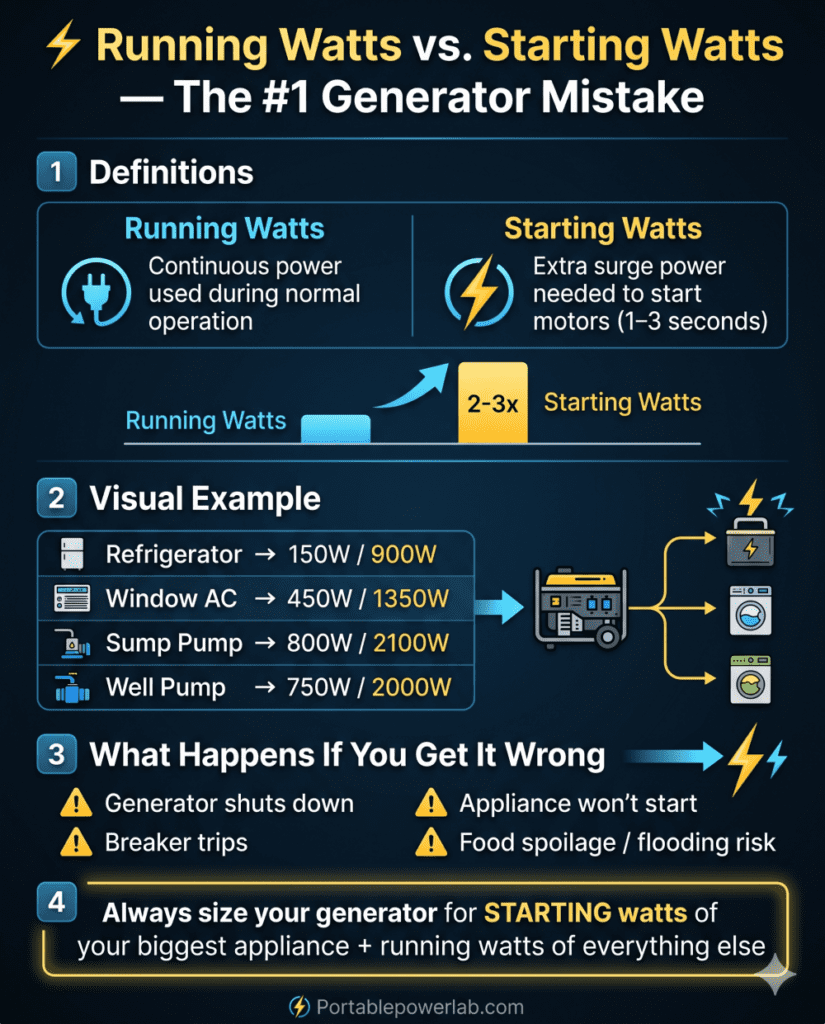
The Lab Rule: Your generator’s peak/surge watt rating must exceed the AC’s startup surge. If they match exactly — that’s borderline dangerous. See the Soft Starter section below for how to fix borderline cases.
🔑 The Soft Starter Secret: How to Make Borderline Generators Work
This is the “power user” topic that 99% of articles in our niche skip entirely — and it could save you from buying a larger (and more expensive) generator.
What is a Soft Starter?
A soft starter is a small electrical device (typically $75–$150) that installs between your generator and your AC unit. It works by gradually ramping up the voltage delivered to the AC compressor during startup, instead of delivering it all at once.
The result: the startup surge can be reduced by 50–70%.
| AC Size | Normal Startup Surge | With Soft Starter | EcoFlow Delta 2 Can Run It? |
|---|---|---|---|
| 5,000 BTU | 1,350–1,500W | 600–700W | ✅ Yes (always) |
| 8,000 BTU | 2,100–2,700W | 900–1,200W | ✅ Now yes (was borderline) |
| 10,000 BTU | 2,700–3,300W | 1,200–1,500W | ✅ Now yes (was impossible) |
| 12,000 BTU | 3,300–3,900W | 1,500–2,000W | ✅ Now yes (was impossible) |
The practical implication: A soft starter effectively upgrades the EcoFlow Delta 2 (2,700W surge) from being able to run a 5,000 BTU AC to potentially running a 10,000 BTU AC. That’s a dramatic expansion of capability for a $100 accessory — versus buying a larger generator that costs $500–$1,000 more.
Popular soft starter models:
🛒 Micro-Air EasyStart Soft Starter on Amazon →
🛒 Bluetooth Soft Starter for Mini-Split / Window AC on Amazon →
Which generators handle a ½ HP sump pump startup surge?
Important note: Soft starters require correct sizing and are typically installed by plugging inline before the AC unit. For window units, most are plug-and-play. For mini-splits and central systems, professional installation is recommended.
Which Solar Generators Can Actually Run a Window AC?
For a 5,000 BTU Window AC (Most Common Scenario)
Running watts: ~450–500W | Startup surge: ~1,350–1,500W
Any of these work without a soft starter:
| Generator | Surge | Can Start? | Runtime (AC at 50% cycle = 250W avg) |
|---|---|---|---|
| EcoFlow Delta 2 | 2,700W | ✅ Easily | ~3.6 hrs |
| Jackery 1000 Plus | 4,000W | ✅ Easily | ~4.4 hrs |
| Anker Solix C1000 | 4,000W | ✅ Easily | ~3.7 hrs |
🛒 EcoFlow Delta 2 on Amazon →
🛒 Jackery Explorer 1000 Plus on Amazon →
For an 8,000 BTU Window AC
Running watts: ~750–900W | Startup surge: ~2,100–2,700W
| Generator | Surge | Without Soft Starter | With Soft Starter |
|---|---|---|---|
| EcoFlow Delta 2 | 2,700W | ⚠️ Borderline | ✅ Yes |
| Jackery 1000 Plus | 4,000W | ✅ Yes | ✅ Yes |
| Anker Solix C1000 | 4,000W | ✅ Yes | ✅ Yes |
| Bluetti AC200L | 4,800W | ✅ Yes | ✅ Yes |
🛒 Jackery Explorer 1000 Plus on Amazon →
🛒 Bluetti AC200L on Amazon →
For a 10,000–12,000 BTU AC
Without a soft starter, only the EcoFlow Delta Pro (7,200W surge) handles these comfortably. With a soft starter, the Bluetti AC200L (4,800W surge) and even the Jackery 1000 Plus (4,000W surge) can handle them.
🛒 EcoFlow Delta Pro on Amazon →
❄️🔥 Heat Pumps vs. Standard ACs: A Critical Distinction
This section addresses a growing source of confusion as heat pumps become more popular across the US.
What’s a heat pump? A heat pump is a single unit that provides both cooling in summer and heating in winter by moving heat rather than generating it. Many newer homes and renovations use mini-split heat pumps instead of separate AC and heating systems.
The generator implication is significant:
| System | Running Watts | Startup Surge | Can a Portable Generator Run It? |
|---|---|---|---|
| Window AC (5,000 BTU) | 450–500W | 1,350–1,500W | ✅ Yes — standard generators |
| Window AC (12,000 BTU) | 1,100–1,300W | 3,300–3,900W | ✅ With soft starter + 4,000W surge |
| Mini-Split Heat Pump (9,000 BTU) | 700–900W | 2,000–2,800W | ✅ With 4,000W surge generator |
| Mini-Split Heat Pump (18,000 BTU) | 1,400–1,800W | 4,200–5,400W | ⚠️ Needs Delta Pro or similar |
| Central Heat Pump (2–3 ton) | 2,000–4,500W | 6,000–13,500W | ❌ Beyond portable generators |
The heating mode consideration: In winter heating mode, heat pumps can actually draw more power than in cooling mode (especially in very cold weather, when a backup resistance heater kicks in). Never assume your summer AC wattage applies to winter heat pump use — measure both modes with a Kill-A-Watt meter or request manufacturer specs for both.
The mini-split opportunity: Inverter-driven mini-split heat pumps (common in newer installations) have variable-speed compressors that dramatically reduce their startup surge compared to fixed-speed window ACs. An 18,000 BTU inverter mini-split may surge at only 2,500–3,500W versus 5,400W for a fixed-speed unit — making them much more generator-friendly.
☀️ The Solar Recharge Math
For a 5,000 BTU AC running at 50% duty cycle: 250W average draw
To sustain 250W continuously from solar, you need a 400W solar array minimum in real-world conditions.
| AC Size | Avg. Running Draw | Solar Array for Sustainability |
|---|---|---|
| 5,000 BTU | ~250W average | 400W solar |
| 8,000 BTU | ~450W average | 600–800W solar |
| 10,000 BTU | ~600W average | 900–1,200W solar |
The Jackery 1000 Plus (800W solar input) or Bluetti AC200L (900W solar input) with 800W of panels can theoretically sustain a 5,000 BTU AC indefinitely in good sun.
🛒 Best 200W Foldable Solar Panels on Amazon →
🌡️ A Smart Summer Outage Strategy
1. Choose one room. Pick the smallest bedroom — typically 120–150 sq ft. A 5,000 BTU window AC is perfectly sized.
2. Seal it properly. Close doors, plug gaps, close blinds. Reduces cooling load by 30–40%.
3. Use targeted cooling windows. Run the AC for 90 minutes to cool the room, then switch to a fan (50W) to maintain temperature. This extends battery life 3–4x.
4. Add a soft starter. If you have an 8,000 BTU or larger AC, a $100 soft starter may eliminate the need to upgrade your generator entirely.
5. Recharge during daylight. Keep solar panels charging while you stay cool.
Real-World Scenario: Tampa, Florida — Summer Outage
Setup: Bluetti AC200L (2,048Wh) + two 200W foldable solar panels
Load plan:
- 5,000 BTU AC at 50% duty: ~250W average
- Refrigerator cycling: ~55W average
- Phones, router: ~35W
- Total: ~340W
Battery-only runtime: 1,802Wh ÷ 340W = 5.3 hours
Solar generation (Tampa August, 6 peak sun hrs): 400W × 6 × 0.80 = 1,920Wh — more than enough to sustain the system indefinitely.
🧰 Lab-Recommended Summer Outage Kit
| Item | Purpose | Link |
|---|---|---|
| Bluetti AC200L or Jackery 1000 Plus | Core power station | Bluetti → / Jackery → |
| 2 × 200W Foldable Solar Panels | Daytime recharging | Amazon → |
| Micro-Air EasyStart Soft Starter | Reduces AC surge 50–70% | Amazon → |
| 12-Gauge Extension Cord | Safe power delivery to AC | Amazon → |
🔗 Trying to decide between battery and gas for summer outages? Our Portable Power Station vs. Gas Generator: 10-Year Cost Math → builds the complete financial case.
What is the best solar generator for running an air conditioner?
For a 5,000 BTU AC: any 1,000Wh class unit with 2,700W+ surge. For 8,000 BTU: Jackery 1000 Plus or Bluetti AC200L. For 10,000+ BTU: EcoFlow Delta Pro, or any 4,000W+ surge generator with a soft starter.
Can a soft starter be used with any window AC?
Most universal soft starters work with window AC units and portable ACs. For mini-splits, check compatibility with your specific brand. The Micro-Air EasyStart is the most widely compatible.
Can a solar generator run a heat pump?
Mini-split heat pumps (9,000–12,000 BTU): Yes, with a generator rated 4,000W+ surge. Central heat pumps: No — they require commercial-grade power beyond portable generators.