Affiliate Disclosure: As an Amazon Associate, Portable Power Lab earns from qualifying purchases at no extra cost to you. We only recommend products we’ve analyzed with real math.
Last Updated: April 2026
Imagine this: A storm knocks out your power at 11 PM. Your refrigerator is humming. Your CPAP machine sits on the nightstand. Your sump pump is in the basement. And you’re staring at a solar generator you bought six months ago, wondering — will this thing actually keep everything running until morning?
The answer lives in one number: watts.
Most homeowners have no idea how much power their appliances actually consume. And here’s what’s worse: every portable power station and solar generator on the market is sold against those numbers — yet almost nobody explains them in plain English.
This guide fixes that. You’ll get the exact wattage for 40+ home appliances, understand the critical difference between running watts and starting watts, walk away knowing precisely which power station you need — and learn how to measure your own appliances with a $20 tool.
⚡ Interactive Power Calculator Suite
Real math tools to find exactly what you need — before you spend a dollar on Amazon.
⛽ Gas Generator
🔋 Battery Power Station
Even on overcast days, panels produce 10–30% of rated output. A 200W panel in a storm might produce 20–60W — still meaningful for extending runtime.
For critical backup (sump pump, medical devices), always design for the minimum sun scenario.
⚡ The Single Most Important Concept: Running Watts vs. Starting Watts
Before we get to the charts, you need to understand one thing that every power station salesperson glosses over.
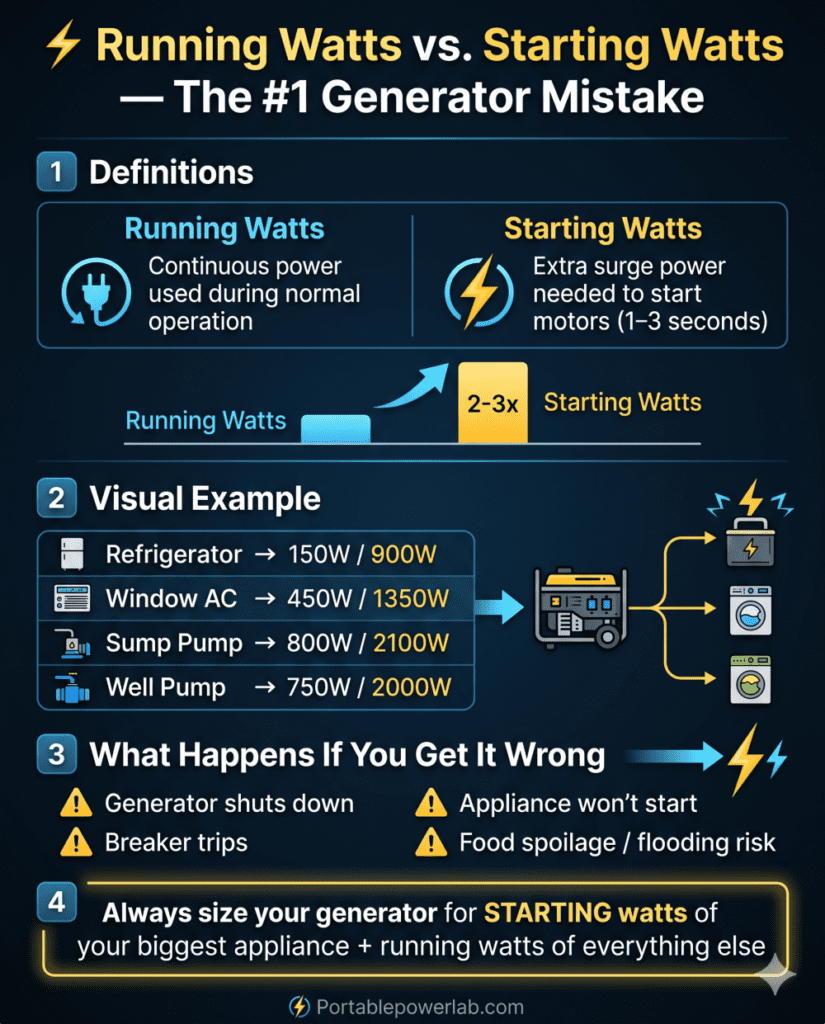
Running watts (continuous watts) = the power an appliance uses once it’s up and running steadily.
Starting watts (surge watts) = the burst of power an appliance needs in the first 1–3 seconds to get its motor spinning.
For appliances with motors — refrigerators, air conditioners, sump pumps, power tools — starting watts can be 2 to 3 times higher than running watts. This is the number that blows circuits, trips breakers, and shuts down undersized generators.
Here’s a real-world example:
| Appliance | Running Watts | Starting Watts | What Happens If Your Generator Can’t Handle Starting Watts |
|---|---|---|---|
| Window AC (5,000 BTU) | 450W | 1,350W | Unit doesn’t start, or generator shuts down |
| Refrigerator (full-size) | 150W | 900W | Fridge tries to cycle, fails, loses your food |
| Sump Pump (½ HP) | 800W | 2,100W | Pump won’t start during flooding — worst case scenario |
| Well Pump (½ HP) | 750W | 2,000W | No water during extended outage |
The Lab Rule: Always buy a power station rated for at least the highest starting wattage of your most critical appliance — plus all running watts of everything else you’ll run simultaneously.
🔗 Deep-Dive: complete startup surge math for every AC BTU size, Solar Generator Air Conditioner Guide → | For sump pump LRA calculations by horsepower, Sump Pump Surge Math Guide →
🧾 The Complete Appliance Wattage Chart (2026 Real-World Data)
These numbers come from manufacturer specifications cross-referenced with real-world measurements. Where ranges exist, we show typical and high-end.
Kitchen Appliances
| Appliance | Running Watts | Starting Watts | Notes |
|---|---|---|---|
| Full-size Refrigerator | 100–400W | 800–1,200W | Cycles on/off; averages ~150W continuous |
| Mini Fridge | 50–100W | 200–400W | Great for small power stations |
| Chest Freezer | 100–400W | 500–1,000W | Similar to fridge; depends on size |
| Microwave (1,000W) | 1,000–1,500W | 1,000–1,500W | No motor startup surge |
| Coffee Maker | 800–1,500W | 800–1,500W | No significant surge |
| Electric Kettle | 1,000–1,500W | Same | Draws max watts for ~3–5 minutes |
| Toaster | 800–1,500W | Same | Short duration |
| Blender | 300–1,000W | 700–2,000W | High surge from blade motor |
Comfort & Climate
| Appliance | Running Watts | Starting Watts | Notes |
|---|---|---|---|
| Window AC (5,000 BTU) | 450–500W | 1,350–1,500W | Most critical surge to plan for |
| Window AC (8,000 BTU) | 700–900W | 2,000–2,500W | Needs 2,000W+ inverter |
| Window AC (12,000 BTU) | 1,100–1,200W | 3,300–3,600W | Requires large generator |
| Portable AC | 900–1,400W | 2,500–4,000W | Higher surge than window units |
| Box Fan | 25–100W | 75–300W | Excellent for low-power setups |
| Ceiling Fan | 15–75W | 75–250W | Very efficient for staying cool |
| Electric Space Heater | 750–1,500W | Same | No surge; pure resistive load |
| Electric Blanket | 50–150W | Same | Easy to power with small stations |
Medical Devices
| Device | Running Watts | Notes |
|---|---|---|
| CPAP (no humidifier) | 30–60W | Most efficient appliance you own |
| CPAP (heated humidifier) | 100–130W | Humidifier nearly doubles draw |
| BiPAP | 40–70W | Similar to CPAP |
| Oxygen Concentrator (1–5 LPM) | 150–300W | Must run continuously; no surge |
| Nebulizer | 75–150W | Short duration, low risk |
| Home Dialysis Machine | 100–500W | Consult medical provider |
| Electric Wheelchair Charger | 150–450W | Important for mobility independence |
Entertainment & Office
| Device | Running Watts | Notes |
|---|---|---|
| 32″ LED TV | 30–55W | Very efficient |
| 65″ LED TV | 80–120W | Still manageable on battery |
| Laptop | 45–90W | Depends on CPU load |
| Desktop Computer | 60–300W | Varies dramatically by GPU |
| WiFi Router | 5–20W | Almost zero draw |
| Phone Charger | 10–25W | Negligible |
| Game Console (PS5/Xbox) | 60–200W | Under load can be higher |
| Printer | 500–1,500W | Surge at startup; short duration |
Lighting
| Type | Watts Per Bulb | Notes |
|---|---|---|
| LED A19 Bulb | 7–12W | Replaces 60W incandescent |
| LED Flood/PAR | 10–18W | Replaces 75–90W incandescent |
| Fluorescent Tube | 15–40W | Less efficient than LED |
| Incandescent | 40–100W | Not recommended for backup |
Example: 10 LED bulbs × 10W = 100W total. You could run your entire home lighting on a 500Wh power station for 4+ hours.
Power Tools & Garage
| Tool | Running Watts | Starting Watts | Notes |
|---|---|---|---|
| Drill (corded) | 300–700W | 700–1,400W | Surge depends on bit resistance |
| Circular Saw | 1,200–1,800W | 2,400–3,600W | High surge; needs large inverter |
| Jigsaw | 400–600W | 800–1,200W | Lower surge than circular saw |
| Belt Sander | 500–1,000W | 1,000–2,000W | Manageable on 2,000W station |
| Air Compressor (1 HP) | 1,000–2,000W | 3,000–6,000W | Very high surge; plan carefully |
Plumbing & Emergency
| Device | Running Watts | Starting Watts | Notes |
|---|---|---|---|
| Sump Pump (⅓ HP) | 300–500W | 900–1,500W | Most common residential size |
| Sump Pump (½ HP) | 500–800W | 1,500–2,400W | Heavier-duty installations |
| Sump Pump (¾ HP) | 750–1,100W | 2,250–3,300W | Needs 2,000W+ station minimum |
| Well Pump (½ HP) | 750–1,000W | 2,000–3,000W | Plan for extended outages |
| Garage Door Opener | 300–500W | 900–1,500W | Momentary surge only |
🔗 For complete sump pump surge math and which generators can handle each HP rating, see our Solar Generator Sump Pump Startup Guide →. This is the most common cause of generator failure during flooding.
👻 The Hidden Drain: Phantom Loads Nobody Accounts For
You’ve measured every appliance. You’ve done the math. Your 1,000Wh power station should last 12 hours.
Then you wake up at 6 AM and it’s at 40%.
What happened? Phantom loads — the constant, invisible power draw of modern electronics even when you think they’re “off.”
What Is a Phantom Load?
Also called “standby power,” “vampire power,” or “idle current draw,” phantom loads are the electricity consumed by devices that appear to be off but remain in a ready state. Modern electronics — TVs, game consoles, cable boxes, smart speakers, microwaves with displays, and phone chargers with nothing plugged in — never truly power down.
They’re waiting for you. And while they wait, they draw power.
Phantom Load by Device Type
| Device | Apparent State | Phantom Load | Annual Wh Waste (grid) | Effect on 1,000Wh Station (24 hrs) |
|---|---|---|---|---|
| Modern LED TV (55″) | “Off” (standby) | 0.5–3W | 4–26 kWh | 12–72Wh lost |
| Cable/satellite box | “Off” | 15–25W | 131–219 kWh | 360–600Wh lost |
| Gaming console (PS5) | Standby mode | 1–2W | 9–18 kWh | 24–48Wh lost |
| Smart speaker (Echo) | Always-on | 1.5–3W | 13–26 kWh | 36–72Wh lost |
| Microwave with display | Clock mode | 1–3W | 9–26 kWh | 24–72Wh lost |
| Desktop computer | Sleep mode | 2–10W | 18–88 kWh | 48–240Wh lost |
| Phone charger (empty) | Plugged in, no phone | 0.1–0.5W | 0.9–4 kWh | 2–12Wh lost |
| WiFi router | Always on | 5–20W | 44–175 kWh | 120–480Wh lost |
| Laser printer | Ready state | 5–20W | 44–175 kWh | 120–480Wh lost |
| Coffee maker (digital display) | Off with clock | 1–3W | 9–26 kWh | 24–72Wh lost |
| Typical Home Total | Multiple devices | 50–100W | — | 1,200–2,400Wh/day |
The reality check: A home with a cable box (20W), smart TV (2W), gaming console standby (2W), desktop sleep (5W), and two smart speakers (5W) draws 34W continuously — even when everyone is asleep and every “off” button has been pressed. Over 24 hours: 816Wh of phantom draw on your power station. That’s most of the usable capacity of a budget 1,000Wh unit — gone to devices that appeared to be off.
The Power Station Phantom Load Impact
| Station Size | 24-Hour Phantom Load (34W scenario) | % of Capacity Consumed | Hours Cut from Your “Real” Loads |
|---|---|---|---|
| 300Wh (Jackery 300 Plus) | 816Wh | 272% — dead in 7 hours | Loses most of its overnight capacity |
| 1,000Wh (EcoFlow Delta 2) | 816Wh | 82% | Loses 8 hours of capacity |
| 2,000Wh (Bluetti AC200L) | 816Wh | 41% | Manageable impact |
For small stations (under 500Wh), phantom loads are a genuine emergency-planning hazard.
Eliminating Phantom Loads During an Outage
Smart power strips with control outlets: These detect when the primary device (TV, computer) is off and cut power to secondary devices (cable box, game console, speakers) automatically.
🛒 Smart Power Strip with Controlled Outlets →
Simple approach: During a power outage, unplug every non-essential device and leave only Priority 1–3 items connected. The difference between an idle TV standby and an unplugged TV is nothing to the TV — but it’s 2–3W back in your power budget per device.
The Kill-A-Watt standby measurement: Use your Kill-A-Watt meter to measure your specific devices in standby mode. Some “smart” TVs draw far more than the industry average; some older cable boxes draw 25W+ even in sleep mode.
The Lab Rule for Outage Power Planning: Add 30–50W of phantom load to your total consumption calculation if you’re planning to leave multiple devices plugged in. For a 1,000Wh station, this 30–50W of invisible drain cuts 18–30 hours of effective runtime over a 24-hour outage.
🔧 NEW: How to Measure Your Own Appliances with a Kill-A-Watt Meter
Published wattage figures are averages. Your specific appliances — especially older ones — may draw more or less than the chart indicates. The only way to know exactly what your fridge, your CPAP, or your sump pump draws is to measure it directly.
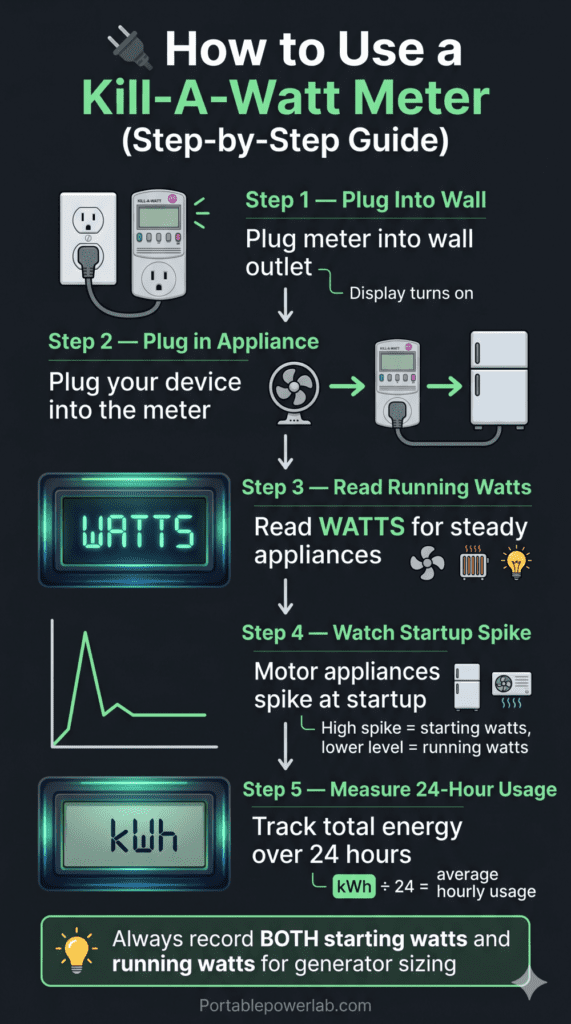
Enter the Kill-A-Watt meter — a $20–$30 device that plugs between your appliance and the wall outlet, displaying real-time wattage, current draw, and cumulative energy use.
🛒 Kill-A-Watt Electricity Usage Monitor on Amazon – Check Price →
How to Use a Kill-A-Watt Meter
Step 1: Plug the Kill-A-Watt into the wall outlet. The display will light up.
Step 2: Plug your appliance into the Kill-A-Watt. Turn the appliance on normally.
Step 3: Read the WATTS display. For steady-state appliances (space heaters, fans, lights), this number is your running wattage.
Step 4: Watch for motor appliances. Refrigerators and AC units cycle on and off. Watch the wattage over 2–3 minutes — you’ll see it spike at startup (that’s your starting wattage) and then settle at a lower number (running wattage). Record both.
Step 5: Let it run for 24 hours for total energy use. Press the KWH button to see total kilowatt-hours consumed. Divide by 24 to get average hourly draw. This is the most accurate number for generator planning.
Kill-A-Watt Measurement Tips
| Appliance Type | What to Watch For | The Number You Need |
|---|---|---|
| Refrigerator | Initial spike at compressor start | Peak (starting) AND average running watts |
| CPAP (no humidifier) | Steady state after 5 minutes | Running watts only |
| Space heater | Immediate steady reading | Running watts (no surge) |
| Power tools | Initial surge at tool start | Peak watts (your most important number) |
| Sump pump | Use a clamp meter instead | Kill-A-Watt is not rated for ½ HP+ pump current |
Lab Note: For sump pumps and well pumps rated ½ HP or larger, the Kill-A-Watt’s 15-amp maximum may be insufficient. Use a clamp-style ammeter instead, which measures current without inline connection. Multiply amps × 120V = watts.
🔢 The Portable Power Lab Runtime Calculator
Use this formula to calculate how long a power station will run your appliances:
Runtime (hours) = [Power Station Capacity (Wh) × Efficiency Rate] ÷ Total Running Watts
Important: Never use the manufacturer’s rated Wh. Apply a real-world efficiency factor:
| Battery Type | Real-World Efficiency Factor |
|---|---|
| LiFePO4 (e.g., Jackery 1000 Plus, EcoFlow Delta 2) | 85–90% |
| NMC (older/budget models) | 78–85% |
| At temperatures below 32°F | Subtract additional 15–25% |
Example: Home Backup Scenario
You want to run your refrigerator (150W average), 10 LED lights (100W), and charge your phones/laptop (60W) during an outage. Total running load = 310 watts.
You have an EcoFlow Delta 2 (1,024Wh):
🛒 Check Price on Amazon — EcoFlow Delta 2 (1,024Wh) →Runtime = (1,024 × 0.87) ÷ 310 = 891 ÷ 310 = ~2.9 hours
But your fridge only runs about 30–40% of the time. Recalculate with average draw:
Total load = 80W (fridge average) + 100W (lights) + 60W (devices) = 240W Runtime = 891 ÷ 240 = ~3.7 hours
Add a 200W solar panel recharging during daylight hours, and you can potentially run this indefinitely.
🔗 See exactly how long each top generator lasts in a real 8-hour outage → Best Solar Generators for Power Outages →
🏆 Which Power Station Do You Actually Need?
| Your Priority | Minimum Capacity | Recommended Station – Check Price on Amazon |
|---|---|---|
| Phones, laptop, lights only | 300–500Wh | Jackery Explorer 300 Plus |
| Fridge + lights + devices | 1,000–1,500Wh | EcoFlow Delta 2 |
| Fridge + window AC + sump pump | 2,000–3,600Wh | EcoFlow Delta Pro |
| Full home backup (multiple appliances) | 3,600Wh+ | Bluetti AC300 + B300 Battery |
| CPAP only | 150–300Wh | Jackery Explorer 240 Plus |
👉 Browse All Portable Power Stations on Amazon →
🚨 The 5 Most Common Power Planning Mistakes
1. Ignoring starting watts. A 1,000W inverter will not start a refrigerator. See the table above.
2. Using 100% of rated capacity. Real-world efficiency is 85–90% for LiFePO4 units. Budget accordingly.
3. Running appliances one at a time. In an outage, you’ll have multiple devices drawing simultaneously. Always calculate your total simultaneous load.
4. Forgetting the inverter limit. A power station’s continuous wattage rating (e.g., 1,800W for the Delta 2) is the ceiling. Exceed it and the unit shuts off.
5. Not accounting for cold weather. LiFePO4 batteries lose 15–25% capacity at freezing temperatures. NMC loses up to 35%.
📋 Printable Emergency Power Audit Sheet (Save or Screenshot This)
Use this table before storm season to know exactly what you’re protecting:
| My Appliance | Rated HP/W | Running Watts | Starting Watts | Priority (1–5) |
|---|---|---|---|---|
| Refrigerator | ||||
| Sump Pump | ||||
| CPAP Machine | ||||
| Lights (total) | ||||
| WiFi Router | ||||
| Window AC | ||||
| Phone/Laptop | ||||
| Medical Device | ||||
| TOTALS |
How to fill it in: Use the wattage charts above for typical values, or measure directly with a Kill-A-Watt meter for your specific appliances.
Priority Guide: 1 = Medical necessity. 2 = Food safety. 3 = Communication. 4 = Comfort. 5 = Optional.
Your generator needs to cover all Priority 1–3 items simultaneously, with the surge wattage of your highest-surge appliance as the peak requirement.
💡 Pro Tip: The 80% Rule
Professional electricians never load a circuit to more than 80% of its rated capacity for sustained operation. Apply the same principle to portable power stations: keep your total running load under 80% of the inverter’s rated output for longer battery life and cooler operation.
🔗 Complete Your Power Prep Research
This wattage guide is your starting point. Here’s where to go next:
- Running AC during an outage? → Can a Solar Generator Run an Air Conditioner? (BTU × Surge Math) →
- Sump pump backup planning? → Will a Solar Generator Run My Sump Pump? (LRA Chart) →
- Choosing between battery vs. gas? → Portable Power Station vs. Gas Generator: 10-Year Cost Math →
- Ready to buy? → Best Solar Generators for Power Outages(2026) →
How many watts does a full-size refrigerator use?
Between 100–400 running watts depending on age and size, with a startup surge of 800–1,200W. Modern Energy Star fridges average closer to 100–150W running. Measure yours with a Kill-A-Watt meter for an exact figure.
How many watts does a window air conditioner use?
5,000 BTU unit uses 450–500 running watts with a 1,350–1,500W startup surge. An 8,000 BTU unit uses 700–900W running with a 2,000–2,500W surge.
What appliances can I NOT run on a portable power station?
Central HVAC systems, electric water heaters, electric ranges, and electric clothes dryers all draw 3,000–6,000W continuously — beyond the range of all portable units.
How many watts does a CPAP use?
Without humidifier: 30–60W. With heated humidifier: 100–130W. A 500Wh power station can run a CPAP all night.