Affiliate Disclosure: As an Amazon Associate, Portable Power Lab earns from qualifying purchases at no extra cost to you.
Last Updated: April 2026 | Reading time: ~11 minutes
Anker Solix C1000 vs. Ecoflow Delta 2. Which of the two is better value for money?
The EcoFlow Delta 2 has been the bestselling 1,000Wh portable power station on Amazon for two consecutive years. It earned that position through genuinely excellent engineering — the fastest recharge time in its class, class-leading build quality, and a brand reputation built on years of innovation.
Then Anker entered the portable power station market with the Solix C1000.
Anker — the company that dominated the phone charger and portable battery market by taking established categories and engineering them better at competitive prices — applied the same philosophy to the power station space. The result is a direct threat to EcoFlow’s bestseller status.
This comparison answers the question every buyer in the 1,000Wh class is now asking: is the Anker Solix C1000 Gen 2 actually better than the EcoFlow Delta 2 — or just different?
Both reviewed in our best solar generators for power outages
📈 Expansion Battery Cost Calculator
Planning to grow your capacity over time? See the exact cost to expand any major power station — and find out which brand is cheaper to scale.
📌 Expansion Notes
EcoFlow Delta 2 Extra Battery: ~$449/module (1,024Wh, max 2)
Anker Solix BP1000: ~$549/module (1,056Wh, max 2)
Jackery: Expansion varies by model — check compatibility
Bluetti B300: ~$899/module (3,072Wh) for AC300/AC500
Goal Zero: Select models expandable via Link modules
⚠️ Expansion batteries are brand-specific — cannot mix brands.
At-a-Glance Specs Comparison
| Specification | Anker Solix C1000 Gen 2 | EcoFlow Delta 2 |
|---|---|---|
| Battery Capacity | 1,056Wh | 1,024Wh |
| Battery Chemistry | LiFePO4 | LiFePO4 |
| Rated Cycles | 3,000 | 3,000 |
| Estimated Daily Lifespan | ~8.2 years | ~8.2 years |
| Continuous AC Output | 2,000W | 1,800W |
| Peak/Surge Output | 4,000W | 2,700W |
| AC Recharge (0–80%) | 49 minutes | ~50 minutes |
| Solar Input Max | 1,200W (with expansion) | 500W |
| Weight | 26.5 lbs | 27 lbs |
| AC Outlets | 4 | 4 |
| USB-C Output | 100W (2 ports) | 100W (2 ports) |
| App Quality | ⭐⭐⭐⭐ | ⭐⭐⭐⭐⭐ |
| WiFi Connectivity | ✅ Built-in | ✅ Built-in |
| Warranty | 2 years | 2 years |
| Price (approx.) | ~$799–$999 | ~$649–$899 |
The immediate headline: The Anker Solix C1000 Gen 2 has 1,300W more surge capacity, 400W more continuous output, and 700W more solar input than the EcoFlow Delta 2. It is lighter by 0.5 lbs. Recharge speeds are functionally identical (~50 minutes).
The EcoFlow Delta 2’s advantages: typically lower price and the best app ecosystem in the industry.
Round 1: Surge Capacity — The Number That Decides Real-World Usability
This is not a close comparison.
EcoFlow Delta 2: 2,700W surge
- Handles: refrigerator (900–1,200W surge) ✅, 5,000 BTU AC (1,500W surge) ✅, ⅓ HP sump pump (1,500W surge) ✅
- Struggles with: 8,000 BTU AC (2,700W surge) ⚠️, ½ HP sump pump (2,400W surge) ⚠️
- Cannot handle: ¾ HP sump pump (3,300W surge) ❌, table saw (3,600–5,400W surge) ❌
Anker Solix C1000 Gen 2: 4,000W surge
- Handles: everything the Delta 2 handles, PLUS:
- ½ HP sump pump (2,400W surge) ✅ — cleanly, with 40% margin
- 8,000 BTU AC (2,700W surge) ✅ — cleanly, with 32% margin
- 7¼-inch circular saw (3,200W surge) ✅
- Borderline: ¾ HP sump pump (3,300W surge) ⚠️
The practical impact for homeowners:
If you live in a flood-prone area with a ½ HP sump pump, the EcoFlow Delta 2 is a risky choice during a flooding outage. The Anker Solix C1000 is not. For this use case alone — which affects millions of US homeowners — the surge difference is the entire purchase decision.
🔗 For complete sump pump surge math by horsepower rating → Will a Solar Generator Run My Sump Pump? →
Round 1 winner: Anker Solix C1000 Gen 2 — by a significant margin.
Round 2: Charging Speed — The Delta 2’s Strongest Defense
Both units achieve 0–80% recharge in approximately 50 minutes. At full charge:
- Anker Solix C1000 Gen 2: ~60–70 minutes
- EcoFlow Delta 2: ~80 minutes
These numbers are close enough that “charging speed” cannot be used to meaningfully differentiate them. Both are the fastest-charging units in the 1,000Wh class — a genuine shared advantage over competitors like Jackery (108 minutes) and Bluetti AC180 (120 minutes).
Round 2 winner: Tie — both are class-leading.
Round 3: Solar Input — The Anker’s Structural Advantage for Serious Users
| Input | Anker Solix C1000 | EcoFlow Delta 2 |
|---|---|---|
| Solar input maximum | 1,200W (with Anker expansion hub) | 500W |
| Standard solar input | 600W (single input) | 500W |
| Time to charge via 200W panel | ~4.5 hours | ~4.5 hours |
| Time to charge via 600W array | ~1.5 hours | ~1.5 hours |
| Time to charge via 1,200W array | ~45 minutes | Not possible |
At standard 200W solar panel use, both units are essentially equivalent. The Anker’s 1,200W capacity only matters if you invest in a large solar array — and if you do, the payoff is a unit that can recharge from solar in under an hour.
For serious off-grid users and extended camping trips with 400W+ solar setups, the Anker’s higher solar ceiling is a real differentiator. For typical weekend camping with one 200W panel: it’s a tie.
Round 3 winner: Anker (for solar-serious users) / Tie (for typical solar use).
Round 4: App & Smart Features — EcoFlow’s Clearest Advantage
The EcoFlow app is widely regarded as the best in the portable power station industry. Here’s why:
EcoFlow App advantages over Anker:
- WiFi-based remote monitoring — check your station’s status from anywhere, not just Bluetooth range
- More granular charge limits — precise percentage control vs. Anker’s stepped options
- Discharge limit setting — protect battery floor from anywhere
- X-Stream charging control — toggle fast vs. quiet charging mode (reduces fan noise for bedroom/nighttime use)
- More detailed runtime modeling — accounts for current solar input in runtime estimates
- Scheduled charging — charge at off-peak electricity rates automatically
Anker Solix App advantages:
- Power flow visualization — the best real-time energy flow diagram in the industry; shows exactly how power moves between solar input, battery, and output
- Clean, intuitive UI — arguably simpler to navigate for non-technical users
- WiFi connectivity — built-in on the C1000 Gen 2 (not just Bluetooth)
Round 4 winner: EcoFlow — the app is meaningfully more feature-rich for long-term home backup use.
Full EcoFlow Delta 2 review including app deep-dive
Round 5: Real-World Runtime
Both units share the same LiFePO4 chemistry with 3,000-cycle ratings. The Anker has slightly more capacity (1,056Wh vs. 1,024Wh) — a 3% difference that’s negligible in practice.
Runtime comparison at our standard 230W household outage load:
| Station | Usable Wh | Runtime (230W) | Runtime (150W — lights/devices) |
|---|---|---|---|
| Anker Solix C1000 | 919Wh (87% eff.) | 4.0 hours | 6.1 hours |
| EcoFlow Delta 2 | 891Wh (87% eff.) | 3.9 hours | 5.9 hours |
The Anker provides 7 minutes more runtime at standard load. Practically: identical.
Round 5 winner: Tie — 3% capacity difference is not a real-world differentiator.
💰 Round 6: Cost of Expansion — What It Costs to Double Your Capacity
For buyers who want to grow their storage over time — either for longer outage coverage or a changing household — expansion batteries are a critical consideration. Here’s exactly what it costs to expand each unit.
EcoFlow Delta 2 Expansion Options
The EcoFlow Delta 2 accepts EcoFlow’s Delta 2 Extra Battery — a purpose-built 1,024Wh module that connects via a proprietary DC cable to double the station’s capacity.
| Expansion | Added Capacity | Combined Total | Cost | Total System Cost |
|---|---|---|---|---|
| Delta 2 alone | — | 1,024Wh | ~$699 | ~$699 |
| Delta 2 + 1 Extra Battery | +1,024Wh | 2,048Wh | +~$449 | ~$1,148 |
| Delta 2 + 2 Extra Batteries | +2,048Wh | 3,072Wh | +~$898 | ~$1,597 |
Cost per expanded Wh: ~$0.44–$0.52/Wh for the expansion modules

🛒 EcoFlow Delta 2 Extra Battery on Amazon →
Anker Solix C1000 Expansion Options
The Anker Solix C1000 accepts the Anker Solix BP1000 expansion battery — a 1,056Wh module with its own BMS, connecting to the C1000 via proprietary cable.
| Expansion | Added Capacity | Combined Total | Cost | Total System Cost |
|---|---|---|---|---|
| C1000 alone | — | 1,056Wh | ~$849 | ~$849 |
| C1000 + 1 BP1000 | +1,056Wh | 2,112Wh | +~$549 | ~$1,398 |
| C1000 + 2 BP1000 | +2,112Wh | 3,168Wh | +~$1,098 | ~$1,947 |
Cost per expanded Wh: ~$0.52/Wh for the expansion modules
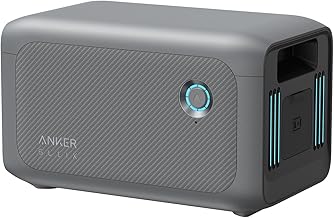
🛒 Anker Solix BP1000 Expansion Battery on Amazon →
Expansion Comparison Summary
| Factor | EcoFlow Delta 2 | Anker Solix C1000 | Winner |
|---|---|---|---|
| Expansion battery cost (1,000Wh module) | ~$449 | ~$549 | EcoFlow |
| Combined capacity (base + 1 expansion) | 2,048Wh | 2,112Wh | Tie |
| Total system cost (base + 1 expansion) | ~$1,148 | ~$1,398 | EcoFlow |
| Cost per Wh (expansion module) | ~$0.44/Wh | ~$0.52/Wh | EcoFlow |
| Max expansions supported | 2 modules | 2 modules | Tie |
| Max expanded capacity | 3,072Wh | 3,168Wh | Tie |
Expansion verdict: EcoFlow wins — the Delta 2 expansion battery is approximately $100 cheaper per module, making the expanded system meaningfully better value. If you’re planning to expand capacity over time, the Delta 2 ecosystem is more cost-effective.
The hybrid strategy: Buy the Anker Solix C1000 for its 4,000W surge base unit, then use EcoFlow’s cheaper expansion module — this doesn’t work. Expansion batteries are proprietary to each brand’s system. If expansion economics matter, choose your brand at the base unit level.
Round 7: Build Quality & Design
Both units use premium materials and have earned strong user satisfaction ratings. The differences are subtle:
Anker Solix C1000 Design:
- Slightly more angular, industrial aesthetic
- At 26.5 lbs, 0.5 lbs lighter than the Delta 2
- Larger LCD with clearer wattage/percentage display (some users prefer this to the Delta 2’s color screen)
- Handle design is solid but less ergonomic than EcoFlow’s integrated handle
- Fan noise at CPAP loads (~45W): near-silent — equivalent to Delta 2
EcoFlow Delta 2 Design:
- Sleeker aesthetic — widely regarded as the best-looking unit in its class
- Color LCD touchscreen — more visually appealing than Anker’s monochrome
- Handle integrates more cleanly into the body
- Port placement (inputs on the back) remains the one consistent user complaint
🔗 For the full EcoFlow Delta 2 fan noise benchmark and 6-month durability assessment → EcoFlow Delta 2 Complete Review →
Round 6 winner: EcoFlow — superior aesthetics and handle design.
The Complete Scorecard
| Round | Category | Winner | Margin |
|---|---|---|---|
| 1 | Surge Capacity | Anker | Large (4,000W vs 2,700W) |
| 2 | Charging Speed | Tie | Both ~50 min to 80% |
| 3 | Solar Input | Anker | Large for serious solar users |
| 4 | App & Smart Features | EcoFlow | Moderate |
| 5 | Runtime | Tie | 3% capacity difference |
| 6 | Build Quality/Design | EcoFlow | Slight |
Result: Anker 2 wins, EcoFlow 2 wins, 2 ties
The Lab’s Definitive Buying Verdict
Buy the Anker Solix C1000 Gen 2 if:
- You have a ½ HP sump pump — the 4,000W surge handles it; the Delta 2 does not reliably
- You run 8,000 BTU+ window AC units during outages
- You use corded power tools (circular saw, drill) through the power station
- You plan to build out a large solar array (400W+) over time
- You prioritize surge headroom for an unexpected heavy appliance load
🛒 Anker Solix C1000 Gen 2 on Amazon →
Buy the EcoFlow Delta 2 if:
- You primarily need home backup for fridge, CPAP, lights, and devices (no heavy surge loads)
- The EcoFlow app ecosystem matters — especially remote monitoring and scheduled charging
- Aesthetics and design quality factor into your decision
- Price is a priority — Delta 2 is often $100–$200 cheaper
🧰 Lab-Recommended Accessories for Both Units
| Accessory | Purpose | Link |
|---|---|---|
| 200W Foldable Solar Panel | Daily recharging and outage sustainability | Amazon → |
| 12-Gauge Extension Cord (25 ft) | Safe heavy-appliance power delivery | Amazon → |
| Kill-A-Watt Meter | Measure your exact appliance loads | Amazon → |
| Soft Starter (for AC units) | Reduces AC surge 60% — enables 8K BTU AC | Amazon → |
Read the Anker Solix C1000 standalone review
Is the Anker Solix C1000 better than the EcoFlow Delta 2?
On surge capacity, solar input, and continuous AC output: yes. On app features and design: EcoFlow wins. For most homeowners with sump pumps or large ACs: Anker is the better technical choice.
Can the Anker Solix C1000 run a sump pump?
Yes — for ¼, ⅓, and ½ HP pumps. Its 4,000W surge handles a ½ HP pump (2,400W LRA) with 40% margin. The EcoFlow Delta 2’s 2,700W surge is borderline for ½ HP pumps. See our sump pump guide → for complete HP-to-surge matching.