Affiliate Disclosure: As an Amazon Associate, Portable Power Lab earns from qualifying purchases at no extra cost to you.
Last Updated: April 2026 | Reading time: ~14 minutes
Most people think about emergency power approximately 90 minutes into a power outage — exactly when it’s too late to do anything useful.
This checklist puts you in the other category: the people who prepared before the storm, whose fridge is still cold, whose CPAP is running, whose pets are warm, and whose family is comfortable while the neighbors throw away $300 of groceries.
This is the only emergency power checklist that includes actual watt-hour math, specific product recommendations, a triage protocol for the moment the lights go out, and a full section covering the emergency power needs of the pets and livestock that most preparedness guides completely ignore.
Calculate your actual watt-hour need with the appliance chart
🌡️ Seasonal Outage Priority Planner
Your outage priorities change completely between a winter ice storm and a summer heat wave. Select your season and appliances to get a personalized triage plan with real watt-hour math.
The Power Triage Framework: Your Decision Architecture
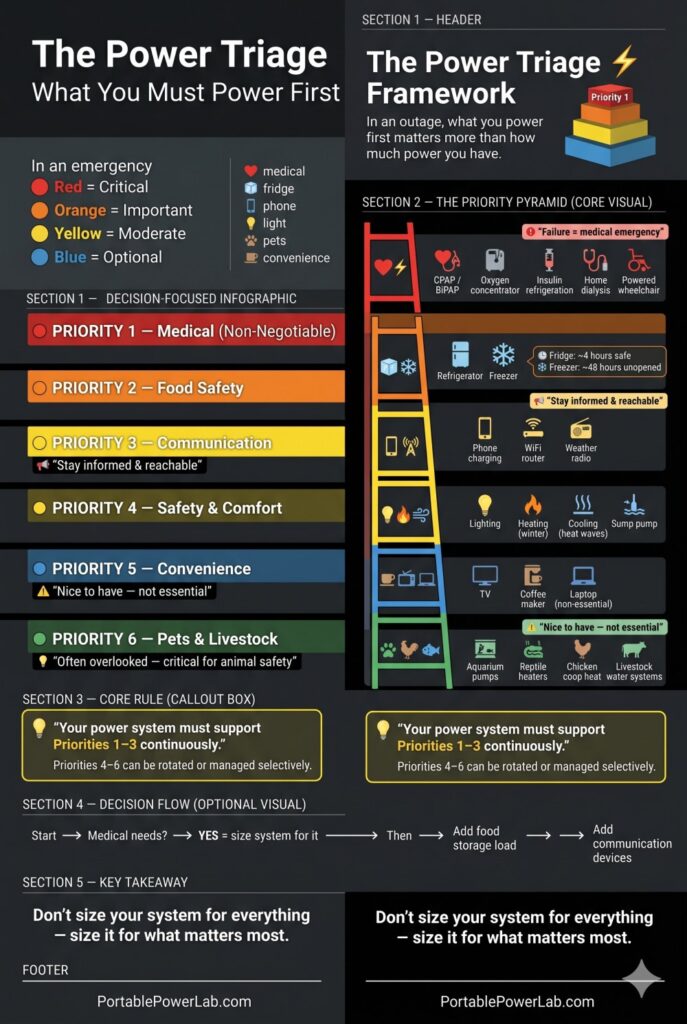
Not all power needs are equal. In an emergency, rank your devices by this priority framework before you spend a dollar on equipment:
Priority 1 — Medical Necessity (Non-Negotiable) CPAP, BiPAP, oxygen concentrator, insulin refrigerator, home dialysis, powered wheelchair charging. A failure here is a medical emergency.
Priority 2 — Food Safety Refrigerator and chest freezer. A full refrigerator stays safe for 4 hours unpowered. A full freezer stays safe for 48 hours unopened.
Priority 3 — Communication & Information Phone charging, WiFi router (if ISP is operational), battery-powered weather radio. You need to know what’s happening and be reachable.
Priority 4 — Safety & Comfort Lighting, heating in winter, cooling in dangerous heat, sump pump in flood conditions.
Priority 5 — Convenience Everything else — TV, coffee maker, laptop for entertainment.
Priority 6 — Pets & Livestock (Covered fully below — most guides skip this entirely) Reptile heating, aquarium pumps, pet fountains, chicken coop heating, livestock water heaters.
Your emergency power system must handle Priorities 1–3 continuously. Priorities 4–6 can be managed selectively.
The Master Emergency Power Shopping List
Core Power Station (Choose Based on Your Priority 1–3 Load)
| Your Situation | Recommended Station | Link | Price |
|---|---|---|---|
| CPAP + phones + lights only | Jackery Explorer 300 Plus | Amazon → | ~$249 |
| CPAP + fridge + lights | EcoFlow Delta 2 | Amazon → | ~$699 |
| CPAP + fridge + window AC | Jackery Explorer 1000 Plus | Amazon → | ~$949 |
| Sump pump + fridge + essentials | Jackery Explorer 1000 Plus | Amazon → | ~$949 |
| Extended 24+ hour backup | Bluetti AC200L | Amazon → | ~$1,399 |
| Oxygen concentrator backup | EcoFlow Delta Pro | Amazon → | ~$2,799 |
Solar Panel (Add for Daytime Recharging)
| Station Size | Solar Size | Link |
|---|---|---|
| Under 500Wh | 100W foldable | Amazon → |
| 500–1,500Wh | 200W foldable | Amazon → |
| 1,500Wh+ | 2 × 200W or 400W set | Amazon → |
Essential Accessories — Non-Negotiable Items
| Item | Why It’s Non-Negotiable | Link |
|---|---|---|
| 12-Gauge Extension Cord (25 ft) | Safe power delivery to fridge, sump pump | Amazon → |
| CO Detector (digital display) | Gas generators kill people indoors | Amazon → |
| Kill-A-Watt Meter | Know exactly what your devices draw | Amazon → |
| Rechargeable Headlamps × 2 | Hands-free lighting during setup | Amazon → |
| Emergency Weather Radio | Broadcasts when internet fails | Amazon → |
| Surge-Protected Power Strip | Maximize outlet use from power station | Amazon → |
Medical-Specific Items
| Item | Who Needs It | Link |
|---|---|---|
| Dedicated CPAP Battery Pack | CPAP users — purpose-built, lightweight | Amazon → |
| Insulin Travel Cooler (12V) | Diabetics — maintains insulin at 36–46°F | Amazon → |
| Battery-Powered Nebulizer | Asthma/COPD patients | Amazon → |
Best power station for seniors and medical devices
🐾 Priority 6: Pets & Livestock — The Section Every Other Guide Skips
More than 90 million US households have pets. During extended power outages, animals face the same temperature, hydration, and health risks as their owners — and in many cases, more acute ones. Reptiles, tropical fish, baby chicks, and livestock with automatic waterers are particularly vulnerable.
This section gives you the specific wattage data and product recommendations to protect your animals before the outage hits.
Pet Emergency Power Requirements
| Animal / Equipment | Device | Running Watts | Hours Critical | Wh Needed (12 hrs) | Urgency |
|---|---|---|---|---|---|
| Reptile (snake, lizard, turtle) | Heat mat or ceramic heat emitter | 25–150W | Continuous | 300–1,800Wh | 🔴 High — hypothermia within hours |
| Reptile (heat lamp) | Incandescent heat lamp | 60–150W | Continuous | 720–1,800Wh | 🔴 High |
| Tropical fish aquarium | Heater + filter + air pump | 50–200W | Continuous | 600–2,400Wh | 🔴 High — temp drop kills fish in hours |
| Cat water fountain | Small pump | 3–10W | Continuous | 36–120Wh | 🟡 Medium |
| Dog water fountain | Small pump | 5–20W | Continuous | 60–240Wh | 🟡 Medium |
| Small animal (hamster, rabbit) | Heating pad | 15–30W | 8–12 hrs/day | 120–360Wh | 🟡 Medium |
| Aquarium CO2 system | Small pump/regulator | 5–15W | Continuous | 60–180Wh | 🟡 Medium |
| Dog door (electric) | Small motor | 5–20W | Intermittent | Minimal | 🟢 Low |
| Electric fence controller | Energizer | 10–25W | Continuous | 120–300Wh | 🔴 High (predator risk) |
| Chicken coop heater (winter) | Radiant heater | 100–250W | 8–12 hrs | 800–3,000Wh | 🔴 High in freezing temps |
| Chicken coop auto door | Small motor | 5–10W | Minimal | Negligible | 🟢 Low |
| Livestock water heater / de-icer | Immersion heater | 150–1,500W | Continuous in winter | 1,800–18,000Wh | 🔴 Critical in freezing temps |
| Livestock automatic waterer | Small pump | 30–150W | As needed | 100–500Wh | 🟡 Medium |
| Pet incubator (orphaned animals) | Small heater | 25–75W | Continuous | 300–900Wh | 🔴 Critical |
The reptile emergency: Cold-blooded animals cannot regulate their own body temperature. In a power outage during winter, a bearded dragon or ball python without a heat source begins experiencing metabolic stress within 2–4 hours at room temperature, and hypothermia within 12 hours in an unheated home. This is not a “comfort” issue — it’s a survival issue.
Pet-Specific Product Recommendations
For reptile owners specifically:
The most energy-efficient approach to reptile heating during outages is a ceramic heat emitter (CHE) paired with a thermostat. CHEs draw 50–150W depending on size and are more power-efficient than incandescent heat lamps because they produce heat without light (no wasted energy as visible light).
| Product | Link |
|---|---|
| Ceramic Heat Emitter (CHE) for reptiles | Amazon → |
| Reptile Thermostat (prevents overheating) | Amazon → |
| Heat Mat (for snakes, ground-dwelling reptiles) | Amazon → |
Power station recommendation for reptile owners:
A single bearded dragon enclosure with a 100W ceramic heat emitter running continuously:
- 100W × 12 hours = 1,200Wh needed overnight
- Recommended station: EcoFlow Delta 2 (1,024Wh) — covers ~8.7 hours; adequate for most outages
- For extended outages: Jackery Explorer 1000 Plus (1,264Wh) — covers ~11 hours
For aquarium owners:
The aquarium’s biological filter is actually more critical than the heater in short outages (under 6 hours). Beneficial bacteria begin dying without oxygenation, leading to ammonia spikes that kill fish even after temperature normalizes.
Priority order for aquarium power:
- Air pump / circulation pump (keeps bacteria alive)
- Aquarium heater (maintains temperature)
- Lighting (lowest priority — fish survive darkness)
For chicken and small livestock owners:
In winter, the most critical threat is frozen water. Livestock require unfrozen water access year-round. In freezing temperatures, standard waterers freeze within hours without power.
| Solution | Watts | Coverage | Link |
|---|---|---|---|
| Heated water bowl (small livestock, poultry) | 60–100W | Continuous in freezing temps | Amazon → |
| Tank de-icer / immersion heater | 250–1,500W | Larger water tanks | Amazon → |
| Solar-powered heated waterer | 0W from battery | Passive solar heating | Amazon → |
Power station for chicken flock (heated waterer 100W, coop heater 150W in winter):
- Combined load: 250W
- Recommended station: Jackery Explorer 1000 Plus — covers ~4.4 hours at full load
- For extended winter outages with livestock: Bluetti AC200L + 200W solar panel provides all-day coverage
The best solar generators tested in our power outage guide
The 30-Minute Power Outage Deployment Protocol
When the lights go out, execute this sequence:
Minutes 0–2: Assess
- Check circuit breaker — local issue or neighborhood-wide?
- Open the utility’s outage map app (bookmark this now)
- Note the time — 4-hour refrigerator safety clock starts now
Minutes 2–5: Protect Priority 1 (Medical)
- Bring power station to bedroom/medical area
- Plug in CPAP, oxygen concentrator, or insulin cooler
- These run first, before anything else
Minutes 5–10: Protect Priority 6 (Pets)
- Plug in reptile heat lamp/CHE if ambient temp below 70°F
- Check aquarium temperature — if below 72°F, plug in heater
- In winter: plug in heated chicken waterer
Minutes 10–15: Protect Priority 2 (Food)
- Connect refrigerator via 12-gauge extension cord
- Do not open the refrigerator
Minutes 15–20: Priority 3 (Communication)
- Phone chargers + WiFi router
- Turn on weather radio for outage updates
Minutes 20–25: Priority 4 (Safety)
- Deploy headlamps at key locations
- In winter: decide on space heater usage (high draw — calculate remaining capacity first)
Minutes 25–30: Set up solar panels
- If daytime: deploy solar panels, connect to power station
- Check app for estimated runtime at current load
🔋 Battery Storage Decay Visualizer
See exactly how much charge your power station retains over time — by chemistry type and storage conditions.
🌡️ Seasonal Triage: Winter vs. Summer Emergency Power Priorities
The 30-minute protocol above applies to any outage. But your Priority 4 decisions (safety and comfort) should shift dramatically based on season. The actions that protect your family during a February ice storm are completely different from a July heat wave.
❄️ Winter Outage Priorities (Below 32°F External / Below 55°F Interior)
In cold-weather outages, the priority matrix shifts because hypothermia is a faster threat than food spoilage, and your power station’s cold-weather capacity loss must factor into your plan.
Adjusted Winter Priority Order:
| Priority | Device | Watts | Notes |
|---|---|---|---|
| 1 | Medical devices (CPAP, O2) | 45–300W | Unchanged — always first |
| 2 | Space heater (targeted room) | 750–1,500W | Elevated — cold is now immediate threat |
| 3 | Refrigerator | 55–80W avg | Remains important but cold ambient helps (fridge loses less heat) |
| 3 | Communication (phone, radio) | 25–40W | Unchanged |
| 4 | Lighting | 50–100W | More important in shorter winter days |
| 5 | Heated blanket vs. space heater | 50–150W | Heated blanket uses 5–10× less power than a space heater |
Winter-specific calculations:
Your power station loses 10–25% capacity in cold weather. Plan accordingly:
- EcoFlow Delta 2 at 25°F ambient: ~790Wh usable (not 891Wh)
- Running a 750W space heater: 790 ÷ 750 = ~1.05 hours
The smart winter heating strategy: A 150W heated electric blanket uses 5× less power than a 750W space heater but can maintain body temperature effectively in a sleeping scenario. Layer blankets + run heated blanket at 150W: 790 ÷ 150 = ~5.3 hours of body-temperature heating vs. 1 hour of room heating.
🛒 Electric Heated Blanket (low watt) →
Frozen pipe risk: If outage exceeds 4 hours in freezing weather, pipe protection takes priority. A pipe heating cable (3–8W per foot) on vulnerable pipes uses very little power and prevents catastrophic water damage.
Keep the power station warm: Store inside your heated room — cold reduces your station’s capacity further. Moving the station from a 30°F garage to a 60°F bedroom recovers 10–15% of its effective capacity.
☀️ Summer Outage Priorities (Above 85°F External / Above 90°F Interior)
In heat-wave outages, the priority matrix shifts because heat stroke can occur within hours, solar panels generate maximum power, and food safety timing is the same but food itself may spoil faster.
Adjusted Summer Priority Order:
| Priority | Device | Watts | Notes |
|---|---|---|---|
| 1 | Medical devices (CPAP, O2) | 45–300W | Unchanged |
| 2 | Cooling — targeted cooling room | 250–500W | Elevated — heat stroke risk within hours for elderly/children |
| 2 | Refrigerator | 55–80W avg | Now requires more cycling in heat (draws more) |
| 3 | Communication | 25–40W | Unchanged |
| 4 | Fans (strategic airflow) | 25–50W each | Use fans before AC if possible — 10× more efficient |
| 5 | Lighting | 50–100W | Less critical in long summer days |
Summer-specific calculations:
Your power station runs at peak efficiency in summer heat (LiFePO4 optimal at 60–80°F). However, the refrigerator in a hot house cycles more frequently — plan for 80W average rather than 55W.
The smart summer cooling strategy:
- Fan first: 3 fans at 50W = 150W total — cools people, not rooms
- 5,000 BTU AC targeted at one room (12’×12′) = ~250W average with 50% duty cycle
- Choose: fans (150W, cools people) OR targeted AC (250W, cools one room)
AC runtime estimate (Delta 2 at summer load): 891Wh ÷ (80W fridge + 250W AC + 75W devices) = 891 ÷ 405 = ~2.2 hours
Add 500W solar (6 summer sun hours): 3,000Wh generated. Net positive — solar sustains the system.
🛒 High-CFM Box Fan (low wattage) →
Seasonal Triage Quick Reference Card
| Priority | Generic Outage | Winter Outage | Summer Outage |
|---|---|---|---|
| 1 | Medical devices | Medical devices | Medical devices |
| 2 | Food safety | Space heater / heated blanket | Targeted AC / fans |
| 3 | Communication | Food safety + communication | Food safety + communication |
| 4 | Lighting | Lighting | Fans before AC |
| 5 | Comfort | Pipe heat cables | Hydration station (fan + water) |
The Emergency Power Maintenance Calendar
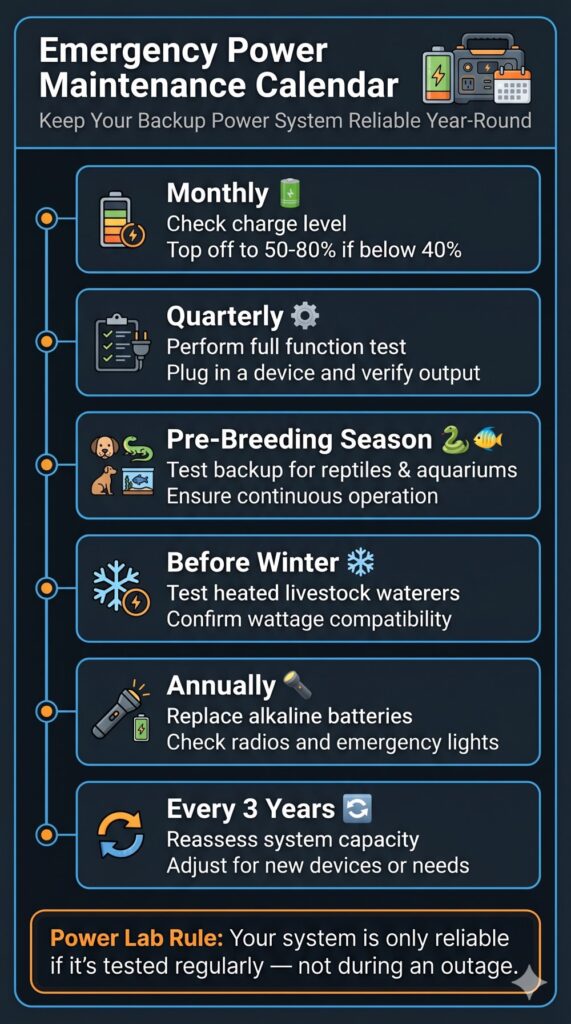
| Frequency | Task |
|---|---|
| Monthly | Check charge level; top off to 50–80% if below 40% |
| Quarterly | Full function test — plug in a device and verify |
| Before pet breeding/incubation season | Test reptile and aquarium backup equipment specifically |
| Before winter | Test heated livestock waterers; verify power station handles the wattage |
| Annually | Replace alkaline batteries in flashlights and radios |
| Every 3 years | Reassess capacity — has your household or livestock changed? |
The “Never Do” Emergency Power List
❌ Never run a gas generator indoors — garages, enclosed patios, near open windows
❌ Never use undersized extension cord (under 12 gauge for heavy appliances)
❌ Never store a power station depleted for months
❌ Never assume the station is charged if you haven’t checked in 3+ months
❌ Never run your reptile’s heat source without a thermostat — a power station running a 150W heat lamp continuously can overheat a small enclosure
❌ Never leave frozen livestock water for more than 24 hours — dehydration sets in faster than expected
The Complete Emergency Power Budget Guide
| Budget | Equipment | Coverage |
|---|---|---|
| $250 | Jackery 300 Plus + headlamps + cord | CPAP + phones + lights |
| $500 | EcoFlow River 2 Pro + 100W panel + accessories | CPAP + short fridge + communication + small pet heat |
| $900 | EcoFlow Delta 2 + 100W panel + full kit | Fridge + CPAP + lights + reptile/aquarium |
| $1,300 | Jackery 1000 Plus + 200W panel + accessories | Fridge + sump pump + window AC + all pets |
| $1,800 | Bluetti AC200L + 200W panel + accessories | 24+ hr full coverage + livestock needs |
| $3,500 | EcoFlow Delta Pro + 400W solar + transfer switch | Whole-home critical circuits + all animal needs |
Will a solar generator run your sump pump? LRA math
What should I buy first for power outage preparation?
Start with your Priority 1 need. Medical device → 300–500Wh station. Refrigerator → 1,000Wh station. Sump pump → 1,000Wh station with 4,000W surge.
Can a portable power station keep my reptile alive during an outage?
Yes. A 100W ceramic heat emitter on a thermostat draws ~60–80W average. An EcoFlow Delta 2 can run a single reptile enclosure for 11+ hours. For multiple enclosures, calculate combined load and size up accordingly.
How do I keep my aquarium going during a power outage?
Priority: air pump/circulation first, heater second. A battery-powered aquarium air pump ($15–$30) keeps bacteria alive independently. A power station handles the heater.
My chickens’ water freezes — what do I need?
A heated waterer (60–100W) or tank de-icer prevents freezing. A Jackery Explorer 1000 Plus runs a 100W heated waterer for ~11 hours on a single charge. Pair with 200W solar for all-day coverage.