Affiliate Disclosure: As an Amazon Associate, Portable Power Lab earns from qualifying purchases at no extra cost to you.
Last Updated: April 2026 | Reading time: ~10 minutes
The question sounds simple. The answer has real consequences for everyone who relies on battery power in winter — whether you’re hunting in November, camping in the Rockies, or trying to keep your fridge running during a February ice storm.
Do portable power stations work in cold weather?
Yes. Emphatically yes. But the marketing claims that your LiFePO4 station maintains “full capacity” at all temperatures are misleading. Every lithium battery loses capacity in cold weather — the chemistry is temperature-dependent, and no battery manufacturer can change that fundamental physics.
What can change is how much capacity you lose, how quickly, and what you can do about it.
Battery chemistry determines cold weather performance — LiFePO4 vs NMC
The Physics of Cold Weather Battery Performance
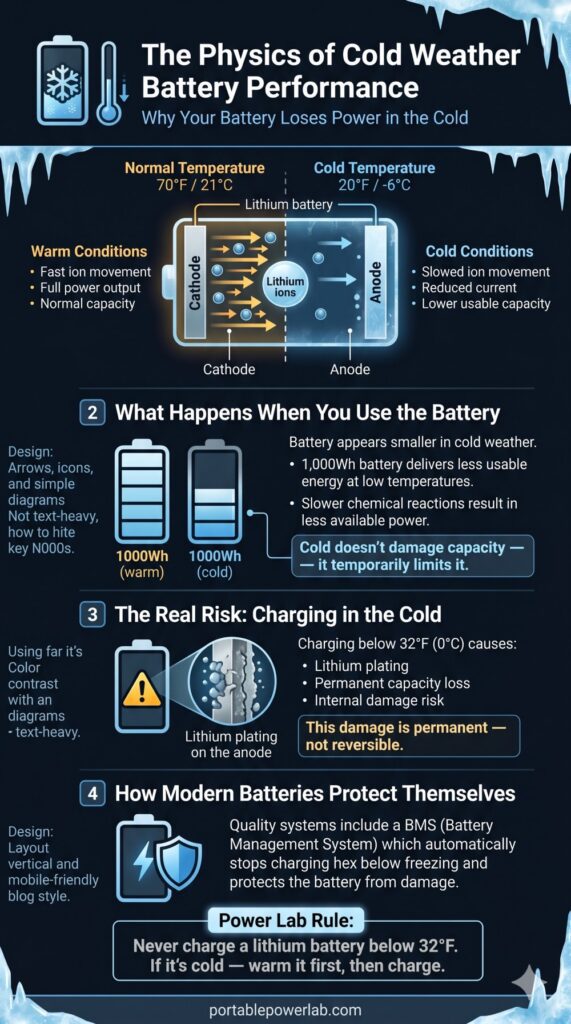
Lithium battery capacity at cold temperatures drops because low temperatures slow the movement of lithium ions between the cathode and anode during discharge. Fewer ions moving per unit time means less current available — which translates directly to lower effective capacity.
The discharge side: Your battery appears smaller than it is. A 1,000Wh battery at 20°F doesn’t deliver 1,000Wh — it delivers less, because the chemical reaction that releases that energy slows down.
The charging side: Charging a lithium battery below 32°F (0°C) causes lithium plating — lithium ions deposit on the anode surface as metallic lithium rather than intercalating properly. This permanently reduces capacity and can create internal short circuits over time. Quality BMS systems automatically prevent charging below 32°F.
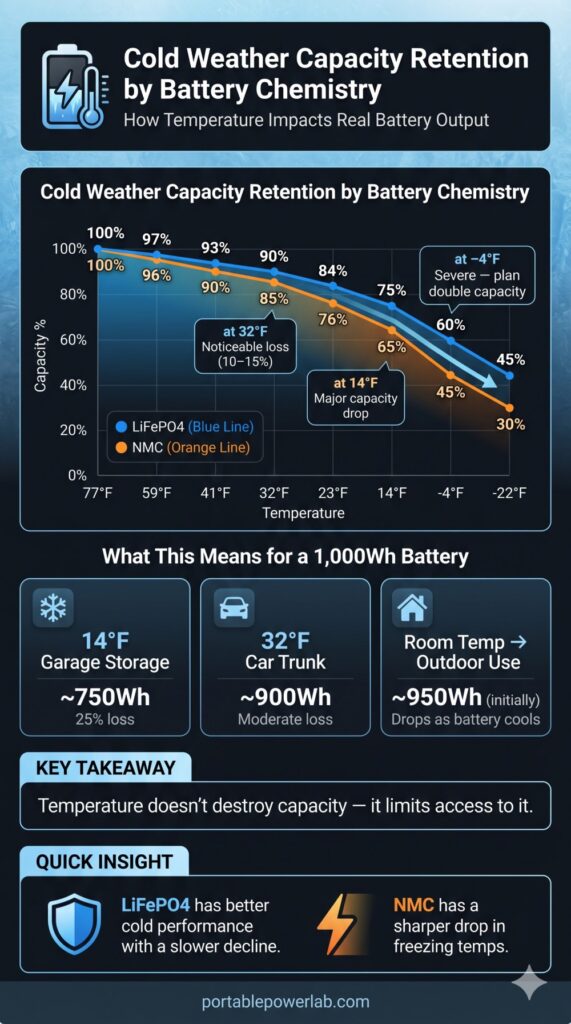
Cold Weather Capacity Retention by Chemistry
| Temperature | LiFePO4 Capacity | NMC Capacity | Practical Impact |
|---|---|---|---|
| 77°F (25°C) | 100% | 100% | Baseline |
| 59°F (15°C) | 97% | 96% | Negligible |
| 41°F (5°C) | 93% | 90% | Minor |
| 32°F (0°C) | 90% | 85% | Noticeable — 10–15% loss |
| 23°F (-5°C) | 84% | 76% | Significant |
| 14°F (-10°C) | 75% | 65% | Major — plan for it |
| -4°F (-20°C) | 60% | 45% | Severe — double the planned capacity |
| -22°F (-30°C) | 45% | 30% | Extreme — emergency use only |
The real-world numbers for a 1,000Wh LiFePO4 unit:
- Stored in 14°F garage during winter: delivers ~750Wh effective capacity
- Stored at 32°F car trunk overnight: delivers ~900Wh
- Stored at room temperature, then moved outside: delivers close to ~950Wh initially, declining as the battery cools during use
The Cold Weather Planning Framework
Step 1: Identify your ambient temperature range
What temperature will the power station be stored and operated at? This determines your effective capacity discount.
Step 2: Apply the capacity factor
Effective capacity = Rated capacity × Efficiency factor (0.87 for LiFePO4) × Cold weather factor
Example: Jackery Explorer 1000 Plus (1,264Wh) in a 14°F hunting camp:
1,264 × 0.87 × 0.75 = ~826Wh effective capacity
Compared to room temperature: 1,264 × 0.87 = ~1,099Wh. You’ve lost about 25% to cold weather.
Step 3: Size up accordingly
For cold weather use, add 25–35% to your calculated power needs to maintain the same effective runtime you’d get at room temperature.
Cold Weather Performance by Top Models
| Station | Rated Capacity | At 14°F (-10°C) | At -4°F (-20°C) | Cold Rating |
|---|---|---|---|---|
| Jackery 1000 Plus | 1,264Wh | ~948Wh | ~758Wh | ⭐⭐⭐⭐⭐ (LiFePO4) |
| EcoFlow Delta 2 | 1,024Wh | ~768Wh | ~614Wh | ⭐⭐⭐⭐⭐ (LiFePO4) |
| Anker Solix C1000 | 1,056Wh | ~792Wh | ~634Wh | ⭐⭐⭐⭐⭐ (LiFePO4) |
| Bluetti AC200L | 2,048Wh | ~1,536Wh | ~1,229Wh | ⭐⭐⭐⭐⭐ (LiFePO4) |
| Goal Zero Yeti 500X | 505Wh | ~328Wh | ~227Wh | ⭐⭐⭐ (NMC — significant loss) |
The LiFePO4 vs. NMC winter gap: At 14°F, LiFePO4 retains 75% capacity while NMC retains only 65%. On a 1,000Wh unit, that’s 100Wh of additional winter capacity — equivalent to 2+ extra hours of CPAP operation on a cold night.
🔗 For the complete LiFePO4 vs NMC chemistry comparison → LiFePO4 vs. NMC vs. NCA: Complete Chemistry Guide →
The 5 Cold Weather Best Practices
1. Store Inside — Always
The single most effective way to maximize cold weather capacity. Bringing your power station inside overnight means it operates at ambient indoor temperature rather than outdoor temperature. A station at 65°F indoor temperature that moves to a 20°F garage for 2 hours retains near-full capacity for the first hour of operation.
Insulated storage bag: A portable power station insulated carry bag significantly slows temperature drop when moving the unit between warm and cold environments.
2. Warm Before Heavy Use
If your station has been stored at freezing temperatures, warm it to above 32°F before drawing heavy loads. The capacity deficit at cold temperatures is partially reversible — as the battery warms from internal resistance during discharge, some capacity returns. This is why a unit that seems dead in the cold sometimes “recovers” after running for 10–15 minutes.
3. Never Charge Below 32°F
LiFePO4 BMS systems prevent this automatically in quality units. But for any unit lacking a BMS temperature sensor, charging at sub-freezing temperatures causes permanent, irreversible damage. When in doubt, warm the battery before connecting solar or AC charging.
4. Use a Smaller Load First to Self-Warm
Start cold operations with a low-power load (LED lights, phone charging) for 10–15 minutes before adding heavy loads. The battery’s internal resistance generates heat during discharge, warming the cells and recovering some cold-weather capacity.
5. Account for Cold in Your Solar Panel Output Too
Solar panels lose approximately 0.3–0.5% efficiency per degree Celsius above 25°C (they actually perform better in cold than heat — cold winter sun can be more efficient for panels). The challenge in winter isn’t panel efficiency — it’s reduced sun hours and panel angle. In northern latitudes in December, you might get only 2–3 peak sun hours per day instead of summer’s 5–6. Angle panels toward the low winter sun.
Cold Weather Camping Scenarios
Winter Car Camping (20°F overnight)
Setup: EcoFlow Delta 2 inside tent vestibule (stays warmer than outside)
- Adjusted capacity at 20°F: 1,024Wh × 0.87 × 0.78 = ~694Wh
- Load: CPAP 45W + LED lights 50W + phone 20W = 115W
- Runtime: 694 ÷ 115 = ~6 hours — covers a full night if battery starts warm
Ice Fishing / Winter Base Camp (0°F ambient)
Setup: Jackery Explorer 1000 Plus inside heated shanty or ice fishing hut (ambient 50°F when heater runs)
- Adjusted capacity inside heated shanty: ~950Wh (minimal cold discount)
- Load: 12V ice auger battery charger (80W) + lights + electronics = 150W
- Runtime: ~6.3 hours — all-day coverage with 200W panel recharging
The complete silent power guide for hunting camp
Best power stations for winter camping by weight-to-wattag
Do portable power stations work in freezing temperatures?
Yes — but with reduced capacity. LiFePO4 units retain ~90% at 32°F and ~75% at 14°F. Size your system 15–25% larger than calculated needs if you’ll be operating in consistently cold conditions.
Can I charge my power station in cold weather?
Not below 32°F. Charging below freezing causes permanent lithium plating damage. Most quality BMS systems prevent this automatically. Warm the battery above 32°F before charging.
Which power station works best in cold weather?
LiFePO4 units from major brands (EcoFlow, Jackery, Bluetti, Anker) all outperform NMC units in cold. Within the LiFePO4 category, there’s minimal difference between brands at the same temperature.