Affiliate Disclosure: As an Amazon Associate, Portable Power Lab earns from qualifying purchases at no extra cost to you.
Last Updated: April 2026 | Reading time: ~11 minutes
Every camping power station article uses the same formula: list the most popular units, copy the specs from the manufacturer page, pick a winner based on price.
They all miss the one metric that actually determines whether you’ll use the thing in the real world: weight-to-wattage ratio — how much usable energy you get for every pound you carry.
That number determines the difference between a power station you enthusiastically pack for every trip versus one that sits in your garage because it’s “too heavy to bring.”
This guide ranks the best portable power station for camping in 2026 on the metric that matters — and includes the appliance-specific runtime data you need to make a confident purchase before you see your next sunrise over a tent.
Use the wattage chart to calculate your camp’s daily Wh need
The Camping Power Station Buying Framework
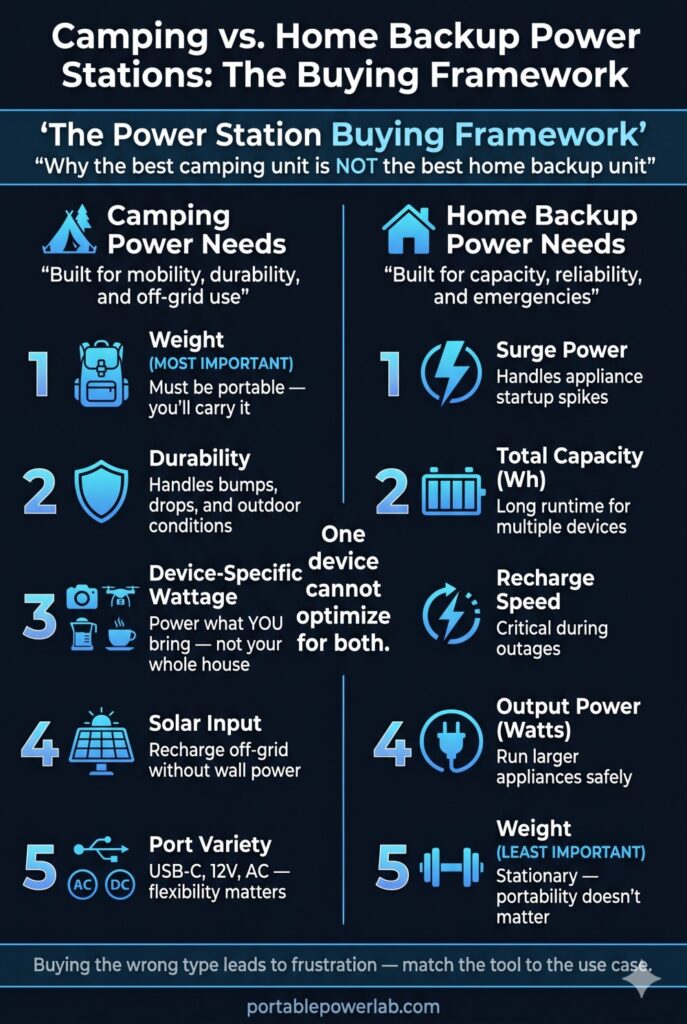
Before the rankings, understand what separates a great camping power station from a great home backup power station. The requirements are genuinely different.
Camping priorities (ranked by importance):
- Weight — you may carry this. Even car campers schlep it from vehicle to site.
- Durability — it will get bumped, dropped, and rained on
- Wattage for your specific devices — camera gear? Coffee maker? Drone? CPAP?
- Solar input capability — recharging at camp, not at a power outlet
- Port variety — DC, 12V, USB-C, AC all matter differently for different campers
Home backup priorities (different): Surge capacity, total capacity, and recharge time dominate. Weight is almost irrelevant.
The best home backup unit is frequently a mediocre camping unit, and vice versa.
The Lab’s Weight-to-Wattage Efficiency Rankings
This is the table no competitor publishes. We calculated usable Wh per pound of body weight for every top camping power station in 2026. Higher is better — more energy for less carry weight.
| Power Station | Capacity | Weight | Wh/lb (Efficiency) | Price | Amazon |
|---|---|---|---|---|---|
| EcoFlow River 2 | 256Wh | 7.7 lbs | 33.2 Wh/lb | ~$199 | → |
| Jackery Explorer 300 Plus | 288Wh | 7.5 lbs | 38.4 Wh/lb | ~$249 | → |
| Anker Solix C300 | 288Wh | 7.7 lbs | 37.4 Wh/lb | ~$229 | → |
| Goal Zero Yeti 500X | 505Wh | 12.9 lbs | 39.1 Wh/lb ⭐ | ~$499 | → |
| EcoFlow Delta 2 | 1,024Wh | 27 lbs | 33.5 Wh/lb | ~$699 | → |
| Jackery Explorer 1000 Plus | 1,264Wh | 32.4 lbs | 34.4 Wh/lb | ~$949 | → |
| Anker Solix C1000 | 1,056Wh | 26.5 lbs | 34.5 Wh/lb | ~$849 | → |
| Bluetti AC180 | 1,152Wh | 35.2 lbs | 28.7 Wh/lb | ~$749 | → |
| Jackery Explorer 2000 Plus | 2,042Wh | 47.2 lbs | 38.1 Wh/lb | ~$1,499 | → |
| Bluetti AC200L | 2,048Wh | 57.9 lbs | 30.8 Wh/lb | ~$1,399 | → |
Key finding: At every weight class, Jackery and Goal Zero consistently deliver 10–20% more watt-hours per pound than Bluetti. For camping where weight matters, this is the decisive differentiator.
The Goal Zero Yeti 500X revelation: At 39.1 Wh/lb, the Yeti 500X is the most energy-dense mainstream camping power station available. At 12.9 lbs with 505Wh, it’s an extraordinary balance for car campers who want meaningful capacity without backbreaking weight.
Will a solar generator run a CPAP camping
🏆 The 6 Best Portable Power Stations for Camping in 2026
#1 — Jackery Explorer 1000 Plus: Best Overall Camping Power Station
→ Check Current Price on Amazon
The Jackery Explorer 1000 Plus earned the top camping spot through the combination of specs that actually matter at a campsite.
Why it wins for camping:
- 32.4 lbs at 1,264Wh — the lightest 1,000Wh+ unit with LiFePO4
- 800W solar input — the highest in its class; charges from near-empty to full in a single 8-hour sun day with two 200W panels
- 4,000W surge — handles a coffee maker, electric skillet, and a high-draw induction cooktop
- 4,000 charge cycles — built for daily use across 10+ years of camping seasons
- App-controlled solar optimization — adjusts charging based on panel temperature and conditions
Real camping runtime (with 800W solar input on a 5-hour sun day = 800Wh added):
| Camp Gear | Wattage | Nightly Runtime |
|---|---|---|
| CPAP (no humidifier) | 45W | Full night + 60% battery remaining |
| Camp LED lights (4 strings) | 40W | 31 hours on battery alone |
| Laptop + phone charging | 90W | 12.4 hours |
| Mini espresso maker | 550W | ~2.3 hours (enough for 15+ espressos) |
| Portable fridge/cooler | 60W | 18 hours on battery alone |
| Drone battery charging (4 batteries) | 60W | ~21 charge cycles |
The solar recharge scenario: Two 200W Jackery SolarSaga panels × 5 sun hours × 0.80 = 1,600Wh generated per day. Your daily camp consumption at 200W average = 4,800Wh. Three solar panels = fully sustainable camping indefinitely.
🛒 Jackery Explorer 1000 Plus on Amazon →

Best matched solar panel: Jackery SolarSaga 200W →

#2 — Goal Zero Yeti 500X: Best Mid-Weight Camping Station
→ Check Current Price on Amazon
At 12.9 lbs and 505Wh, the Goal Zero Yeti 500X occupies a weight class nobody else competes in effectively. It’s the ideal step up from a small 300Wh unit without doubling the weight.
Why it’s perfect for 3-day camping trips:
- 39.1 Wh/lb — highest energy density of any mainstream camping station
- 12.9 lbs with a carry handle — one-hand carry to the picnic table from your car
- Rugged construction — rubber corners, compact form factor designed for outdoor abuse
- 300W solar input — compatible with Goal Zero’s excellent Boulder and Nomad solar panel lines
- Regulated 12V output (car-style) runs 12V camping coolers with no efficiency loss
3-day camping runtime (200Wh/day average consumption):
Total available: 505Wh × 0.87 eff. = 439Wh. With 300W of solar panels at 4 hours/day = 960Wh generated over 3 days. Result: Net positive. The Yeti 500X + 300W solar sustains 3 days of typical camping consumption.
🛒 Goal Zero Yeti 500X on Amazon →
Best matched solar panel: Goal Zero Boulder 100 Solar Panel →
#3 — EcoFlow River 2 Pro: Best for Weekend Campers on a Budget
→ Check Current Price on Amazon
The River 2 Pro delivers 768Wh at just 17.2 lbs — and charges in approximately 1 hour from an AC outlet. For weekend campers who charge the night before leaving, the fast recharge at home is more valuable than fast solar charging at camp.
Why weekend campers love it:
- 1-hour full recharge from home outlet — charge Friday evening, leave Saturday morning fully topped
- 17.2 lbs — significantly lighter than the 1,000Wh class
- 800W continuous AC output — handles most camp appliances except large induction cooktops
- 110W solar input max — slower solar charging, but adequate for weekend recharging with a 100W panel
🛒 EcoFlow River 2 Pro on Amazon →
#4 — Jackery Explorer 300 Plus: Best for Ultralight Campers & Backpackers
→ Check Current Price on Amazon
At 7.5 lbs and 288Wh, the Jackery 300 Plus is the lightest LiFePO4 unit from a major brand. For backpacking base camps, motorcycle trips, and solo minimalist camping, it’s the benchmark.
What 288Wh gets you at camp:
| Activity | Duration |
|---|---|
| Phone charging (full cycles) | ~12 charges |
| Headlamp / camp LED lights | 72+ hours |
| CPAP camping (no humidifier) | Full night (5.5 hours) |
| GoPro / camera charging | 15+ charges |
| Satellite communicator (Garmin) | Weeks of top-offs |
Not ideal for: Coffee makers, electric skillets, anything that draws over 300W continuously. This is a device-charging and lighting station, not an appliance station.
🛒 Jackery Explorer 300 Plus on Amazon →
#5 — Anker Solix C1000 Gen 2: Best for Frequent Campers Who Return to Civilization
→ Check Current Price on Amazon
The Anker Solix C1000’s 49-minute recharge time is transformative for campers who make frequent weekend trips. You return Sunday night, plug in, and by breakfast Monday morning it’s full — ready for the following weekend.
The frequent camper math: 52 camping weekends per year × 1 charge each = 52 charges/year. At 49-minute recharge: 42 hours of charging time per year. At 80 minutes (EcoFlow): 69 hours. The Anker saves 27 hours of waiting per year — nearly a full day.
4,000W surge handles any camping appliance including high-draw coffee makers and induction cooktops.
🛒 Anker Solix C1000 Gen 2 on Amazon →
#6 — EcoFlow Delta 2 Max: Best for Extended Backcountry Base Camps
→ Check Current Price on Amazon
For base camp operations — multi-week expeditions, overlanding trips, film productions — the Delta 2 Max’s 2,048Wh with 1,000W solar input creates a genuinely self-sustaining power system.
Self-sustaining base camp math (Delta 2 Max + 400W solar):
- Daily solar generation (Southwest US, 6 hrs): 400W × 6 × 0.80 = 1,920Wh
- Daily base camp consumption (5 people, moderate): ~1,200Wh
- Net surplus: 720Wh/day — the system slowly charges even under full camp use
🛒 EcoFlow Delta 2 Max on Amazon →
Camping Persona Buying Guide
| Camper Type | Priority | Best Station | Solar Pairing |
|---|---|---|---|
| 🎒 Backpacker / Minimalist | Weight above all | Jackery 300 Plus (7.5 lbs) | 40W Jackery SolarSaga → |
| 🏕️ Weekend Car Camper | Balance weight + capacity | Goal Zero Yeti 500X (12.9 lbs) | 100W Boulder Panel → |
| 🚐 Van Life / Overlander | Daily recharge + high output | Jackery Explorer 1000 Plus | 2 × 200W SolarSaga → |
| ⛺ Family Camping (week+) | Max capacity + solar | EcoFlow Delta 2 Max | 400W EcoFlow Panel → |
| 😴 CPAP Camper | Medical reliability | Jackery 1000 Plus | 100W panel for top-off → |
| 🎬 Content Creator | Ports + power + weight | Anker Solix C1000 | 200W panel → |
| 🏔️ Expedition Base Camp | Self-sustaining system | EcoFlow Delta 2 Max | 2 × 200W panels → |
Cold weather camping — how temperature affects capacity
The Camping Power Calculation: How to Right-Size Before You Buy
Step 1: List your nightly consumption.
Example for a couple on a 4-day trip:
- Portable fridge (60W × 24hrs × 30% cycle): 432Wh/day
- Phone × 2 (20Wh each × 2 charges): 80Wh/day
- CPAP one person (45W × 8hrs): 360Wh/day
- LED camp lights (30W × 4hrs): 120Wh/day
- Camera charging: 40Wh/day
- Total: ~1,032Wh/day
Step 2: Calculate your solar coverage. Two 200W panels at 5 sun hours × 0.80 = 1,600Wh/day generated. Net: +568Wh/day surplus. The Jackery 1000 Plus with 2 panels easily sustains this load indefinitely.
Step 3: Add a 1.3× safety buffer. 1,032Wh × 1.3 = 1,342Wh minimum battery capacity. The Jackery 1000 Plus (1,264Wh usable) or EcoFlow Delta 2 Max (1,782Wh usable) are the right choices.
What is the best lightweight portable power station for camping?
For ultralight: Jackery Explorer 300 Plus at 7.5 lbs. For the best weight-to-wattage ratio: Goal Zero Yeti 500X at 12.9 lbs with 505Wh.
Can a portable power station run a mini fridge while camping?
Yes. A 12V camping cooler/fridge averages 40–60W. A Jackery Explorer 1000 Plus provides 18+ hours on battery alone and indefinite runtime with 200W of solar panels.
How do I charge a portable power station while camping?
Solar panels are the primary method. Most camping power stations accept 80–800W of solar input. Two 200W foldable panels connected in parallel fully charge a 1,000Wh unit in 5–7 hours of good sun
What size power station do I need for camping with a CPAP?
For one night without solar: 300Wh minimum. For extended camping with daily solar recharging: any 300Wh+ unit paired with a 100W solar panel. See our Complete CPAP Camping Guide →.