By Portablepowerlab | Last Updated: December 2025
As an Amazon Associate, Portable Power Lab earns from qualifying purchases
If you have sleep apnea, the idea of camping “off-grid” is terrifying.
You picture yourself in a tent at 2:00 AM, the battery dying, and waking up gasping for air. I get it. The good news is that yes, a solar generator can absolutely run your CPAP machine camping.
But you cannot just buy any random battery on Amazon.
If you buy a unit that is too small, it won’t last the night. If you buy one that is too big, you are wasting $500 on weight you don’t need to carry.
We have crunched the numbers for the most common machines (ResMed AirSense 10 & 11, Philips DreamStation) to tell you exactly what size you need.
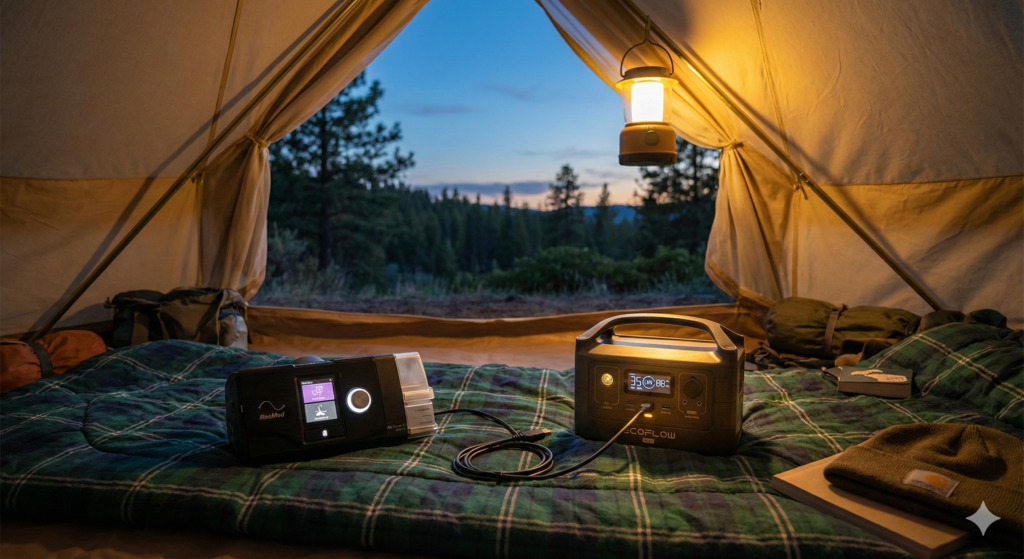
The “Golden Rule” of CPAP Camping
Before we talk about batteries, we need to talk about your Heated Humidifier.
This is the single biggest factor in how long your battery lasts. It is not about the motor; it is about the heat.
- Heater ON (Standard Mode): Your machine pulls 50–60 Watts constantly to boil water.
- Heater OFF (Passive Mode): Your machine pulls 5–10 Watts just to push air.
The Lab Verdict: If you leave your humidifier and heated tube turned ON, you will need a massive, expensive battery (1000Wh+) just to get through one night.
If you turn the humidity OFF (or use “Passive Mode” where air passes over the water without heating it), you can run your CPAP for 3-4 nights on a small, affordable battery.
For this guide, we assume you are camping smart and turning the humidifier OFF.
The Secret Weapon: The DC Converter Cable
Stop! Do not plug your standard wall plug into the power station.
Your CPAP machine runs on DC power (Direct Current). The wall outlet in your house is AC power (Alternating Current).
- The Inefficiency Loop: If you use the standard wall plug, the power station has to convert battery power (DC) to wall power (AC). Then, your CPAP “brick” converts it back to DC.
- The Cost: You lose 20–30% of your battery life to this heat conversion (often called “Vampire Drain” or Inverter Loss).
The Solution: Buy the specific DC Converter Cable for your machine (usually ~$30–$50). It looks like a car cigarette lighter plug. This creates a direct, efficient link from the battery to the machine.
- ResMed AirSense 10: Requires a 24V DC Converter.
- ResMed AirSense 11: Requires a specific 24V DC Converter (different plug shape than the 10).
- Philips DreamStation: Requires a 12V DC Cable.
How Much Battery Do You Need? (The Math)
We measure battery capacity in Watt Hours (Wh). This is the size of the gas tank.
Here is the “Lab Math” for a standard ResMed AirSense 10, pressure setting 10 cmH2O, with the humidifier OFF, using a DC Cable.
- Average Draw: ~7 Watts per hour.
- Sleep Time: 8 Hours.
- Total Consumption:
7W × 8h = 56Wh per night.
Note: We always add a 20% “safety buffer” because batteries shouldn’t be drained to 0%, and cold weather reduces capacity.
The Formula:
(Nights × 56Wh) ÷ 0.80 = Minimum Battery Size
Comparison Data Table: Battery Sizing Guide
Estimates based on ResMed AirSense 10/11 usage with DC Cable.
| Scenario | Humidifier Status | Est. Wattage | 1 Night Need | 3 Night Need | Recommended Size |
| Efficient Camper | OFF | 7-10 Watts | ~70Wh | ~210Wh | 300Wh Unit |
| Comfort Camper | Low (1-2) | 25-30 Watts | ~300Wh | ~900Wh | 500Wh – 1000Wh |
| Luxury Camper | High (4+) | 50-60 Watts | ~600Wh | 1800Wh+ | 1000Wh – 2000Wh |
Top 3 Common Camping Scenarios
We have matched specific power stations to the three most common “Buyer Personas” we see at the Lab.
Scenario 1: The Weekend Warrior (1-2 Nights)
You need: At least 200Wh – 300Wh.
- Top Pick: Jackery Explorer 300 Plus
- Capacity: 288Wh (LiFePO4)
- Nights of Sleep (Humidifier OFF): ~3 to 4 nights.
- Why: It fits in a backpack, weighs only 8 lbs, and is dead simple to use. It’s plenty for a weekend trip if you aren’t running other heavy electronics.
- Lab Note: This unit uses the new LiFePO4 battery, so it will last 10 years even if you use it every weekend.

Scenario 2: The Long Haul (3-5 Nights)
You need: At least 500Wh – 700Wh.
- Top Pick: EcoFlow River 2 Pro
- Capacity: 768Wh (LiFePO4)
- Nights of Sleep (Humidifier OFF): ~7+ nights.
- Nights of Sleep (Humidifier LOW): ~2 nights.
- Why: This gives you massive peace of mind. Even if you want to turn the humidifier on low for a few hours to deal with dry desert air, you have the extra capacity. Plus, it charges from 0-100% in 70 minutes if you find an outlet at a campground bathroom.

Scenario 3: “I Need My Humidifier ON”
You need: At least 1000Wh – 1500Wh.
- Top Pick: Jackery Explorer 1000 v2
- Capacity: 1002Wh
- Nights of Sleep (Humidifier ON): ~1 to 1.5 nights.
- Why: Heat consumes energy rapidly. You need a “big block” battery. This unit will get you through the night with humidity blasting, but you will likely need to recharge it the next day using Folding Solar Panels.
- See Also: Compare this against the competition in our Jackery vs. EcoFlow Pillar Review.

Critical “Lab” Tips for CPAP Success
1. Test at Home First
Do not test your battery for the first time in the woods.
- The “Living Room Test”: One week before your trip, sleep in your own bed using only the battery and the DC cable.
- Why: You might discover your mask leaks. A leaky mask forces the machine to work harder (blow more air), which can double your power consumption and kill the battery faster than our charts predict.
2. Manage Your Pressure
- The Variable: A pressure setting of 15 cmH2O uses significantly more power than 7 cmH2O.
- Advice: If you have a high prescription (12+), assume you are on the “high end” of power draw. Bump up to the next battery size (e.g., get a 500Wh instead of a 300Wh) to be safe.
3. Insulation Matters
- The Cold: Lithium batteries hate freezing temps. If you are winter camping, the cold can zap 20% of your capacity.
- The Fix: Put the power station inside a wool sock or a small cooler (with the lid slightly cracked for airflow) to keep its self-generated heat contained.
FAQ: Frequently Asked Questions
Q: Can I charge the battery with solar panels while I use it?
A: Yes, this is called “Pass-Through Charging.” However, it is rarely useful for CPAP because you sleep at night when there is no sun. This is only useful if you nap during the day.
Q: Will the inverter beep and wake me up when it runs out?
A: Most modern units (Jackery/EcoFlow) have silent modes or very quiet fans. However, if the battery dies, the machine shuts off instantly. This is why we recommend buying a battery with double the capacity you think you need.
Q: Can I bring these batteries on a plane?
A: Maybe.
- Under 100Wh: Allowed in carry-on (unlimited).
- 100Wh – 160Wh: Allowed with airline approval (max 2).
- Over 160Wh: BANNED. You cannot fly with a Jackery 300 or EcoFlow River 2. They are too big. You must drive or ship them.
Final Verdict
Don’t let sleep apnea keep you indoors.
- For 90% of campers: Buy the EcoFlow River 2 Pro. It is the “Goldilocks” size—small enough to carry, but big enough to last a whole week if you keep the humidifier off.
- On a budget? The Jackery Explorer 300 Plus is the absolute minimum I would trust with my health. It’s affordable and reliable for short trips.
Sleep tight.