Affiliate Disclosure: As an Amazon Associate, Portable Power Lab earns from qualifying purchases at no extra cost to you.
Last Updated: October 2026 | Reading time: ~13 minutes
Best Foldable Solar Panels – The Matching Mistake That Wastes Half Your Panel’s Output
The most common solar panel buying mistake on this site’s entire topic isn’t choosing a bad panel — it’s choosing a panel your power station physically can’t use at full output. Every power station has a maximum solar input ceiling, and a panel generating more than that ceiling doesn’t charge any faster past it. The reverse mistake is just as common: undersizing a panel relative to a high-capacity station, leaving real charging speed on the table.
Before anything else on this page, match your panel wattage to your specific station’s input ceiling.
| Power Station | Max Solar Input | Right-Sized Panel |
|---|---|---|
| EcoFlow River 2 | 110W | 1 × 100W |
| EcoFlow Delta 2 | 500W | 1-2 × 200W |
| Jackery Explorer 1000 Plus | 800W | 4 × 200W |
| Bluetti AC200L | 900W | 4-5 × 200W |
| Jackery Explorer 2000 Plus | 1,200W | 6 × 200W |
| EcoFlow Delta Pro | 1,600W | 8 × 200W |
| EcoFlow Delta Pro Ultra | 5,600W | Up to 28 × 200W |
The River 2 example that illustrates the problem clearly: its 110W ceiling means even a single full-size 200W panel is throttled by the unit itself — the extra 90W the panel could generate simply goes unused. That’s not a reason to avoid a 200W panel if you already own one, but it’s worth knowing before buying one specifically for this unit.
Foldable vs. Rigid — Which One You Actually Need
This is the single most important durability decision in solar panel buying, and it’s determined entirely by how you plan to use the panel — not by price or brand.
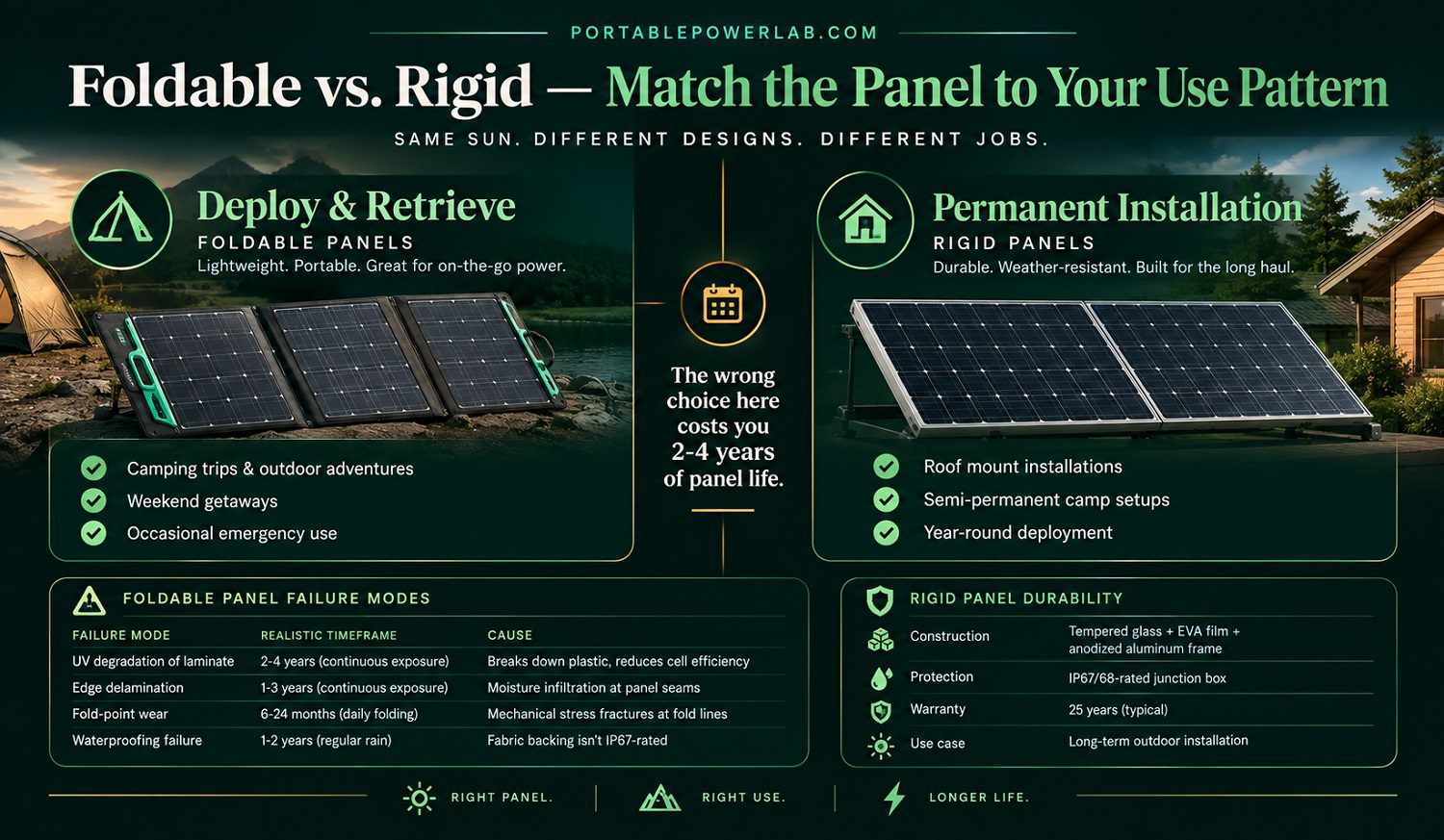
Foldable Panels — Built for Deploy-and-Retrieve, Not Permanent Installation
Foldable panels use monocrystalline cells encapsulated in ETFE or PET laminate film bonded to a fabric backing, with hinged or fabric fold points. This construction is lightweight and genuinely portable — and genuinely not designed for continuous outdoor exposure.
| Failure Mode | Realistic Timeframe | Cause |
|---|---|---|
| UV degradation of laminate | 2-4 years continuous exposure | Breaks down plastic, reduces cell efficiency |
| Edge delamination | 1-3 years continuous exposure | Moisture infiltration at panel seams |
| Fold-point wear | 6-24 months of daily folding | Mechanical stress fractures at fold lines |
| Waterproofing failure | 1-2 years in regular rain | Fabric backing isn’t IP67-rated |
Foldable panels are rated for exactly what their name implies: deploy them when generating power, fold and store them when you’re not. Left outside permanently for a year or more, they degrade meaningfully faster than their rigid counterparts.
Rigid Panels — Built for Permanent Installation
Rigid panels use tempered low-iron glass over the cells, sealed with EVA film, in an anodized aluminum frame with an IP67/68-rated junction box. This is genuinely 25-year-warranty construction — the same panel type used in residential rooftop solar, scaled down for portable use.
The decision rule: If the panel will be deployed and retrieved regularly — car camping, a weekend trip, occasional emergency use — foldable is the right choice and the durability concerns above are largely irrelevant, since the panel spends most of its life folded and stored. If the panel will sit outside permanently or near-permanently — a semi-permanent camp setup, a roof mount, year-round deployment — rigid is the only durable option.
See the complete rigid vs. foldable analysis for long-term off-grid and prepper use
Buy a 100W Rigid Glass Solar Panel (permanent mount) → | Buy a 200W Rigid Glass Solar Panel →
The Best Foldable Panels by Wattage Tier
Best 100W Panel — For Light-Duty and Budget-Tier Stations
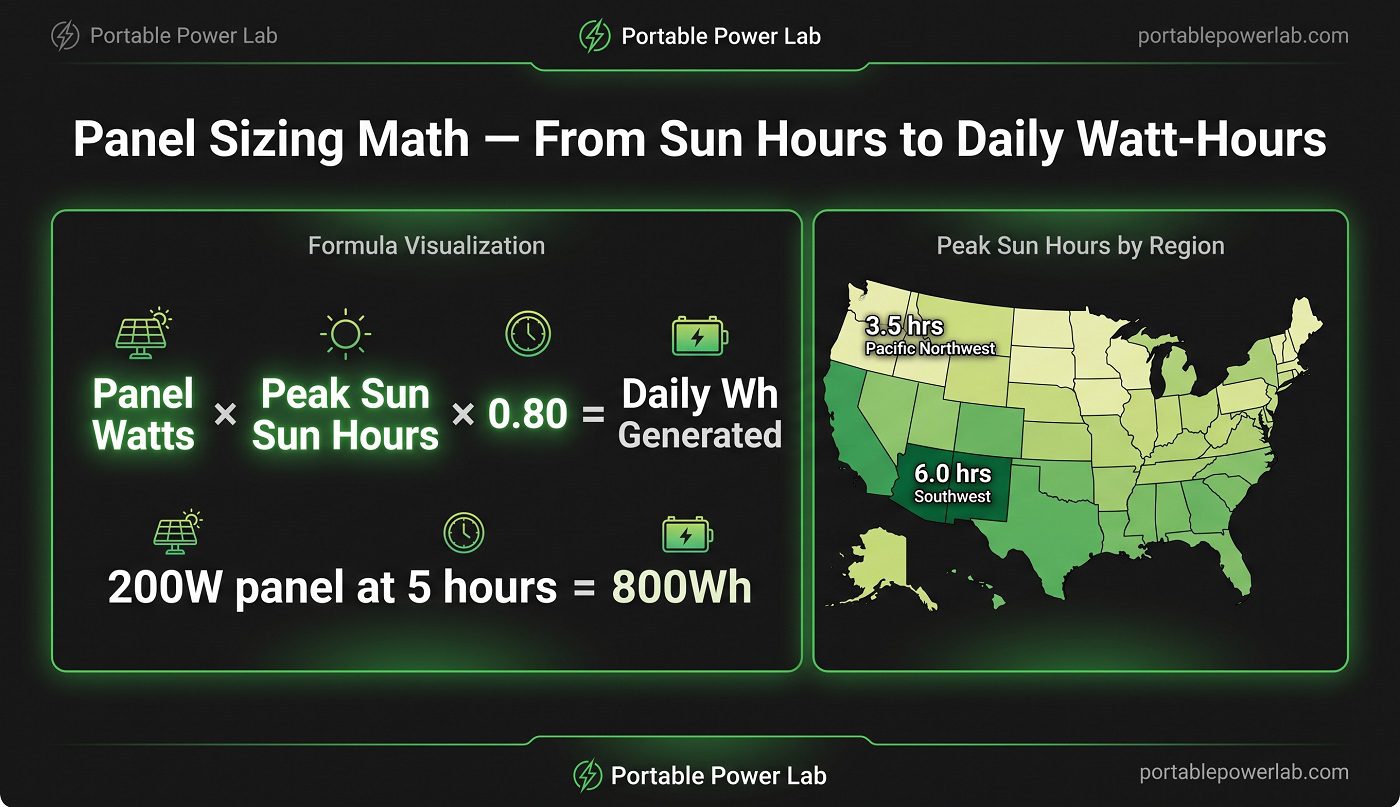
The right match for the EcoFlow River 2 and similar budget-tier units with solar ceilings at or below 110W. A 100W panel at 5 peak sun hours generates roughly 400Wh per day at 80% system efficiency — enough to fully recharge a 256Wh unit with capacity to spare.
Best 200W Panel — The Universal Workhorse
The single most useful panel size across this entire site’s recommendations — scales from a single-panel setup for mid-tier stations to multi-panel arrays for high-capacity units. One 200W panel generates approximately 800Wh per day at 5 peak sun hours, matching well against the EcoFlow Delta 2’s 500W ceiling with room for a second panel.
Scaling to a multi-panel array: For stations with a solar ceiling above 500W, a 2-pack or 4-pack bundle reaches your station’s full input capacity in a single purchase, typically at a modest per-panel discount versus buying individually.
Best 400W Panel Set — For High-Capacity Stations
The efficient choice for the EcoFlow Delta Pro and similar high-ceiling units, where reaching the station’s full input capacity with 200W panels alone would require unwieldy numbers of individual units. A 400W set generates roughly 1,600Wh per day at 5 peak sun hours — a meaningful fraction of the Delta Pro’s daily consumption from solar alone.
Complete Delta Pro Ultra solar array sizing including the 5,600W ceiling
Wiring Multiple Panels — Series, Parallel, and the Voltage Limit Most Buyers Never Check
This matters the moment you move beyond a single panel. Wattage ceilings get the attention, but charge controllers also enforce a separate, stricter limit: maximum open-circuit voltage (Voc) — and exceeding it, unlike exceeding a current or wattage rating, risks permanent hardware damage rather than simply being throttled.
Why Voltage Matters More Than Wattage Here
A charge controller’s wattage ceiling is the product of voltage and current, but the controller enforces voltage and current limits independently. A current overage is something the controller can typically manage or throttle safely. A voltage overage is different — exceeding the controller’s rated input voltage can damage its internal components immediately, with no graceful throttling available.
This is the critical distinction when wiring multiple panels together:
Series wiring (positive of one panel to negative of the next) adds voltage while current stays the same as a single panel. Three 24V panels wired in series produce roughly 72V — a voltage that can exceed many consumer charge controllers’ safe input ceiling well before you’d expect, simply by adding a third panel to a setup that worked fine with two.
Parallel wiring (all positives joined, all negatives joined) adds current while voltage stays the same as a single panel. Three 24V panels wired in parallel still present roughly 24V to the controller, regardless of how many panels you add — current rises instead, which is the limit controllers are generally better equipped to manage safely.
The Practical Rule of Thumb
For most consumer multi-panel setups, parallel wiring is the safer default — voltage stays predictable and low regardless of how many panels you connect, removing the voltage-stacking risk entirely. This is also why the official multi-panel splitter and combiner cables sold by major power station manufacturers are typically configured for parallel wiring: it’s the safer default for buyers who haven’t individually calculated their specific controller’s voltage ceiling.
Before wiring any panels in series specifically, check two numbers: your power station’s maximum rated input voltage (stated in its spec sheet, separate from its wattage ceiling), and your panels’ individual open-circuit voltage. Series wiring is genuinely useful for reducing current-related cable losses on long wiring runs, but only once you’ve confirmed your specific combination stays under the controller’s voltage ceiling — never assume it does.
Buy Official Parallel Panel Splitter/Combiner Cables
Buy 10AWG Heavy-Duty Outdoor Solar Extension Cable (reduces current-related losses on long runs) →
Solar Panel Connector Compatibility — Check Your Specific Model
Every power station brand uses a proprietary default solar input connector, and — this matters more than which specific connector each brand uses — connector types vary by model generation within each brand’s own lineup, not just between brands. Rather than risk giving you an outdated or model-specific mapping as if it were universal, the reliable approach is simpler and more durable: check the exact input port on your specific unit’s model number against the panel’s output connector before ordering.
Most panels ship with, or can be paired via, a widely available adapter — MC4-to-barrel and XT60-to-barrel combinations cover the large majority of cross-brand pairing needs, typically for $10-15.
Buy a Universal Solar Connector Adapter Kit
Seasonal Panel Care — Winter and Storm Considerations
Winter — Steepen the Angle, Clear Snow Gently
The sun sits meaningfully lower in the sky during winter, and a panel angled for summer efficiency captures far less of that lower-angle light. Tilt foldable panels significantly steeper for winter use — commonly in the 45-60° range depending on latitude, versus a flatter summer angle.
Clear snow and ice with a soft foam brush or squeegee designed for solar panels — never a metal scraper or stiff-bristle broom, both of which can permanently scratch the laminate or glass surface and reduce light transmission for the rest of the panel’s life.
Partial Shading — Why a Small Shadow Costs More Than It Looks Like It Should
Solar cells within a single panel are wired in series internally to produce the panel’s rated voltage, and in a series circuit, current is limited by the weakest point in the string. This means even a small patch of shade — a tree branch, a tent pole’s shadow, part of the panel sliding into a vehicle’s shadow as the sun moves — can disproportionately reduce the entire panel’s output, well beyond what the shaded area’s percentage alone would suggest.
Quality panels include bypass diodes, which route current around a shaded section rather than letting it bottleneck the entire string — this limits the damage from partial shading but doesn’t recover the power that section would otherwise have generated.
The practical takeaway: Position panels with completely unobstructed exposure during peak sun hours, and if you notice generation dropping well below expectations, check for a small shadow crossing even a small portion of the panel before assuming a hardware fault — partial shading is a far more common cause of underperformance than most buyers suspect.
Active Storms — Bring Foldable Panels Indoors
A foldable panel’s large, lightweight, flat surface catches wind efficiently — at sustained winds as low as Category 1 hurricane strength, an unsecured panel can become airborne debris. Bring every foldable panel indoors well before any forecast storm arrives, and don’t redeploy until sustained winds have dropped to a safe level and the area has been checked for debris.
Frequently Asked Questions
What size solar panel do I need for my power station?
Match the panel’s total wattage to your power station’s maximum solar input rating, not its battery capacity — exceeding the input ceiling wastes panel output, while staying well below it leaves charging speed on the table. See the complete matching table above for every major power station on this site.
Is a foldable or rigid solar panel better?
Neither is universally better — it depends entirely on use pattern. Foldable panels are the right choice for deploy-and-retrieve use (camping, occasional emergency backup); their ETFE/PET laminate construction degrades meaningfully faster than rigid panels under continuous outdoor exposure. Rigid panels, with tempered glass and a 25-year-rated construction, are the right choice for any semi-permanent or permanent installation.
Will my EcoFlow or Jackery solar panel work with a different brand’s power station?
Often yes, with the right adapter — but the exact connector type varies by model generation within each brand, not just between brands. Check your specific unit’s input port before ordering a cross-brand panel, and budget $10-15 for a connector adapter if needed.
How much power does a 200W solar panel actually generate per day?
Approximately 800Wh per day at 5 peak sun hours, accounting for a realistic 80% system efficiency factor. This varies significantly by region — closer to 560Wh/day in the Pacific Northwest’s 3.5 peak sun hours, up to 960Wh/day in the Southwest’s 6.0 peak sun hours.
Should I wire multiple solar panels in series or parallel?
For most consumer setups, parallel wiring is the safer default — it keeps voltage the same as a single panel regardless of how many panels you add, avoiding the risk of exceeding your charge controller’s voltage ceiling. Series wiring adds voltage with each panel and can exceed that ceiling faster than expected, risking hardware damage rather than simply being throttled. Check your specific power station’s maximum input voltage rating before wiring any panels in series.
Browse Foldable Solar Panels on Amazon
The Lab’s Verdict
Match your panel’s wattage to your power station’s input ceiling before anything else — this single step determines whether you’re actually using the panel you bought or leaving real charging speed unused. Beyond that, the foldable-versus-rigid decision comes down entirely to how the panel will live: folded and stored between trips, or deployed semi-permanently. Get both of those right, and the specific brand matters far less than most buying guides suggest.
Series vs. parallel wiring principles and open-circuit voltage (Voc) limits reflect standard, well-established solar electrical engineering rather than site-specific testing. This site has not independently verified specific Voc ceiling figures for each individual power station covered — those numbers vary by model and are available on each manufacturer’s own spec sheet — so this guide intentionally provides the general wiring principle and the practical “check your specific unit” instruction rather than asserting unverified per-unit voltage figures. Partial shading and bypass diode behavior reflect standard series-circuit solar cell engineering.
Browse All Solar Panels on Amazon
Portable Power Lab — Real Math. No Fluff. Independent since 2025.