Affiliate Disclosure: As an Amazon Associate, Portable Power Lab earns from qualifying purchases at no extra cost to you.
Last Updated: May 2026 | Reading time: ~14 minutes
Jackery Vs. Ecoflow – The Comparison That Should Have Existed From Day One
This site has compared Jackery against Bluetti, EcoFlow against Bluetti, Anker against EcoFlow, Goal Zero against Jackery, and Bluetti against Goal Zero. The two biggest names in the category — Jackery and EcoFlow — have never been put head-to-head directly across this site, which is a genuine gap given how often buyers are choosing between exactly these two.
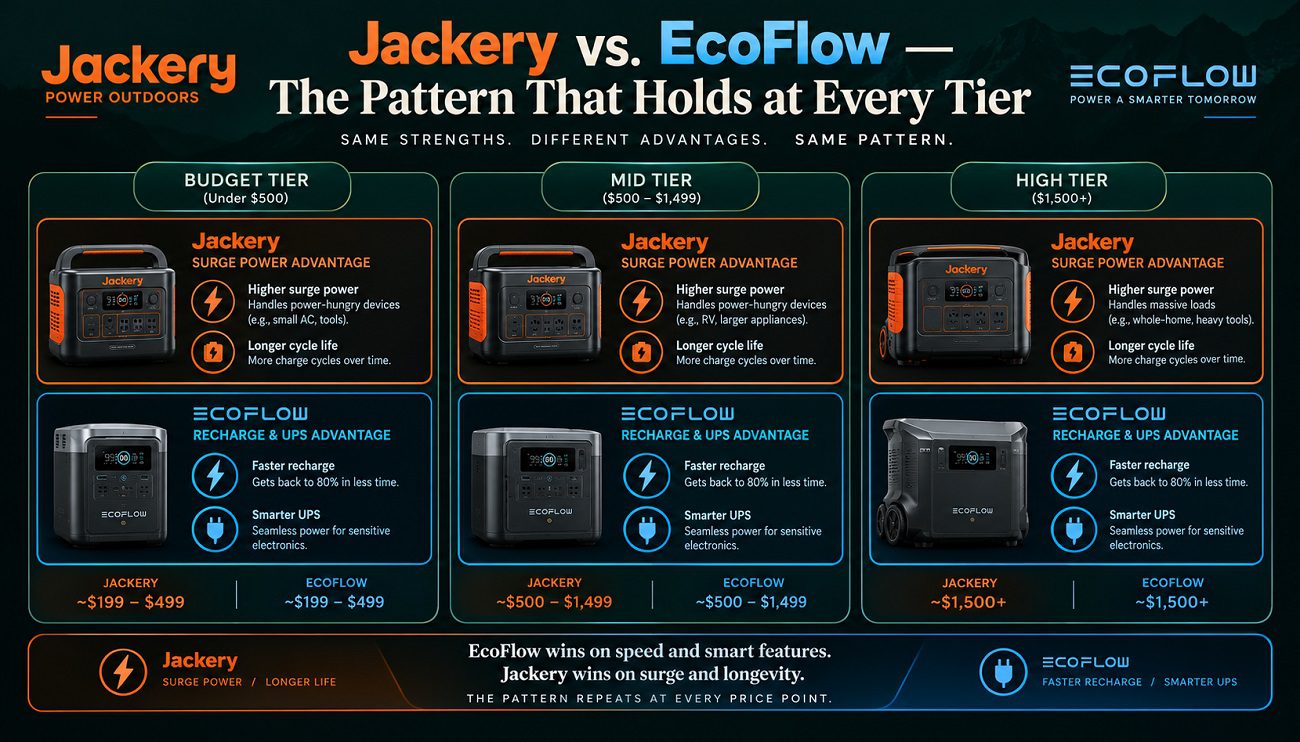
They are not interchangeable. They are built around two different engineering priorities, and once you see the pattern, it holds consistently across every capacity tier: Jackery optimizes for longevity and surge headroom. EcoFlow optimizes for recharge speed and smart integration. Neither priority is wrong — they just serve different buyers.
INFO: Before comparing brands, calculate your own household’s critical load — the right brand depends on your specific appliances, not a general preference. See the complete appliance wattage database: https://portablepowerlab.com/how-many-watts-does-every-home-appliance-use/
The Core Philosophy Difference
Jackery — Built for the Decade-Long Investment
Across every capacity tier Jackery sells, two numbers stay consistently ahead of EcoFlow’s equivalent: cycle count (4,000 cycles on the Plus series, versus EcoFlow’s typical 3,000) and surge rating (routinely 4,000-6,000W at tiers where EcoFlow’s standard lineup sits at 2,700W).
The trade-off: Jackery’s recharge speed consistently trails EcoFlow’s by roughly double, and no Jackery unit at any tier offers UPS/EPS pass-through mode — a feature available across EcoFlow’s entire current lineup.
EcoFlow — Built for Speed and Smart Integration
EcoFlow’s defining advantage is recharge speed — its X-Stream charging technology delivers 0-80% in 50 minutes across multiple capacity tiers, roughly half the time Jackery’s equivalent units take. EcoFlow also leads decisively on smart features: the most refined app in the industry, UPS pass-through mode with sub-30ms switchover, and — at the Delta Pro Ultra tier — native 240V output and whole-home Smart Panel automation that Jackery has no current equivalent for.
Head-to-Head by Capacity Tier
Budget Tier — EcoFlow River 2 vs. Jackery Explorer 300 Plus
| Spec | EcoFlow River 2 | Jackery Explorer 300 Plus |
|---|---|---|
| Capacity | 256Wh | 288Wh |
| Surge | 600W | 600W |
| Recharge | ~60 min | ~120 min |
| UPS Mode | ✅ Yes | ❌ No |
| Weight | 7.7 lbs | 7.5 lbs |
| Price (approx.) | ~$199 | ~$249 |
At this tier, the River 2’s UPS pass-through and faster recharge make it the stronger pick for most buyers — the full breakdown, including van life storage dimensions and offline app testing, is in the dedicated comparison.
Full budget-tier comparison: https://portablepowerlab.com/ecoflow-river-2-vs-jackery-explorer-300-plus/
Mid Tier — EcoFlow Delta 2 vs. Jackery Explorer 1000 Plus
| Spec | EcoFlow Delta 2 | Jackery Explorer 1000 Plus |
|---|---|---|
| Capacity | 1,024Wh | 1,264Wh |
| Continuous Output | 1,800W | 2,000W |
| Surge | 2,700W | 4,000W |
| Recharge (0-80%) | ~50 min | ~108 min |
| Cycle Rating | 3,000 | 4,000 |
| Warranty | 5 years | 3 years |
| UPS Mode | ✅ Yes | ❌ No |
| Price (approx.) | ~$699 | ~$949 |
This is the tier where the philosophy split is clearest. The Delta 2 recharges in roughly half the time and includes UPS mode — genuinely valuable for rolling outages and router/desktop protection. The Jackery 1000 Plus’s 4,000W surge is the deciding factor the moment a ½ HP sump pump or 8,000 BTU window AC enters the picture — the Delta 2’s 2,700W surge is borderline for both.
The deciding question: Do you have a high-surge appliance (sump pump, large AC, power tools)? If yes, Jackery. If your loads are standard (fridge, lights, devices, medical equipment), the Delta 2’s speed and UPS mode make it the better everyday choice.
Buy the EcoFlow Delta 2 → | Buy the Jackery Explorer 1000 Plus →
High Tier — EcoFlow Delta 2 Max vs. Jackery Explorer 2000 Plus
| Spec | EcoFlow Delta 2 Max | Jackery Explorer 2000 Plus |
|---|---|---|
| Capacity | 2,048Wh | 2,042Wh |
| Continuous Output | 2,400W | 3,000W |
| Surge | 2,700W | 6,000W |
| Recharge | ~100 min | ~120 min |
| Cycle Rating | 3,000 | 4,000 |
| Weight | 43 lbs | 47.2 lbs |
| Price (approx.) | ~$1,099 | ~$1,499 |
At matched capacity, the gap widens in Jackery’s favor on raw power delivery — 6,000W surge versus 2,700W is not a marginal difference, it’s the gap between starting a table saw or ¾ HP sump pump and not being able to. EcoFlow closes some of that gap on weight (4 lbs lighter) and remains the faster-charging option, but at this tier the Jackery’s surge advantage is large enough that it’s the clearer overall pick unless portability or recharge speed specifically outweighs it for your use case.
Buy the EcoFlow Delta 2 Max → | Buy the Jackery Explorer 2000 Plus →
Scaling Capacity — Which Brand Is Cheaper to Expand
For buyers planning to grow capacity over time rather than buying their ceiling upfront, the expansion battery economics differ meaningfully between the two brands.
| Brand | Expansion Module | Added Capacity | Cost | Cost Per Wh |
|---|---|---|---|---|
| EcoFlow (Delta 2 / Delta 2 Max) | EcoFlow Delta 2 Extra Battery | 1,024Wh | ~$449 | ~$0.44/Wh |
| Jackery (Explorer 2000 Plus) | Jackery Battery Pack 2000 Plus | 2,042Wh | ~$799 | ~$0.39/Wh |
Jackery’s expansion economics come out slightly ahead on a pure cost-per-watt-hour basis, and its module adds roughly double the capacity in a single purchase — relevant if you want to reach a higher total capacity in fewer transactions rather than incrementally. EcoFlow’s smaller module size offers more granular scaling if you want to add capacity in smaller increments rather than committing to a larger jump each time.
The practical difference at scale: Reaching roughly 4,000Wh total capacity costs approximately $1,698 with one Jackery expansion module added to the 2000 Plus, versus approximately $2,196 for the equivalent EcoFlow path (base Delta 2 Max plus three Extra Battery modules) — a real, non-trivial gap if you’re planning to scale toward whole-home capacity over time.
Beyond Jackery’s Current Ceiling — EcoFlow Delta Pro and Delta Pro Ultra
Jackery’s current lineup tops out at the Explorer 2000 Plus. EcoFlow extends meaningfully further, with the Delta Pro (3,600Wh, 7,200W surge) and the Delta Pro Ultra (6,144Wh, 7,200W continuous, native 240V output, whole-home Smart Panel integration) occupying a tier Jackery doesn’t currently compete in at all. If your capacity need exceeds roughly 2,000Wh, the comparison stops being Jackery-vs-EcoFlow and becomes a question of how much EcoFlow capacity you need.
See the Complete Delta Pro Ultra + Smart Home Panel II System →
Full Delta Pro Ultra review: https://portablepowerlab.com/ecoflow-delta-pro-ultra-review/
The One Feature Gap That Applies at Every Tier — UPS Mode
This is worth stating plainly rather than burying in a spec table: no Jackery unit, at any capacity tier currently sold, offers UPS/EPS pass-through mode. Every EcoFlow unit in the current lineup does, with switchover times ranging from roughly 20-30 milliseconds depending on the model.
For buyers specifically wanting to protect a router, desktop computer, or home office setup with always-on battery buffering — the station stays plugged into the wall continuously, switching to battery in milliseconds if grid power fails — this single feature makes EcoFlow the only option between these two brands, regardless of which tier you’re shopping in.
The home office protection bundle: Pair the EcoFlow River 2 or Delta 2 with a short, low-profile extension cord to keep your desk setup tidy, and a basic surge protector strip for the devices themselves.
Buy a Short Heavy-Duty Extension Cord → | Buy a Surge Protector Power Strip →
See the complete transfer switch and whole-home integration comparison: https://portablepowerlab.com/how-to-wire-transfer-switch-portable-power-station/
Charging Acoustics — The Trade-Off Behind EcoFlow’s Speed Advantage
EcoFlow’s 50-minute recharge is a genuine advantage, but speed and silence are physically in tension during AC charging — converting more energy in less time generates more heat, and heat requires active cooling. This is not a guess: EcoFlow’s own app includes a dedicated Quiet Charging Mode specifically because standard-speed charging on their units is loud enough to warrant an alternative. Toggling it on trades recharge speed for a near-silent fan profile — roughly tripling charge time in exchange for meaningfully less noise, useful for overnight charging in a bedroom or small space.
Jackery’s charging speed is fixed — there is no equivalent quiet-mode toggle, for better or worse. The unit charges at one rate with one fan profile regardless of time of day or noise sensitivity.
The practical takeaway: If you’re charging during the day in a garage or utility room, EcoFlow’s speed advantage is close to a pure win. If you’re charging overnight in a bedroom — particularly relevant for CPAP users relying on the same unit — EcoFlow requires you to actively trade away some of that speed advantage via Quiet Mode to get a comparable noise profile to Jackery’s fixed, moderate charging sound.
See the complete Quiet Charging Mode testing and fan noise data: https://portablepowerlab.com/ecoflow-river-2-vs-jackery-explorer-300-plus/
Battery Chemistry — No Difference Between the Brands
Both Jackery and EcoFlow use LiFePO4 chemistry across their entire current lineups — this is not a differentiator between the two brands the way it can be when comparing against brands with mixed NMC/LiFePO4 lineups (like Goal Zero’s entry-tier units).
| Chemistry | Rated Cycles | Daily-Use Lifespan |
|---|---|---|
| Jackery (Plus series) | 4,000 | ~11 years |
| EcoFlow (current lineup) | 3,000 | ~8.2 years |
The cycle count gap (4,000 vs 3,000) is real and consistent across tiers, but both numbers represent genuinely long-lived LiFePO4 chemistry — this is a difference in degree, not a difference in kind.
Complete chemistry comparison: https://portablepowerlab.com/lifepo4-vs-nmc-vs-nca/
Which Brand Should You Choose
Choose Jackery If:
- You have a sump pump, large window AC, or power tools — surge rating matters more than recharge speed for your use case
- You want the longest rated cycle life.
- You prioritize simplicity — Jackery’s interface is consistently the easiest to operate for first-time users and seniors
- Recharge speed is a secondary concern (you’re not dealing with frequent rolling outages)
Choose EcoFlow If:
- You want UPS pass-through mode for router, desktop, or home office protection
- Fast recharge matters — rolling outages, frequent camping trips, or simply not wanting to wait 2 hours to top off
- You want the most refined app experience, including Quiet Charging Mode and granular discharge settings
- Your capacity need exceeds 2,000Wh, where EcoFlow’s Delta Pro and Delta Pro Ultra extend well beyond Jackery’s current ceiling
Frequently Asked Questions
Is Jackery or EcoFlow better overall?
Neither is categorically better — they optimize for different priorities. Jackery leads on surge capacity, cycle life, and warranty length at every tier. EcoFlow leads on recharge speed, app sophistication, and UPS mode availability. The right choice depends on whether your critical appliances need high surge (favor Jackery) or your use case benefits more from fast recharge and always-on protection (favor EcoFlow).
Which brand has a longer-lasting battery?
Jackery’s Plus series carries a 4,000-cycle rating versus EcoFlow’s typical 3,000 cycles — roughly 11 years of daily use versus 8.2 years. Both figures represent genuinely long-lived LiFePO4 chemistry; the gap is real but both brands are built for the long term compared to older NMC-chemistry competitors.
Does EcoFlow or Jackery charge faster?
EcoFlow, consistently and by a wide margin. Its X-Stream charging technology delivers 0-80% in approximately 50 minutes at multiple capacity tiers — roughly half the time Jackery’s equivalent units require.
Can I use Jackery and EcoFlow solar panels interchangeably?
No — each brand uses its own proprietary solar connector as the default, though adapters are available for most third-party and cross-brand panels. Check the specific connector type for your unit before purchasing solar panels from a different brand.
Solar Panel Compatibility — Check Your Specific Model Before Ordering.
Both brands use proprietary solar input connectors as their default, and — this is the detail that matters more than which exact connector each brand uses — the specific connector type varies by model generation within each brand’s own lineup, not just between brands. A connector guide that confidently states “Jackery uses X, EcoFlow uses Y” risks being wrong the moment either brand updates a product line, which both have done before.
The reliable approach: Before ordering any third-party or cross-brand solar panel, check the exact input port on your specific unit — model number, not just brand name — against the panel’s output connector. Most portable panels ship with, or can be paired via, a widely available adapter (MC4-to-barrel, XT60-to-barrel, and similar combinations are all commonly sold), so compatibility is almost always solvable with a $10-15 adapter cable — the risk isn’t incompatibility, it’s ordering the wrong adapter because you assumed a connector type instead of checking it.
Buy a Universal Solar Connector Adapter Kit
Browse Jackery Power Stations on Amazon
Browse EcoFlow Power Stations on Amazon
The Lab’s Verdict
The pattern holds remarkably consistently across every capacity tier these two brands compete in: Jackery wins on surge headroom and cycle life. EcoFlow wins on recharge speed, app refinement, and UPS mode availability. Neither brand is the universal right answer — the right answer depends on whether your home has a sump pump sitting in the basement waiting for the next heavy rain, or whether you’re more likely to need your router to survive a three-second blink without rebooting.
Charging acoustics guidance reflects this site’s previously documented EcoFlow Quiet Charging Mode testing. Solar connector compatibility guidance intentionally avoids asserting a single fixed connector-to-brand mapping, since connector types vary by specific model generation within both brands’ lineups and an overly confident mapping risks inaccuracy as product lines update. Expansion battery pricing cross-referenced against this site’s previously verified figures from the Anker Solix vs. EcoFlow Delta 2 comparison and Jackery Explorer 2000 Plus coverage.
Match the brand to your actual appliances, not to brand loyalty.
See the Complete Best Overall Power Station Picks
Portable Power Lab — Real Math. No Fluff. Independent since 2025.