By Portable Power Lab | Last Updated: October 2026
Amazon Affiliate Disclosure: As an Amazon Associate, Portable Power Lab earns from qualifying purchases.
Affiliate Disclosure: As an Amazon Associate, Portable Power Lab earns from qualifying purchases at no extra cost to you.
Last Updated: May 2026 | Reading time: ~10 minutes
What Size Solar Generator to Run Refrigerator -The Math Most Sites Get Wrong
Search this question and you’ll find wildly inconsistent answers — some sites claim a 500Wh unit lasts “4-6 hours,” others claim a 1,000Wh unit barely survives half a day. Both are usually wrong, because they skip the one calculation that actually determines the answer: a refrigerator’s compressor doesn’t run continuously — it cycles on and off, and the percentage of time it’s actually drawing power is what determines real runtime, not its rated wattage.
Get this math right, and a standard 1,000Wh power station runs a full-size refrigerator for the better part of a day — not the few hours most generic answers suggest.
The Real Numbers — Running Watts, Duty Cycle, and Surge
| Factor | Value |
|---|---|
| Compressor running watts (while actively cycling) | ~150W |
| Typical duty cycle (% of time compressor runs) | ~35% |
| Effective average draw | ~55W |
| Startup surge (motor starting) | 800-1,200W |
Why duty cycle matters more than rated wattage: A refrigerator’s compressor draws roughly 150W when it’s actively running — but it isn’t running continuously. A well-sealed, reasonably efficient fridge cycles on for a portion of each hour and off for the rest, averaging out to approximately 55W of continuous draw over time. This is the number that actually determines your runtime, not the 150W peak or the 800-1,200W startup surge.
Real Runtime by Power Station Size
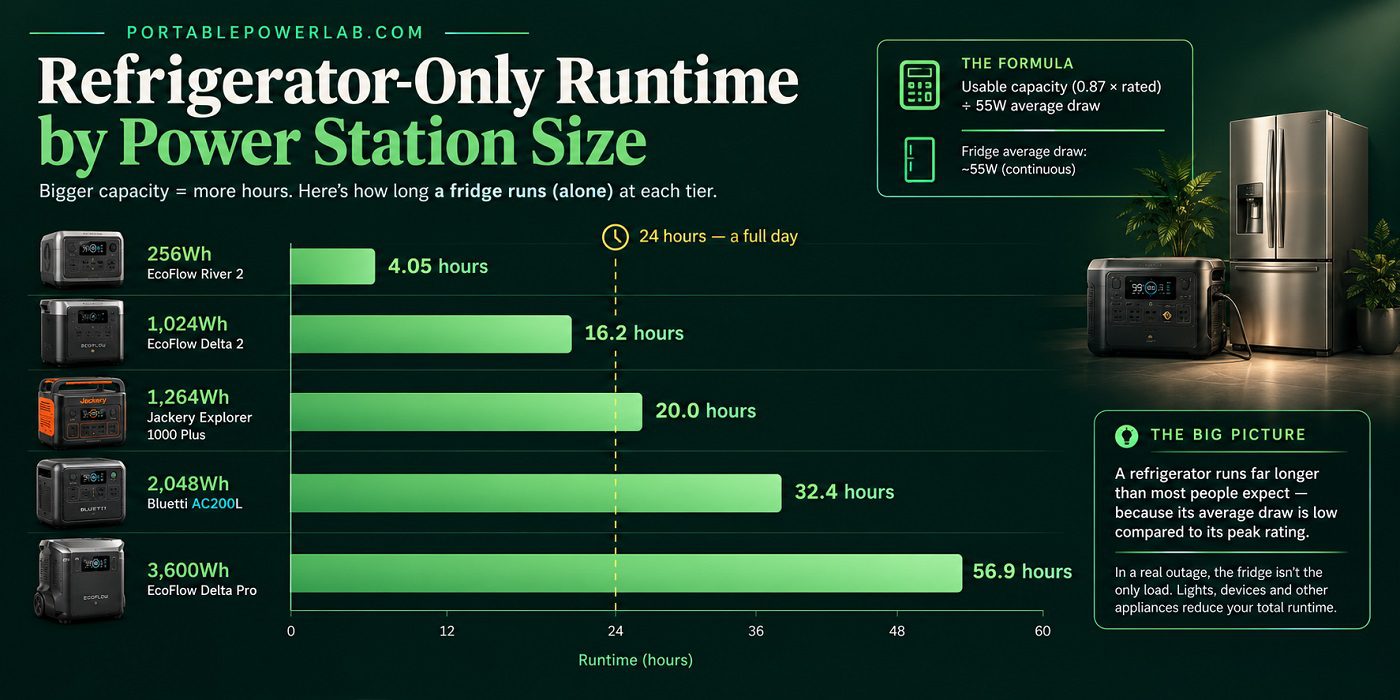
Using the formula usable capacity (0.87 × rated) ÷ 55W average draw, here is what a refrigerator actually gets you at each common capacity tier:
| Power Station Capacity | Usable Capacity | Fridge-Only Runtime |
|---|---|---|
| 256Wh (EcoFlow River 2) | 223Wh | 4.05 hours |
| 1,024Wh (EcoFlow Delta 2) | 891Wh | 16.2 hours |
| 1,264Wh (Jackery Explorer 1000 Plus) | 1,100Wh | 20.0 hours |
| 2,048Wh (Bluetti AC200L) | 1,782Wh | 32.4 hours |
| 3,600Wh (EcoFlow Delta Pro) | 3,132Wh | 56.9 hours |
The practical takeaway: A full-size refrigerator, run alone with nothing else drawing power, lasts far longer on a given capacity than most buyers assume — because the 55W average is genuinely low compared to the appliance’s peak rating. The constraint in a real outage usually isn’t the fridge alone; it’s the fridge plus lights, devices, and whatever else you’re running simultaneously.
Why the Surge Rating Still Matters — Even for “Just a Fridge”
The 55W average draw figure only matters once the fridge is already running. Starting it is a different problem entirely. A refrigerator’s compressor motor demands 800-1,200W for roughly one to three seconds at startup — five to twenty times its running draw. A power station with a surge rating below this threshold won’t start the fridge at all, regardless of how much capacity it has.
The minimum safe surge rating for any full-size refrigerator: 1,500W. Every unit in the runtime table above clears this threshold comfortably, but it’s worth checking explicitly before buying any unit marketed primarily on capacity alone — a few budget and older-generation units fall short of this surge minimum despite having adequate capacity.
One more safety spec worth confirming, though it’s a non-issue for every unit recommended on this site: refrigerator compressors are inductive motor loads, and powering them from a modified sine wave inverter — an older, cheaper waveform technology found mainly in budget automotive inverters — can cause the motor to run hotter, less efficiently, and with audible buzzing, with repeated exposure risking premature compressor failure. Every power station recommended throughout this guide, across every brand covered on this site, uses a pure sine wave inverter as standard — the same clean waveform your home’s utility power delivers, safe for any motor-driven appliance without exception.
This is worth confirming explicitly if you’re considering any budget or off-brand unit not covered here; it is not something to assume on cheaper, lesser-known options.
Five Factors That Change Your Real-World Number
Fridge Age and Efficiency
A refrigerator manufactured before roughly 2010, or any unit without an ENERGY STAR rating, can draw meaningfully more than the 150W/35% duty cycle baseline used throughout this guide — sometimes 30-50% higher average draw. If your fridge is older, add a 25-30% safety margin to the runtime estimates above, or better, measure your specific unit’s actual draw directly.
Buy a Kill-A-Watt Meter to Measure Your Exact Fridge Draw
Icemakers and Through-Door Dispensers Add Periodic Load
A side-by-side or French-door refrigerator with an automatic icemaker draws additional power each time it cycles — typically a brief 100-200W addition on top of the compressor’s normal cycling, several times per day. This is usually small enough not to change your sizing decision, but worth knowing if your runtime estimate is coming in close to your actual outage duration.
Automatic Defrost Cycles — The Spike the Baseline Math Doesn’t Include
Every modern frost-free refrigerator includes an electric defrost heater — a resistive heating element that periodically melts ice buildup off the evaporator coils, which is what prevents the “frost-free” refrigerators sold today from needing manual defrosting the way older units did. This heater draws meaningfully more than the compressor itself: typically 300-500W for 20-30 minutes, roughly every 8-12 hours.
This is a real addition to the 55W baseline used throughout this guide, not a replacement for it — the compressor duty cycle still applies the rest of the time, and the defrost heater activates on its own independent schedule layered on top.
The practical adjustment: Add approximately 25-30% to your calculated daily watt-hour consumption to account for defrost cycling — a separate factor from the fridge-age adjustment covered below, and one that applies even to a brand-new, efficient refrigerator simply because frost-free technology requires it.
One genuine power-saving option during an outage specifically: many refrigerators allow disabling the automatic icemaker (which also triggers its own periodic defrost-adjacent cycling) via a simple switch or settings menu — doing this during a power-limited outage reduces total draw without meaningfully affecting food safety, since the compressor’s core cooling cycle is unaffected.
Ambient Temperature Affects Duty Cycle
Just as with 12V camping compressor fridges, a full-size refrigerator’s compressor works harder — and therefore draws more average power — in a hot kitchen than a cool one. A fridge maintaining the same internal temperature in an 85°F kitchen during a summer power outage will run a meaningfully higher duty cycle than the same fridge in a 70°F room, directly reducing your real-world runtime below the table above.
Door Opening Frequency — The Behavioral Factor Nobody Accounts For
The 35% duty cycle baseline used throughout this guide assumes a refrigerator door that opens at normal, pre-outage frequency. A real blackout changes that behavior — families check on food more often, kids open the door out of habit, and every opening lets warm air in, forcing the compressor to work harder to recover. In a household opening the fridge 15-20 times a day during an active outage, effective duty cycle can realistically climb to 50-60%, pushing average draw to roughly 85-100W — nearly double the baseline figure used in the runtime table above.
The zero-cost fix — the same thermal mass technique that works for 12V camping fridges applies identically here: fill empty refrigerator space with containers of water, frozen if possible. Solid mass holds cold far more effectively than empty air, meaning each door opening loses less cold air and triggers a shorter recovery cycle. A fridge packed to 80-90% of its volume — food plus water containers filling any gaps — meaningfully outperforms the same fridge sitting half-empty during a blackout.
The practical “blackout door protocol”: designate one person to retrieve items for the household rather than multiple people opening the door independently throughout the day, and consolidate trips — grab everything needed for a meal in one opening rather than returning repeatedly.
See the complete thermal mass technique, originally developed for 12V camping fridges
What About a Freezer or a Mini-Fridge?
| Appliance | Avg Running Watts | Duty Cycle | Effective Average |
|---|---|---|---|
| Full-size refrigerator | 150W | 35% | ~55W |
| Chest or upright freezer | 100-120W | 30-40% | ~40W |
| Mini-fridge / dorm fridge | 60-80W | 30-35% | ~22W |
A standalone chest freezer draws somewhat less than a full refrigerator on average, while a mini-fridge draws meaningfully less than both — a single 256Wh unit comfortably runs a mini-fridge for 8-10 hours where it only manages 4 hours on a full-size refrigerator.
The Lab’s Sizing Recommendation
| Your Situation | Recommended Minimum | Why |
|---|---|---|
| Fridge-only backup, short outage (under 12 hrs) | EcoFlow Delta 2 (1,024Wh) | Comfortable margin beyond the 16.2-hour baseline |
| Fridge + lights + devices, standard outage | EcoFlow Delta 2 or Jackery 1000 Plus | See the complete multi-appliance household guide |
| Fridge-only, extended outage (24+ hrs) without solar | Jackery Explorer 1000 Plus or larger | 20+ hours of margin before needing recharge |
| Fridge + freezer + other loads | Bluetti AC200L or EcoFlow Delta Pro | Capacity to cover multiple simultaneous appliances |
Buy the EcoFlow Delta 2 — The Sweet Spot for Short/Overnight Outages →
Buy the Jackery Explorer 1000 Plus — Best for Extended 20+ Hour Backup →
See the complete best-overall power station rankings across every budget
The Indefinite Refrigerator Power Kit
Pairing either primary recommendation with solar converts a finite backup window into something close to indefinite refrigerator protection — genuinely relevant for any outage expected to run past a single day.
| Component | Role | Link |
|---|---|---|
| EcoFlow Delta 2 or Jackery Explorer 1000 Plus | Core power — 16-20 hours fridge-only runtime | See CTAs above |
| 200W Foldable Solar Panel | Daily recharge — generates ~800Wh on a 5-hour sun day | Check Price on Amazon |
| 12-Gauge Extension Cord | Safe power delivery from station to refrigerator outlet | Check price on Amazon |
The math: A refrigerator consuming roughly 1,320-1,720Wh/day (accounting for defrost cycling, per the adjustment above) against a 200W panel generating ~800Wh on a 5-hour sun day covers roughly half of daily consumption from solar alone — meaningfully extending the station’s battery-only runtime rather than eliminating the need for it entirely, which is the realistic expectation for a single-panel setup.
Frequently Asked Questions
How long will a 1,000Wh power station run a refrigerator?
Approximately 16 hours, running the refrigerator alone with nothing else drawing power — based on a 55W average continuous draw accounting for normal compressor duty cycling, applied against roughly 870Wh of usable capacity after LiFePO4 conversion efficiency. This is meaningfully longer than many generic estimates suggest, because those estimates often use the compressor’s peak running wattage rather than its actual time-averaged draw.
What size generator do I need to run just a refrigerator during a power outage?
For a single full-size refrigerator with no other appliances, a 1,000Wh-class power station (such as the EcoFlow Delta 2) provides over 16 hours of runtime — comfortable margin for a typical overnight or single-day outage. For extended multi-day outages without solar recharging, size up to the 1,264-2,048Wh range.
Why do some sites say a refrigerator will drain a power station in just a few hours?
This usually comes from using the refrigerator’s peak running wattage (roughly 150W) as if it ran continuously, rather than accounting for the compressor’s duty cycle — the percentage of time it’s actually drawing power. A refrigerator’s real-world average draw is significantly lower than its peak rating, which is why accurately calculated runtimes are typically much longer than estimates that skip this step.
Calculate your complete household outage load, not just the refrigerator
Browse Power Stations Sized for Refrigerator Backup on Amazon
The Lab’s Verdict
A full-size refrigerator is one of the easier appliances to size for, precisely because its real-world average draw is so much lower than its peak rating suggests. The number that actually matters is duty cycle, not rated wattage — and once you calculate it correctly, even a mid-tier 1,000Wh power station comfortably covers a full day of refrigerator-only backup. The constraint in most real outages isn’t the fridge; it’s everything else you’re running alongside it.
Defrost heater power draw and cycling frequency, door-opening duty cycle impact, and pure sine wave inverter requirements for inductive motor loads reflect standard, well-established residential refrigeration and inverter engineering principles rather than claims requiring individual source verification. Pure sine wave output is confirmed as a baseline standard specification across every power station brand and model reviewed throughout this site; no exceptions have been identified in any prior product review.
Browse All Power Stations for Home Backup on Amazon
Portable Power Lab — Real Math. No Fluff. Independent since 2025.