By Portable Power Lab | Last Updated: January 2026
Amazon Affiliate Disclosure: As an Amazon Associate, Portable Power Lab earns from qualifying purchases.
Building a custom electrical system for a van is a nightmare. In this guide, we show you how to build the best portable power station for van life.
You have to deal with crimping wires, sizing fuses, buying expensive pure sine wave inverters, and drilling holes in your roof. If you mess up the math, you risk an electrical fire.
That is why in 2026, most van lifers are switching to the “No-Build” Power System.
You simply buy a portable power station, plug in your fridge and solar panels, and you are done. But not all batteries are built for the road. In a van, space is gold and charging speed is king (because you need to recharge quickly while driving between campsites).
We tested the top units to find the ones that fit under a bench seat but still pack enough punch to run a 12V fridge and a laptop 24/7.
The “Van Life” Criteria: How We Chose
Don’t just buy the biggest battery. For life on the road, you need three specific features that “home backup” users don’t care about.
1. Regulated 12V Output (The Fridge Saver)
- The Problem: 12V Fridges (like Dometic or Iceco) have a “Low Voltage Cutoff.” If your battery voltage drops slightly as it drains, an unregulated port will drop to 11V, causing your fridge to think the battery is dead. It shuts off, ruining your food, even if the battery has 40% left.
- The Solution: You must buy a power station with a Regulated 12V Port. This keeps the voltage steady at 12.8V – 13V regardless of battery level, ensuring your fridge runs until the battery is truly empty.
2. The “Coffee Shop” Charge Speed
- The Reality: On cloudy days, you might only have 1 hour of access to a wall outlet (at a gym, library, or coffee shop).
- The Requirement: You need a unit that hits 0-80% in under an hour. Old units that take 6 hours to charge are useless for van life.
3. “Stackable” Form Factor
- The Reality: In a van, every inch matters.
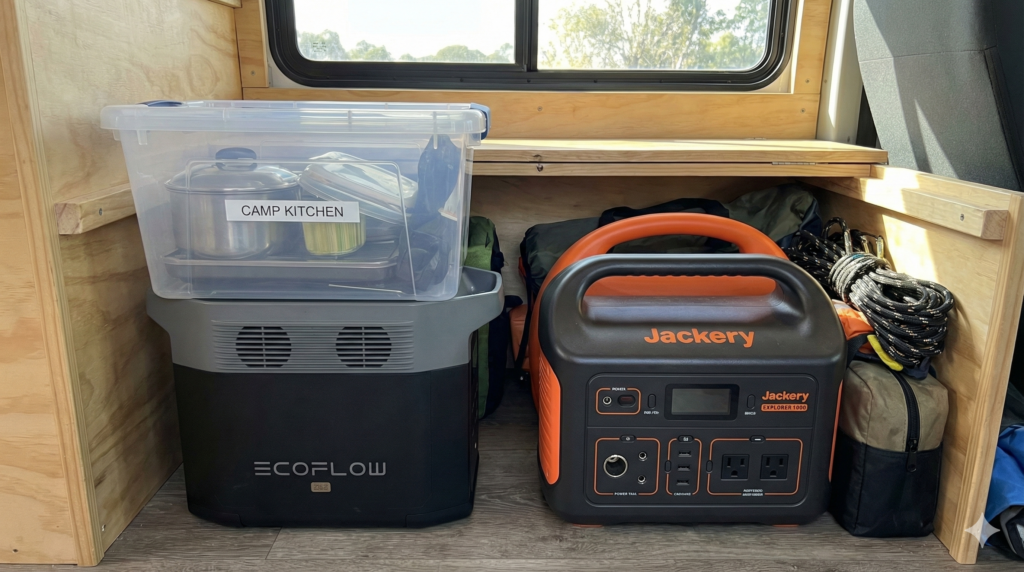
- The Requirement: We look for Flat Top designs. Rounded handles (like older Jackerys) are annoying because you can’t stack bins or gear on top of them in your “garage” area.
1. Best Overall for Van Life: EcoFlow Delta 2
The “Goldilocks” Size.
This is the most popular unit in the van life community for a reason. It balances size, power, and price perfectly.
- The “Stackable” Design: Unlike the Jackery, the Delta 2 has a flat top with handles that protrude to the side. You can easily slide this under a bed platform or stack a crate of gear on top of it.
- Fast Charging: It charges from 0-80% in 50 minutes via a wall outlet.
- Real World Use: You can stop for a quick lunch, plug it in, and have enough power for 2 days by the time you finish eating.
- Expandable: If you decide later that 1024Wh isn’t enough, you don’t have to sell it. You just plug in a Delta 2 Extra Battery to double your capacity to 2kWh.
- The Van Life Flaw: The fans can be loud during fast charging. If you are sleeping in a small van while charging, it might be annoying.

2. Best Heavy Duty (Cooking & AC): Bluetti AC200L
The “Full Replacement” System.
If you want to run an Induction Cooktop, a blender, or a hair dryer, the Delta 2 isn’t enough. You need the massive inverter of the Bluetti AC200L.
- The RV Cheat Code: This unit has a built-in 30A RV Port (NEMA TT-30).
- Why this is huge: You can plug your entire van’s shore power cable directly into this unit. It instantly powers your van’s existing outlets, lights, and water pump without any adapters.
- Cooking Power: With 2400W of output, it can easily handle a 1500W induction burner or a microwave.
- LiFePO4 Longevity: Rated for 3,000+ cycles. It will outlast your van.
- The Downside: It is a beast. It weighs 63 lbs. You are not moving this around often. It needs a dedicated spot on the floor.

3. Best “Budget” Weekend Setup: Bluetti EB70S
Small, Mighty, and Cheap.
If you are just doing weekend trips in a minivan or SUV and just need to charge phones, a laptop, and maybe run a small fan, you don’t need to spend $1,000.
- Capacity: 716Wh (LiFePO4).
- Design: It is compact and boxy (easy to store). It has a built-in LED light which is great for reading in bed.
- Regulated 12V: Yes, it has a regulated DC port, so it will run a small 12V fridge efficiently.
- The Flaw: The “brick” charger is bulky and slow compared to EcoFlow. It takes 3-4 hours to charge. But for the price, it is the best entry-level option.

4. Best for “Rugged” Overlanders: Jackery Explorer 1000 v2
The Dust & Dirt Survivor.
If your van life involves 4×4 trails, dust, and dirt, the Jackery is built better for abuse.
- Durability: The casing is one solid piece with rubberized seals. It handles vibrations and dust significantly better than the rigid plastic of the Bluetti.
- Solar Simplicity: If you rely on portable solar panels (not roof-mounted), Jackery’s system is easier. The connectors are simple, and the panels set up in seconds.
- The Update: The “v2” model now supports fast charging, fixing the biggest complaint about the old Jackery units.
- The Form Factor: It still has the handle on top. Great for carrying, bad for stacking.

Critical Lab Insight: Charging While Driving (The Alternator Trick)
The biggest struggle in van life is charging while you drive. You have a massive generator under the hood (your engine), but using it is tricky.
Method A: The Cigarette Lighter (Slow)
- How it works: You plug the power station into your car’s 12V socket.
- The Problem: Most sockets are limited to 100 Watts.
- The Math: To charge a 1000Wh battery (like the Delta 2), it will take 10+ hours of driving. That is too slow for most travelers.
Method B: The Alternator Charger (Fast)
- The Solution: Devices like the [EcoFlow 800W Alternator Charger] connect directly to your van’s starter battery.
- The Speed: It pumps 800 Watts into your battery while you drive.
- The Result: You can charge your Delta 2 from 0-100% in just 1.5 hours of driving. This is a game-changer for “No-Build” setups.
The Math: What Size Do You Actually Need?
Do not guess. Use our average consumption numbers for a standard Van Life setup (Fridge + Laptop + Lights).
| Appliance | Avg Watts | Hrs/Day | Daily Wh Needed |
| 12V Fridge (Dometic) | 35W (Cycling) | 24 | ~350Wh – 500Wh |
| Laptop (MacBook) | 60W | 4 | ~240Wh |
| LED Lights / Fan | 10W | 5 | ~50Wh |
| Phone Charging | 10W | 2 | ~20Wh |
| TOTAL | ~800Wh / Day |
Lab Recommendation:
- For 1 Day of Autonomy: Get a 1000Wh unit (EcoFlow Delta 2).
- For 2+ Days (or Induction Cooking): Get a 2000Wh unit (Bluetti AC200L).
FAQ: Van Power
Q: Can I leave these plugged into my cigarette lighter 24/7?
A: Be careful. Most modern vans turn off the cigarette lighter when the engine is off. However, some older vans (Ford E-Series, older Chevy Express) leave the socket “hot.” If you leave your power station plugged in overnight, it will drain your van’s starter battery, and you will be stranded. Always unplug when parked unless you have verified your socket turns off.
Q: Does cold weather affect these batteries?
A: Yes. LiFePO4 batteries (Delta 2 / Bluetti) generally cannot charge below freezing (32°F / 0°C). The BMS (Battery Management System) will block charging to protect the cells.
- Van Life Tip: If you camp in winter, keep the battery inside the heated living space, not in the uninsulated garage.
Q: Can I use solar panels mounted on my roof?
A: Yes! You just need an adapter cable (usually MC4 to XT60 for EcoFlow, or MC4 to 8mm for Jackery) to run the wires from your roof rack down to the unit.
Final Verdict
- The Best All-Rounder: Buy the EcoFlow Delta 2. It charges the fastest, fits in tight spaces, and has the best app for monitoring your power levels from the driver’s seat.
- The “Power User”: Buy the Bluetti AC200L. The 30A RV plug makes it the ultimate hub for bigger vans with existing wiring systems.