Affiliate Disclosure: As an Amazon Associate, Portable Power Lab earns from qualifying purchases at no extra cost to you. We only recommend products we’ve analyzed with real data.
Last Updated: April 2026
⚡ Top Picks At-A-Glance (Skip to Full Reviews Below)
Not sure where to start? The table below shows our top picks by use case. Scroll down for the complete math-based analysis on each.
| Generator | Best For | Capacity | Runtime* | Surge | Price | Amazon |
|---|---|---|---|---|---|---|
| EcoFlow Delta 2 | Most families | 1,024Wh | 3.9 hrs | 2,700W | ~$649–$899 | Check Price → |
| Jackery 1000 Plus | Sump pump homes | 1,264Wh | 4.8 hrs | 4,000W | ~$899–$999 | Check Price → |
| Anker Solix C1000 | Rolling outages | 1,056Wh | 4.0 hrs | 4,000W | ~$799–$999 | Check Price → |
| Bluetti AC200L | Extended outages | 2,048Wh | 7.8 hrs | 4,800W | ~$1,299–$1,499 | Check Price → |
| EcoFlow Delta Pro | Whole-home backup | 3,600Wh | 13.8 hrs | 7,200W | ~$2,499–$3,000 | Check Price → |
| Jackery 300 Plus | Apartments / light use | 288Wh | 2.5 hrs | 600W | ~$199–$299 | Check Price → |
Runtime based on 230W average load (fridge cycling + lights + devices). See full calculation method below.
Here’s what nobody tells you when you’re standing in the dark at 2 AM with a flashlight, wondering if the groceries in your fridge are still safe.
That solar generator you saw advertised — the one that claims it’ll “run a refrigerator for 10 hours”? Under actual real-world conditions, accounting for efficiency loss, your fridge’s cycling behavior, and the devices you’re inevitably also running? It might run half that.
This is the guide that fixes that problem.
🔗 Before buying anything: Use our Complete Appliance Wattage Guide → to calculate your exact power needs. This is the prerequisite to making the right purchase.
🎯 Power Station Brand Finder
Answer 5 questions. Get a specific brand and model recommendation — based on the same criteria our analysts use.
Why Most “Best Generator for Outages” Articles Get It Wrong
The majority of roundup articles rank products by specs alone: battery capacity, inverter output, recharge time. These are important. But they miss the question every homeowner actually has: “Will this keep my food from spoiling and my family comfortable for 8+ hours?”
Answering that question requires three things almost no article does:
- Apply a real efficiency factor (LiFePO4 delivers ~87% of rated capacity, not 100%)
- Model actual appliance behavior (your fridge runs 30–40% of the time, not 100%)
- Account for simultaneous loads (you’re not just running one thing during an outage)
We do all three. Every runtime estimate below is calculated — not copied from a brochure.
The Lab’s Outage Scenario: What Real Families Actually Run
For a fair comparison, we modeled a realistic 8-hour overnight outage with the following load:
| Appliance | Running Watts | Actual Average Draw | Notes |
|---|---|---|---|
| Full-size Refrigerator | 150W | 55W | Cycles 30–40% of time |
| 10 LED Lights | 100W | 100W | On full time |
| Phone Charging (2 phones) | 30W | 20W | Average over 8 hours |
| WiFi Router | 15W | 15W | Always on |
| Laptop | 65W | 40W | 60% of time |
| Total Average Load | — | ~230W | Realistic baseline |
🏆 The 6 Best Solar Generator for Power Outages in 2026
1. EcoFlow Delta 2 — Best Overall for Most Families
→ Check Current Price on Amazon

Specs that matter:
- Battery capacity: 1,024Wh (LiFePO4)
- Continuous AC output: 1,800W | Peak: 2,700W
- Real-world efficiency: ~87% | Usable: ~890Wh
- Solar input: Up to 500W
Runtime calculation (230W scenario):
890Wh ÷ 230W = 3.9 hours without solar
Add a 220W solar panel during daylight (6 hours of decent sun = ~1,100Wh input), and the Delta 2 becomes a near-indefinite daytime backup system.
Handles the startup surge? Refrigerator (900–1,200W startup): Yes. 5,000 BTU window AC (1,350W startup): Yes. 8,000 BTU AC (2,000W+ startup): Borderline — test before relying on it. ½ HP sump pump (2,400W startup): No. See sump pump guide →
The verdict: For a family running fridge, lights, devices, and a CPAP machine, the Delta 2 is the gold standard.
See our full EcoFlow Delta 2 review including fan noise data
2. Jackery Explorer 1000 Plus — Best for LiFePO4 Longevity + Sump Pumps
→ Check Current Price on Amazon

Specs that matter:
- Battery capacity: 1,264Wh (LiFePO4)
- Continuous: 2,000W | Peak: 4,000W
- Real-world efficiency: ~88% | Usable: ~1,112Wh
- Solar input: Up to 800W | Charge cycles: 4,000
Runtime calculation (230W scenario):
1,112Wh ÷ 230W = 4.8 hours without solar
What separates this from the Delta 2: The 4,000W surge rating handles a ¾ HP sump pump (2,250–3,300W startup) — something the Delta 2 can’t claim. For flood-prone homes, this surge capacity is essential.
Jackery Explorer 1000 Plus full review
🛒 Jackery Explorer 1000 Plus on Amazon →
3. Anker Solix C1000 Gen 2 — Best for Rolling Outages
→ Check Current Price on Amazon
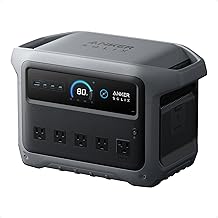
Specs that matter:
- Battery capacity: 1,056Wh (LiFePO4)
- Continuous: 2,000W | Peak: 4,000W
- Recharge from 0–80%: 49 minutes (fastest in class)
- Solar input: Up to 1,200W
Runtime calculation: 919Wh ÷ 230W = 4.0 hours without solar
The rolling outage advantage: If grid power returns for 30 minutes, the C1000 Gen 2 charges faster than anything in its class. During rolling outages (power on/off repeatedly), this is a strategic win no other unit matches.
🛒 Anker Solix C1000 on Amazon →
4. Bluetti AC200L — Best for Extended Outages
→ Check Current Price on Amazon
Specs: 2,048Wh | 2,400W continuous | 4,800W surge | 900W solar input
Runtime (230W): 1,802Wh ÷ 230W = 7.8 hours without solar
Runtime with 5,000 BTU AC added (680W total): 1,802Wh ÷ 680W = 2.6 hours of fridge + AC + everything else
For Southeastern US homeowners during hurricane season, or anyone in the Midwest during winter ice storms, the AC200L is the right size.
5. EcoFlow Delta Pro — Best for Whole-Home Critical Backup
→ Check Current Price on Amazon
Specs: 3,600Wh | 3,600W continuous | 7,200W surge | 1,600W solar
Runtime (230W): 3,168Wh ÷ 230W = 13.8 hours without solar
Bonus capability: Connects to your home’s circuit panel via a Transfer Switch, powering specific circuits throughout your home without extension cords.
🛒 EcoFlow Delta Pro on Amazon →
6. Jackery Explorer 300 Plus — Best for Apartments & Light Backup
→ Check Current Price on Amazon
Specs: 288Wh | 300W continuous | LiFePO4
Runtime (phones + router only = ~25W): 250Wh ÷ 25W = 10+ hours
Apartment dwellers: See our complete guide — Best Power Station for Apartments → — which covers building lease restrictions, UPS router backup, and balcony solar options.
🛒 Jackery Explorer 300 Plus on Amazon →
📊 Side-by-Side Comparison: All 6 Solar Generators
| Generator | Capacity | Surge | Runtime (230W) | Recharge Speed | Solar Input | Warranty |
|---|---|---|---|---|---|---|
| EcoFlow Delta 2 | 1,024Wh | 2,700W | 3.9 hrs | ~80 min | 500W | 2 years |
| Jackery 1000 Plus | 1,264Wh | 4,000W | 4.8 hrs | ~108 min | 800W | 3 years |
| Anker Solix C1000 | 1,056Wh | 4,000W | 4.0 hrs | 49 min | 1,200W | 2 years |
| Bluetti AC200L | 2,048Wh | 4,800W | 7.8 hrs | ~2 hrs | 900W | 2 yrs (+5 w/ reg.) |
| EcoFlow Delta Pro | 3,600Wh | 7,200W | 13.8 hrs | ~2.5 hrs | 1,600W | 2 years |
| Jackery 300 Plus | 288Wh | 600W | 2.5 hrs | ~2 hrs | 80W | 3 years |
Updated Comparison Table with App Monitoring Column
| Generator | Capacity | Surge | Runtime | Recharge | Solar | App Quality | Warranty |
|---|---|---|---|---|---|---|---|
| EcoFlow Delta 2 | 1,024Wh | 2,700W | 3.9 hrs | ~80 min | 500W | ⭐⭐⭐⭐⭐ | 2 years |
| Jackery 1000 Plus | 1,264Wh | 4,000W | 4.8 hrs | ~108 min | 800W | ⭐⭐⭐⭐ | 3 years |
| Anker Solix C1000 | 1,056Wh | 4,000W | 4.0 hrs | 49 min | 1,200W | ⭐⭐⭐⭐ | 2 years |
| Bluetti AC200L | 2,048Wh | 4,800W | 7.8 hrs | ~2 hrs | 900W | ⭐⭐⭐⭐⭐ | 2 yrs (+5 reg) |
| EcoFlow Delta Pro | 3,600Wh | 7,200W | 13.8 hrs | ~2.5 hrs | 1,600W | ⭐⭐⭐⭐⭐ | 2 years |
| Jackery 300 Plus | 288Wh | 600W | 2.5 hrs | ~2 hrs | 80W | ⭐⭐⭐ | 3 years |
📱 App & Remote Monitoring: Why It Matters During a Real Outage
In an emergency, you shouldn’t have to walk across the house to check how much battery you have left. A quality app turns your power station into a real-time dashboard you can monitor from your phone — and during a 12-hour outage, that information changes how you manage your energy budget.
EcoFlow App — Best in Class
Platform: iOS / Android | Connection: Bluetooth (local) + WiFi (remote)
What it shows:
- Real-time input/output wattage in watts (not just a % estimate)
- Precise runtime countdown at current load
- Battery temperature
- Individual charging source contribution (solar vs. AC vs. car)
What you can control:
- AC output on/off
- DC output on/off
- Charging speed (Quiet Mode for nighttime use — reduces fan noise significantly)
- Charge limit (50–100%): The critical battery preservation setting — keep at 80% for daily storage
- Discharge limit: Set a floor of 20% to protect long-term battery health
- Solar panel input details
Outage use case: During a 10-hour outage, you open the EcoFlow app, see 891Wh remaining at 215W load, and the app calculates 4.1 hours of runtime. You decide to unplug the laptop (65W savings) and the app instantly recalculates to 5.6 hours. This is active energy management — something no display-only unit enables.
🛒 EcoFlow Delta 2 (best app in class) →
Jackery App — Clean and Reliable
Platform: iOS / Android | Connection: Bluetooth (local)
What it shows:
- Battery percentage (large, clear display)
- Estimated runtime countdown
- Input/output wattage
- Charging status
What you can control:
- Power on/off remotely
- Charge limit setting (important for daily storage at 80%)
- Fan mode
Limitation: Bluetooth-only — no remote monitoring when you’re not near the unit. For home backup use (you’re in the same house), this isn’t a meaningful limitation.
🛒 Jackery Explorer 1000 Plus →
Bluetti App — Best Technical Depth
Platform: iOS / Android | Connection: Bluetooth + optional WiFi module
What it shows:
- Cell-level battery voltage (the only major brand with this transparency)
- Battery temperature
- Precise state of health percentage
- Real-time input/output breakdown
What you can control:
- Granular charge limit (10% increments from 30–100%)
- Discharge limit
- UPS pass-through mode scheduling
- Grid charge timing (charge during off-peak electricity rates)
Best for: Technically-minded users who want full system transparency and are using the power station as a semi-permanent home backup installation.
Anker Solix App — Good, Getting Better
Platform: iOS / Android | Connection: Bluetooth + WiFi (built-in on C1000)
What it shows:
- Real-time power flow visualization
- Battery status and runtime
- Solar input data
Standout feature: The Anker app has the best real-time power flow visualization — a live diagram showing exactly how power is moving between solar input, battery, and output loads. Intuitive for non-technical users.
App Verdict for Outage Use
| Priority | Best App | Reason |
|---|---|---|
| Most features + remote monitoring | EcoFlow | WiFi, charge limit, real-time wattage |
| Best technical depth | Bluetti | Cell-level monitoring, granular controls |
| Simplest to use | Jackery | Clean UI, easy for non-technical family members |
| Best power flow visualization | Anker | Live diagram format is intuitive |
🛡️ Warranty & US-Based Customer Support Comparison
For a $600–$3,000 purchase, warranty and support quality matter enormously. Here’s what you’re actually getting:
| Brand | Standard Warranty | Extended Warranty | US Support Quality | Community Size |
|---|---|---|---|---|
| EcoFlow | 2 years | 5 years (paid plan) | ⭐⭐⭐⭐ — Active US team, fast email response | Very large |
| Jackery | 3 years | N/A | ⭐⭐⭐⭐⭐ — Widely praised US support center | Largest |
| Anker (Solix) | 2 years | N/A | ⭐⭐⭐⭐ — Anker’s overall excellent service reputation | Large |
| Bluetti | 2 years | 5 years (free registration) | ⭐⭐⭐⭐ — Improved significantly; strong tech community | Large |
| Goal Zero | 2 years | N/A | ⭐⭐⭐⭐ — Smaller team but quality interactions | Medium |
Lab Recommendation on warranty:
- Best standard warranty: Jackery (3 years, all models)
- Best long-term coverage: Bluetti (5 years free with registration)
- If post-purchase support anxiety is a concern, Jackery’s documented customer service track record is the strongest in the industry
🔗 Is battery power actually the right choice vs. a gas generator? See our 10-Year Cost of Ownership Comparison → — the $2,068 savings calculation may surprise you. Also: are these solar generators completely safe indoors? → Indoor Safety Guide (The CO Myth) →
🌞 How Solar Panels Change Everything
Solar charging rule of thumb:
Daily solar generation (Wh) = Panel wattage × Hours of usable sun × 0.80
- A 200W panel in Texas (5.5 hrs): 200 × 5.5 × 0.80 = 880Wh/day
- A 200W panel in Michigan (3.5 hrs, overcast): 200 × 3.5 × 0.80 = 560Wh/day
🛒 Best-Selling 200W Portable Solar Panels on Amazon →
🧰 Lab-Recommended Accessories for Every Outage Kit
Don’t buy just the generator — build a complete system:
| Accessory | Why You Need It | Link |
|---|---|---|
| 200W Foldable Solar Panel | Recharges generator during daylight | Amazon → |
| 12-Gauge Extension Cord (25ft) | Safe power delivery to distant appliances | Amazon → |
| Kill-A-Watt Meter | Measure your appliances’ exact wattage | Amazon → |
| CO Detector (if you also have gas backup) | Essential safety for any gas generator use | Amazon → |
How long will a 1,000Wh solar generator power a refrigerator?
Using real-world efficiency (~87%) and the fridge’s average cycling (30–40%), a modern full-size refrigerator draws about 50–80W average. A 1,000Wh unit delivers ~870Wh usable — running the fridge approximately 11–17 hours on fridge-only.
Can a solar generator run a whole house during an outage?
No portable unit can power an entire home. But the EcoFlow Delta Pro, connected to a transfer switch with solar panels, can sustain your most critical circuits for 12–24+ hours.
Is it safe to run a solar generator inside my home?
Yes. Unlike gas generators, battery-based solar generators produce zero emissions and are completely safe indoors. Read our complete indoor safety guide →