Affiliate Disclosure: As an Amazon Associate, Portable Power Lab earns from qualifying purchases at no extra cost to you.
Last Updated: May 2026 | Reading time: ~17 minutes
Two Completely Different Storms, One Confused Category
Winter storm power outage preparedness: Most winter storm preparedness content treats “winter storm power outage” as a single scenario. It isn’t. There are two fundamentally different mechanisms by which winter weather takes your power out, they fail on different timelines, they damage different infrastructure, and the right preparation for one is not automatically the right preparation for the other.
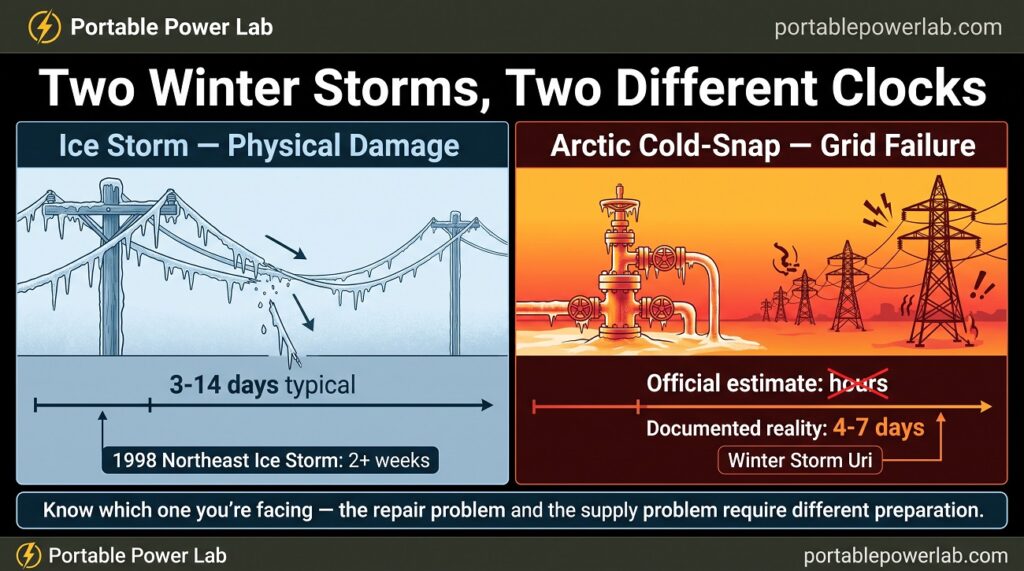
Ice storms cause physical, mechanical damage — freezing rain accumulates on power lines, poles, and tree branches until the sheer weight snaps them. This is a repair problem: utility crews have to clear debris, replace physical hardware, and restring lines, often across a wide, hard-to-access area.
Arctic cold-snap grid failures — the pattern behind Texas’s Winter Storm Uri in 2021 and the broader Winter Storm Elliott in 2022 — are a generation-capacity problem. Extreme cold freezes natural gas wellheads, pipelines, and processing equipment, taking power plants offline at exactly the moment heating demand spikes hardest. This is a supply problem, not a repair problem, and it can affect an entire regional grid simultaneously rather than being localized to physically damaged lines.
Understanding which one you’re facing — and in some storms, both simultaneously — changes how long you should realistically expect to be without power, and therefore how you should size your backup system.
INFO: This guide is the winter companion to our hurricane preparedness coverage. If you haven’t built your baseline emergency kit yet, start there: https://portablepowerlab.com/emergency-power-checklist/
How Long Will You Actually Be Without Power?
Ice Storms — The Physical Repair Timeline
Ice accumulation as thin as a quarter inch can snap tree limbs and pull down power lines. Documented restoration guidance puts typical ice storm outages at 3 to 14 days, because crews must physically clear fallen debris, replace snapped poles, and restring downed lines — work that cannot be shortcut by adding generation capacity the way a fuel-supply problem can.
The physics behind why this takes so long: Just half an inch of ice on a power line adds weight roughly equivalent to a baby grand piano hanging on that line. That load doesn’t just strain the line — it brings down the trees around it too, and utility crews frequently cannot even begin electrical repairs until the fallen trees and debris are cleared first. In one documented 2025 Michigan ice storm, conditions were dangerous enough that crews could not begin restoration work of any kind until the third day of the event.
Historical reference point: The 1998 Northeast ice storm — with ice accumulation up to 4 inches in the hardest-hit areas of northern New York and southeastern Canada — left millions without power, some for longer than two weeks, with full recovery efforts stretching into weeks and, for the hardest-hit communities, months.
Recent reference point: Winter Storm Fern in January 2026 left more than one million customers without power at its peak, with Tennessee alone recording over 300,000 customers in a blackout — a useful, current-generation reminder that this is not a rare, once-a-decade risk.
Arctic Cold-Snap Grid Failures — The Supply Timeline
Winter Storm Uri (February 2021) is the defining modern example. As sub-freezing temperatures gripped Texas, natural gas production fell nearly 45% statewide as unweatherized wellheads, pipelines, and processing equipment froze. Gas-fired power plants — which provide the majority of Texas’s generation capacity — lost fuel at the exact moment heating demand peaked. The result: over four million households lost power, many for days, in dangerous sub-freezing conditions.
The expectation-versus-reality gap is the critical data point here. The official outage estimate when rolling blackouts began was measured in hours. The reality for many Texas households was four to seven consecutive days without power in temperatures that made homes genuinely uninhabitable. Over 240 people died, the majority from hypothermia.
Winter Storm Elliott (December 2022) followed a similar pattern at a different regional scale: natural gas plants accounted for more than 70% of unplanned generation outages across the PJM grid territory during the Christmas week event, forcing emergency conservation measures across a multi-state region.
The structural lesson: Arctic cold-snap failures can affect an entire regional grid simultaneously, are driven by fuel and generation capacity rather than physical line damage, and — critically — official early outage estimates during these events have proven unreliable. Plan around the documented reality (multi-day), not the initial official estimate (hours).
The Cold Weather Battery Penalty — Sizing for Reality, Not the Spec Sheet
This is the section every other winter storm guide skips, and it is the single most important technical adjustment specific to winter preparedness on this site.
LiFePO4 batteries — the chemistry used in every power station recommended throughout this site — lose meaningful usable capacity as temperature drops. This is not a defect; it is basic electrochemistry, and it applies to every brand equally.
| Temperature | LiFePO4 Capacity Retention |
|---|---|
| 32°F (0°C) | ~90% |
| 14°F (-10°C) | ~75% |
| -4°F (-20°C) | ~60% |
| -22°F (-30°C) | ~45% |
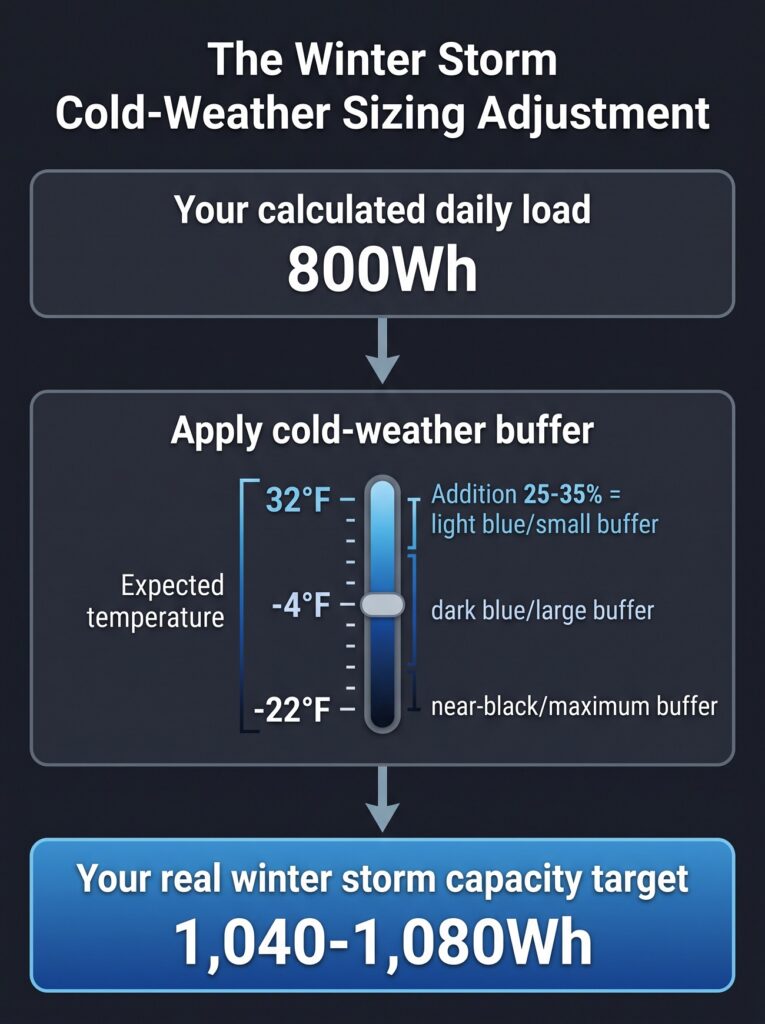
The practical sizing rule: In any climate where winter storm temperatures reach 14°F or below — a realistic scenario across most of the northern two-thirds of the country during an arctic cold-snap event — size your power station 25-35% larger than your calculated daily load to account for cold-weather capacity loss alone, before factoring in the extended restoration timelines documented above.
Critical charging restriction: LiFePO4 batteries cannot safely charge below 32°F — attempting to do so risks permanent lithium plating damage to the cells. Quality battery management systems block charging automatically below this threshold. This means a power station left in an unheated garage or vehicle during a winter storm may discharge normally but refuse to recharge from solar or AC power until it warms back above freezing — a genuine operational constraint unique to winter events.
Self-Heating Batteries — Which Units Actually Have This, and Which Don’t
The sub-32°F charging lockout described above is a real limitation for standard power stations. A small number of premium units solve it with a built-in battery heater — but this feature is far less common than it might seem, and getting the specific models right matters for anyone shopping with this exact constraint in mind.
How it works: An internal heater pre-warms the battery cells above freezing using a small amount of the unit’s own stored power before accepting a charge, enabling safe charging in conditions where a standard unit would simply refuse input until manually warmed. This typically consumes roughly 5-10% of battery capacity per warming cycle — a real but modest cost for the capability.
Which units actually have this feature, verified against manufacturer specifications:
| Power Station | Internal Heater | Min Charge Temp (No Heater) | Min Charge Temp (With Heater) |
|---|---|---|---|
| EcoFlow Delta Pro Ultra | ✅ Yes | 32°F (0°C) | -4°F (-20°C) |
| Bluetti AC300 | ✅ Yes (optional module) | 32°F (0°C) | 14°F (-10°C) |
| Jackery Explorer 3000 Pro | ✅ Yes | 32°F (0°C) | 14°F (-10°C) |
| Jackery Explorer 1000 Plus | ❌ No | 32°F (0°C) | — |
| EcoFlow Delta 2 | ❌ No | 32°F (0°C) | — |
| Anker Solix C1000 | ❌ No | 32°F (0°C) | — |
| Bluetti AC200L | ❌ No | 32°F (0°C) | — |
| EcoFlow River 2 | ❌ No | 32°F (0°C) | — |
The important correction: None of the mainstream, frequently-recommended units on this site — the EcoFlow Delta 2, Anker Solix C1000, Jackery Explorer 1000 Plus, or Bluetti AC200L — include an internal battery heater. This is a premium-tier feature currently limited to the EcoFlow Delta Pro Ultra and a small number of other high-end units. If sub-freezing charging capability is a genuine requirement for your specific winter climate — not just discharge, but active charging during the storm itself — this narrows your realistic options considerably, and it is worth confirming directly against current manufacturer specifications before purchasing, since this is exactly the kind of feature list that changes as product lines update.
For every other unit on this site: the correct approach remains what this guide already recommends — keep the unit in heated living space throughout the event, and if it must be moved to an unheated space temporarily, allow it to fully warm to room temperature before attempting to charge it.
Buy the EcoFlow Delta Pro Ultra (built-in cold-weather charging)
The storage protocol: Keep your primary power station inside heated living space throughout a winter storm event, not in a garage, shed, or vehicle. If it must be moved to an unheated space temporarily, allow it to warm to room temperature before attempting to charge it.
See the complete cold weather performance data across every temperature range
Generator Cold-Start Realities — What Actually Fails, and Why
For households relying on a gas standby generator rather than, or alongside, a battery system, winter cold introduces specific and well-documented mechanical vulnerabilities distinct from the fuel-supply story above.
The Four Documented Residential Cold-Start Failure Points
Battery cold-cranking failure. Freezing temperatures reduce a standard 12V starter battery’s cold-cranking amps below what the generator’s starter motor requires, preventing the engine from turning over — one of the most commonly reported real-world winter generator failures.
Engine oil thickening. Standard oil thickens in extreme cold, increasing engine drag at precisely the moment the starter battery is already compromised, compounding the cranking problem.
Propane tank pressure drop. Propane-fueled generators face a genuine, well-documented risk: propane pressure drops in sub-freezing temperatures, an effect that worsens with undersized tanks — a distinct vulnerability from natural gas.
Natural gas regulator freezing. Less common but real: the gas regulator itself can freeze during severe cold snaps, interrupting fuel delivery to an otherwise fully functional generator, separate from the pipeline-level production failures described in the Uri/Elliott section above.
The honest, documented conclusion: Natural-gas-connected standby generators have generally proven more resilient than the broader electrical grid during major winter events — during Uri, gas lines continued flowing in many areas even as the grid itself collapsed. The practical cold-weather risk for most standby generator owners is the battery-and-oil cold-start problem above, addressable through routine maintenance and, in genuinely extreme climates, a cold-weather battery or block heater accessory.
See the complete battery vs. gas generator comparison including this exact winter vulnerability analysis in full detail
The battery power station has no equivalent mechanical failure mode. No starter battery to cold-crank, no oil to thicken, no gas regulator to freeze. Its only cold-weather constraint is the capacity reduction and sub-32°F charging restriction covered above — a fundamentally different, and in most respects simpler, set of considerations.
Critical Load Priorities — The Winter-Specific Priority Flip
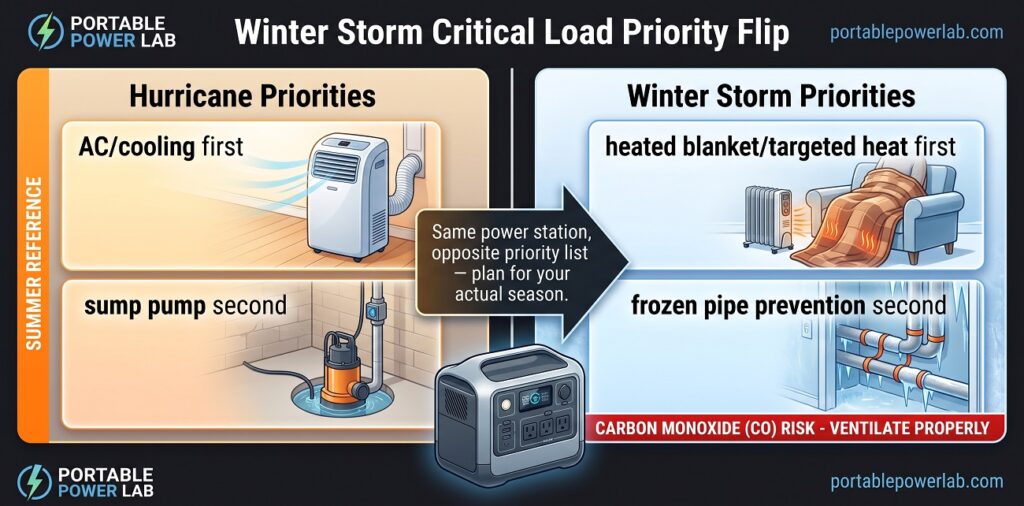
Hurricane season centers your priorities on cooling. Winter storms invert that completely.
Priority 1 — Heat, Not Cold
A multi-day outage in sub-freezing temperatures is a genuine hypothermia risk, particularly for elderly residents, infants, and anyone with a cardiovascular condition. The math favors targeted, efficient heating over trying to heat an entire home:
| Heating Option | Running Watts | Runtime on 1,024Wh (usable ~891Wh) |
|---|---|---|
| Electric heated blanket | 150W | ~5.9 hours |
| Small ceramic space heater (750W) | 750W | ~1.2 hours |
| Small ceramic space heater (1,500W) | 1,500W | ~0.6 hours |
The Lab rule: A 150W heated blanket delivers body-temperature warmth for roughly 5x longer than a 750W space heater on the same battery charge. Prioritize direct-to-body heating (heated blankets, layered bedding) over room heating whenever battery capacity is the binding constraint — the same efficiency logic our hurricane guide applies in reverse to cooling.
Priority 2 — Frozen Pipe Prevention
This is the one critical winter-specific risk with no hurricane equivalent, and it is frequently overlooked in power planning. A burst pipe from freezing can cause catastrophic water damage that costs far more to repair than any generator or power station.
Power-dependent pipe protection options:
- A furnace blower fan (even without full furnace heating capacity, circulating existing warm air helps) — typically 200-800W depending on system size
- Pipe heating cable/tape on the most vulnerable exposed runs — typically 3-8W per linear foot, a genuinely low-draw, high-value protective measure
- Simply maintaining minimal whole-home heating (even 55-60°F) rather than zone-heating one room, if pipes run through multiple areas of the home
The Zero-Power Contingency — What to Do If Your Battery Runs Out
Every power-dependent pipe protection method above assumes your power station still has charge. For a severe ice storm running toward the 1-2+ week end of the restoration range documented earlier in this guide, planning for the scenario where your battery depletes before power is restored is not pessimism — it is the same real-math discipline this entire site is built on.
The manual shutoff-and-drain protocol requires no electricity at all and is the standard professional winterization procedure used whenever a home will go without heat for an extended period:
- Locate your main water shutoff valve before the storm arrives — not during an emergency. It is typically near where the main line enters the home (basement, crawlspace, or a utility closet), or at the street-side meter box. Confirm you can operate it by hand; some older valves require a wrench.
- Shut off the main valve once it becomes clear your power station’s remaining charge cannot sustain pipe protection through the expected outage duration.
- Open every faucet in the house, hot and cold, starting with the highest fixtures in the home and working down to the lowest — this lets trapped water drain by gravity rather than sitting in the pipe under pressure, where freezing expansion causes the actual bursts.
- Flush every toilet once to clear the tank and bowl, which hold standing water that can freeze and crack porcelain even with the supply line shut off.
- For an extended vacancy in genuinely extreme cold, non-toxic RV/marine antifreeze poured into toilet bowls, tank traps, and sink P-traps prevents the remaining trap water from freezing and cracking those fixtures — inexpensive insurance against a much larger repair bill.
This protocol trades running water for pipe integrity — a trade worth making the moment your power budget can no longer support both heating and standard household water pressure through the remainder of a documented multi-week restoration event.
Buy Non-Toxic RV/Marine Antifreeze (Pipe & Trap Protection)
Priority 3 — Carbon Monoxide Risk Is Elevated, Not Just Present
CO poisoning deaths spike during winter storm outages specifically, for a grimly predictable reason: desperate for warmth, people make worse decisions about generator and heater placement than they would in a summer outage. Bringing a gas generator into a garage “just for a few minutes,” running a car in an attached garage to get warm, or using a camp stove for supplemental indoor heat are all documented causes of winter storm CO deaths.
The 1998 Northeast ice storm’s aftermath specifically documented carbon monoxide poisoning as one of the recurring causes of injury and death during the “unsafe practices” households turned to while trying to restore basic heat and light — a pattern that repeats in nearly every major winter outage event since.
A battery power station eliminates this risk category entirely — zero combustion, zero CO, safe in any enclosed space including directly beside your bed.
See the complete indoor safety guide, including why battery power carries none of this risk profile.
Sizing Your System — By Scenario
| Your Situation | Realistic Outage Range | Recommended Approach |
|---|---|---|
| Suburban/urban, minor ice accumulation, quick crew access | 1-3 days | 1,000-1,264Wh + cold-weather 25% capacity buffer |
| Rural or tree-heavy area, moderate ice storm | 5-8 days | 2,000Wh+ + solar (limited winter sun hours — see note below) |
| Arctic cold-snap grid failure event (Uri/Elliott-pattern) | 4-7 days, regional | 2,000-3,600Wh, prioritize targeted heating load over whole-home |
| Severe ice storm, downed lines, rural access-limited | 1-2+ weeks | 3,600Wh+ with expansion, natural-gas standby generator as primary if available |
Winter Solar Optimization — Angle and Snow Removal
Solar remains genuinely useful through winter — cold temperatures actually improve panel efficiency — but two physical factors specific to the season need active management to capture that potential.
Steepen your panel angle for the low winter sun. The sun sits meaningfully lower in the sky during winter months, and a panel angled for summer efficiency captures far less of that lower-angle light. As a general rule of thumb, tilt your panels significantly steeper for winter than you would for summer — commonly in the 45-60° range depending on your specific latitude, versus a flatter summer angle. Most portable panel kickstands support at least a partial angle adjustment; use the steepest setting available during winter deployment, and if you’re planning a semi-permanent rigid panel installation specifically for winter use, factor this angle difference into your mounting design from the start.
Clear snow and ice with the right tool, not the closest one. A dusted or ice-covered panel generates dramatically less power regardless of angle or sun hours — but the clearing method matters as much as doing it at all. Use a soft foam brush or squeegee designed for solar panels, never a metal scraper, stiff-bristle broom, or hard plastic tool. Both foldable ETFE-laminate panels and rigid glass panels can scratch under abrasive contact, and scratches reduce light transmission permanently — a self-inflicted efficiency loss that compounds every winter for the rest of the panel’s life. Clear from the top down using gentle downward strokes, and avoid using hot water to melt ice, which can cause thermal shock cracking on a cold panel surface.
Buy a Soft Foam Solar Panel Snow Removal Brush
See the complete tiered preparedness framework this sizing table is built on.
The Winter Storm Watch-to-Warning Countdown
Winter storm forecasting generally offers a shorter reliable warning window than hurricane forecasting — commonly 2-4 days of meaningful lead time versus a hurricane’s 5-day cone. Act accordingly.
3-4 Days Out — Winter Storm Watch
- Charge your power station to 100%, overriding any default 80% storage charge limit
- Confirm heated blankets, extra bedding, and any pipe heating cable are accessible and functional
- If relying on a standby generator, confirm the battery holds a proper charge and schedule pre-storm testing
24-48 Hours Out — Winter Storm Warning / Ice Storm Warning
- Bring your power station indoors to heated living space if it is not already there — cold-soaking before the storm even begins reduces your effective capacity from hour one
- Let taps drip slightly on the most exposed plumbing runs to reduce freeze risk
- Charge all secondary devices and power banks to 100%
- If a gas generator is your primary system, run it briefly under load to confirm cold-start reliability before you actually need it
During the Event
- Prioritize the heating-and-pipe-protection loads covered above over convenience loads
- Monitor official restoration estimates with appropriate skepticism — as the Uri data above demonstrates, early hour-based estimates during severe events have proven unreliable
- If using any combustion heat source as backup, follow strict CO safety protocol — never bring a generator indoors or into a garage under any circumstance, regardless of temperature desperation
The Complete Winter Storm Power Kit
The Essential Kit (Under $1,200)
| Item | Purpose | Link |
|---|---|---|
| EcoFlow Delta 2 or Jackery Explorer 1000 Plus | Core power, sized with cold-weather buffer | Check Price on Amazon |
| Electric Heated Blanket | Efficient targeted body heat | Check Price on Amazon |
| Pipe Heating Cable | Frozen pipe prevention, very low draw | Check Price on Amazon |
| Battery-Powered CO Detector | Non-negotiable safety layer | Check Price on Amazon |
Non-Toxic RV/Marine Antifreeze | Zero-power fixture protection if battery depletes | Check Price on Amazon |
The Extended Outage Kit ($1,500-$3,500)
| Item | Purpose | Link |
|---|---|---|
| Jackery Explorer 2000 Plus or EcoFlow Delta Pro | Higher capacity for extended ice storm scenarios | Check Price on Amazon |
| Expansion Battery Module | Extends runtime for multi-week restoration | Check Price on Amazon |
| Cold-Weather Battery Insulation Wrap | Reduces cold-soak capacity loss during storage | Check Price on Amazon |
| Soft Foam Solar Panel Snow Brush | Non-abrasive panel clearing — prevents permanent scratching | Check Price on Amazon |
| Adjustable Solar Panel Angle Stand | Enables the steep 45-60° winter tilt angle | Check Price on Amazon |
Frequently Asked Questions
How long does power typically stay out after an ice storm?
Documented restoration guidance places typical ice storm outages at 3 to 14 days, driven by the physical repair burden of clearing downed trees and replacing snapped poles and lines rather than a fuel or generation-capacity problem. Severe historical events, like the 1998 Northeast ice storm, saw restoration stretch beyond two weeks in the hardest-hit areas. This is a meaningfully different — and often longer — timeline than an arctic cold-snap grid failure event.
How long did power stay out during Winter Storm Uri?
The official outage estimate when Texas’s rolling blackouts began was measured in hours. The documented reality for many households was four to seven consecutive days without power in dangerous sub-freezing temperatures, as natural gas production fell nearly 45% statewide and gas-fired power plants lost fuel supply. Over 240 people died, primarily from hypothermia.
Do power stations lose capacity in cold weather?
Yes — this applies to every LiFePO4 power station regardless of brand. Capacity retention is approximately 90% at 32°F, dropping to roughly 75% at 14°F, 60% at -4°F, and 45% at -22°F. Charging below 32°F is unsafe and typically blocked automatically by the battery management system. Size your system 25-35% larger than your calculated need for any winter storm scenario reaching 14°F or below, and store the unit in heated living space throughout the event.
Is carbon monoxide risk worse during winter storms specifically?
Yes. CO poisoning deaths spike during winter storm outages because people under cold-weather duress make riskier decisions about generator and heater placement than they typically would otherwise — bringing generators into garages, running vehicles in attached garages for warmth, or using unsafe supplemental heat sources indoors. This pattern has been documented repeatedly, including during the aftermath of the 1998 Northeast ice storm. Battery power stations eliminate this risk entirely, since they produce zero combustion byproducts.
What should I do if my power station runs out during a multi-week ice storm?
Beyond conserving remaining charge for medical devices and communication, protect your plumbing with a zero-power fallback: shut off your home’s main water valve, open every faucet from the highest fixture down to the lowest to drain trapped water by gravity, and flush toilets to clear standing water from tanks and bowls. For extended vacancy in extreme cold, non-toxic RV antifreeze in toilet bowls and sink traps prevents freeze-cracking of those fixtures. This protocol requires no electricity and is the standard professional approach to protecting an unheated home’s plumbing.
Do any power stations have a built-in heater for cold-weather charging?
A small number of premium units do — confirmed models include the EcoFlow Delta Pro Ultra (charges down to -4°F), Bluetti AC300 with its optional heater module (14°F), and the Jackery Explorer 3000 Pro (14°F). The mainstream, frequently-recommended units on this site — including the EcoFlow Delta 2, Anker Solix C1000, Jackery Explorer 1000 Plus, and Bluetti AC200L — do not include this feature and require manual warming above 32°F before charging, consistent with standard LiFePO4 charging safety limits.
Browse Winter Storm Power Stations on Amazon
The Lab’s Verdict
Winter storm power preparedness fails most often because people treat “winter storm” as one scenario when it is genuinely two — a physical repair problem that takes days to weeks to fix by hand, and a regional supply-capacity problem that can affect millions of households simultaneously and has repeatedly proven official early estimates wrong.
Size for the documented reality, not the optimistic official estimate. Apply the cold-weather capacity buffer before you need it, not after your battery underperforms in the field. Prioritize targeted heat and frozen-pipe protection over trying to heat your whole home. And treat carbon monoxide risk as elevated, not merely present, during exactly the moments when cold-weather desperation makes people most likely to make an unsafe decision.
Read the Complete Cold Weather Performance Guide
Browse Cold-Weather-Ready Power Stations on Amazon
Portable Power Lab — Real Math. No Fluff. Independent since 2025.
SOURCING NOTE FOR PUBLISHER
Ice storm restoration timeline data sourced from PowerOutage.us storm preparedness guidance, the National Weather Service’s 25th-anniversary retrospective on the 1998 Northeast ice storm, and documented utility restoration reporting from 2025-2026 ice storm events (Michigan Country Lines, T&D World, Alpena News), May 2026. Winter Storm Uri and Elliott grid-failure data cross-referenced against the U.S. Energy Information Administration, the Union of Concerned Scientists’ gas plant failure analysis, and Survive Essentials’ documented household restoration timeline research, consistent with sourcing previously verified for this site’s EcoFlow Delta Pro Ultra vs. Generac comparison. Generator cold-start failure mechanisms verified against CT Generator Service’s documented cold-weather failure analysis. LiFePO4 cold-weather capacity retention figures consistent with this site’s existing cold weather performance guide. Historical death toll and economic figures represent documented public reporting on the referenced events.
Internal battery heater specifications cross-referenced against this site’s previously published and separately verified LiFePO4 power station comparison research, confirming heater availability is limited to the EcoFlow Delta Pro Ultra, Bluetti AC300 (optional module), and Jackery Explorer 3000 Pro among units commonly covered on this site — correcting a broader, less precise claim about heater availability across the EcoFlow and Anker product lines generally. Manual pipe-draining protocol reflects standard residential winterization practice. Solar panel winter tilt angle guidance reflects general solar engineering principles (steeper angle for lower winter sun elevation) rather than a single universal figure, since optimal angle varies by latitude.