Affiliate Disclosure: As an Amazon Associate, Portable Power Lab earns from qualifying purchases at no extra cost to you.
Last Updated: May 2026 | Reading time: ~17 minutes
The Timing Mistake That Ruins Most People’s Hurricane Prep
Hurricane Power Outage Preparedness: Every hurricane season follows the same pattern. A tropical system forms, the National Hurricane Center issues its first advisory, and for three or four days the cone of uncertainty wanders across a map while most people watch and wait. Then, roughly 48 hours before landfall becomes likely, everyone decides to prepare at once. Store shelves empty of batteries, water, and generators within hours. Amazon delivery windows stretch past the storm’s arrival. The power station that would have solved every problem sits in a warehouse instead of a living room.
This is not a failure of individual planning so much as a predictable, well-documented pattern — and it is entirely avoidable with the right information at the right time.
This guide exists to solve two problems most hurricane prep content ignores. First, most guides never answer the question that actually determines what you need to buy: how long will your specific power actually be out, based on your storm’s category and your location’s grid infrastructure? Second, almost nothing online translates a hurricane watch or warning into a concrete, hour-by-hour action countdown — leaving people to guess when “soon” actually means “now.”
INFO: This guide complements our general emergency preparedness resource. If you have not yet built your baseline emergency kit, start there: https://portablepowerlab.com/emergency-power-checklist/
How Long Will You Actually Be Without Power? The Real Data
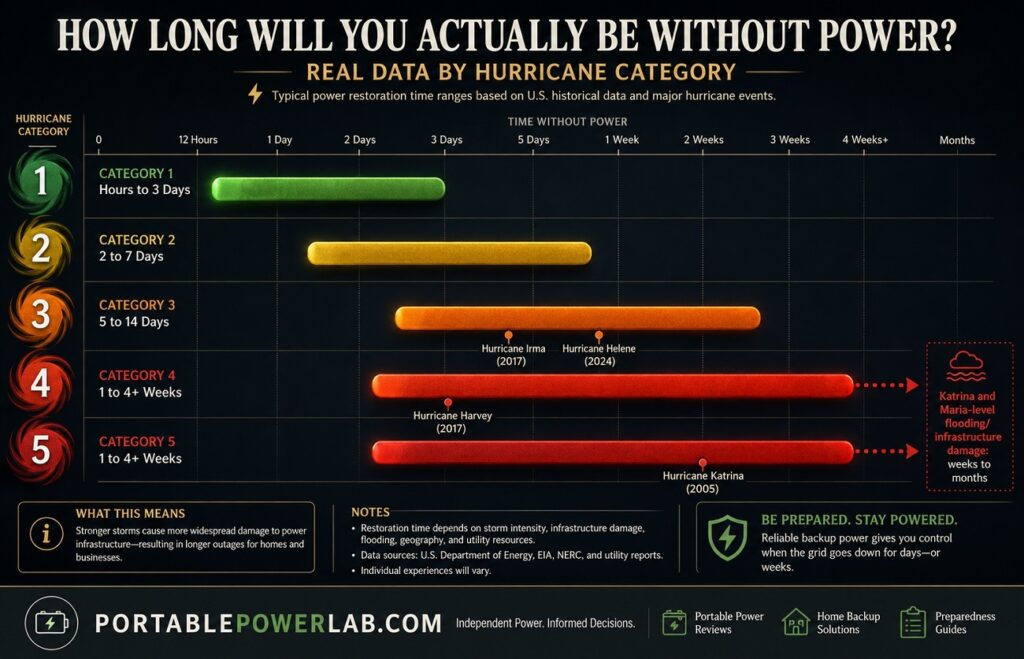
This is the single most important question in this entire guide, and it is the one number that should drive every purchasing decision that follows. Here is what documented restoration data from actual hurricanes shows — not marketing estimates, not worst-case fearmongering, but the real range you should plan around.
The General Pattern, By Storm Severity
Independent analysis of weather-related power outages shows a clear scaling relationship: minor wind events restore power in hours, while major hurricanes with extensive infrastructure damage can take one to four weeks for full restoration. Category 1 hurricanes (74+ mph sustained winds) typically produce scattered, localized outages. Category 3 and above (111+ mph sustained winds) typically produce regional blackouts that can extend for weeks in the hardest-hit areas.
Critically: over 90% of hurricane-related power outages last more than 24 hours, and a meaningful share extend well beyond a single week. Any preparedness plan built around “I’ll just wait it out for a few hours” is planning for the exception, not the rule.
Real Restoration Timelines From Actual Hurricanes
Rather than relying on general estimates, here is documented restoration data from specific, well-recorded storms — the kind of real-world evidence that should anchor your planning more than any generic guideline.
| Storm | Year | Category at Landfall | Documented Restoration Pattern |
|---|---|---|---|
| Hurricane Irma | 2017 | Cat 4 (Keys), Cat 3 (SW Florida) | Most Florida counties: ~3 days to restore 80% of customers. Ten rural north-central Florida counties: 7–8 days |
| Hurricane Harvey | 2017 | Cat 4 | Some areas restored within 2 days; others remained without power up to 3 weeks due to flooding and localized damage |
| Hurricane Ike | 2008 | Cat 2 | Texas residents reported outages ranging from several days to 3 weeks depending on location |
| Hurricane Katrina | 2005 | Cat 3 (at landfall) | Weeks-long outages in New Orleans due to catastrophic flooding damage to grid infrastructure |
| Hurricane Helene | 2024 | Cat 4 (Florida), weakening inland | South Carolina average restoration: approximately 53 hours |
| Hurricane Maria | 2017 | Cat 4 | Puerto Rico — the longest blackout in US history; some rural municipalities exceeded 120 days without power |
The Urban vs. Rural Gap — A Factor Almost Nobody Accounts For
Documented restoration data consistently shows a significant gap between urban and rural recovery times, independent of storm severity. Urban customers frequently see power restored within 24 to 48 hours after most storms, while rural customers — served by longer distribution lines with fewer redundant paths and lower crew-to-customer ratios — routinely wait several days to over a week longer for the same storm.
The practical planning implication: If you live in a dense suburban or urban area, your realistic worst-case outage for a moderate hurricane is likely measured in days. If you live in a rural area, on a barrier island, or served by an electric cooperative with limited crew resources, plan for the outage to run meaningfully longer than the same storm would produce for an urban neighbor thirty miles away.
The NHC Countdown — Translating a Watch or Warning Into Action
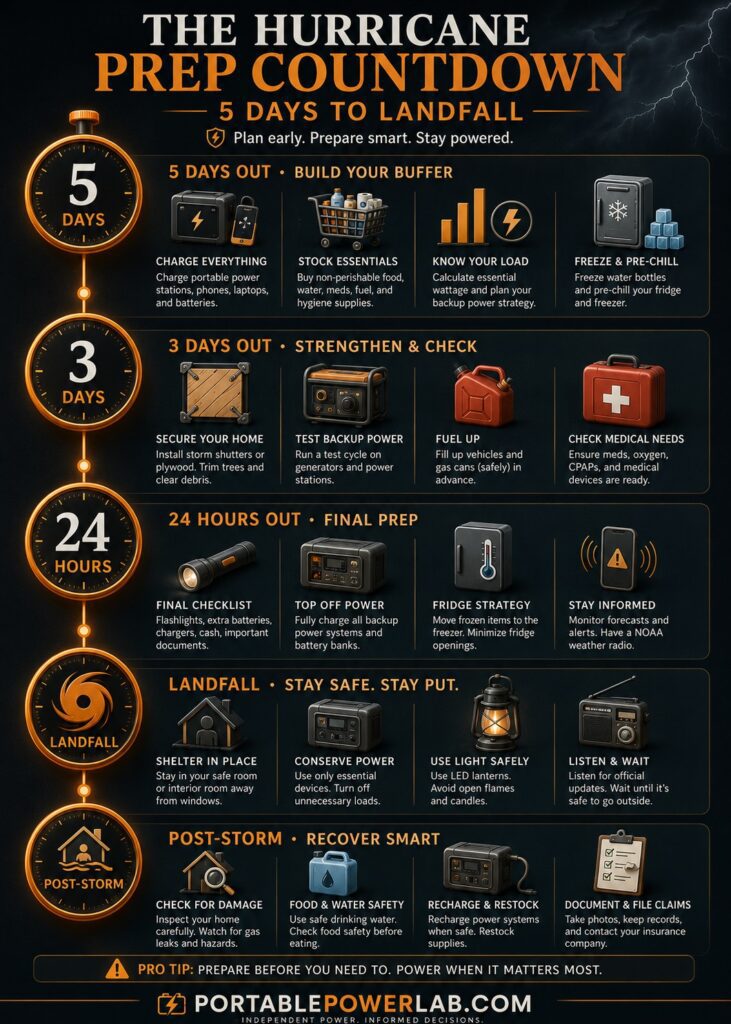
The National Hurricane Center’s forecast cone represents genuine, quantified uncertainty — even a well-forecast storm at 72 hours out carries a real margin of error in both track and intensity. Waiting for certainty means waiting until it is too late to act. This countdown framework translates standard NHC advisory milestones into concrete preparedness actions.
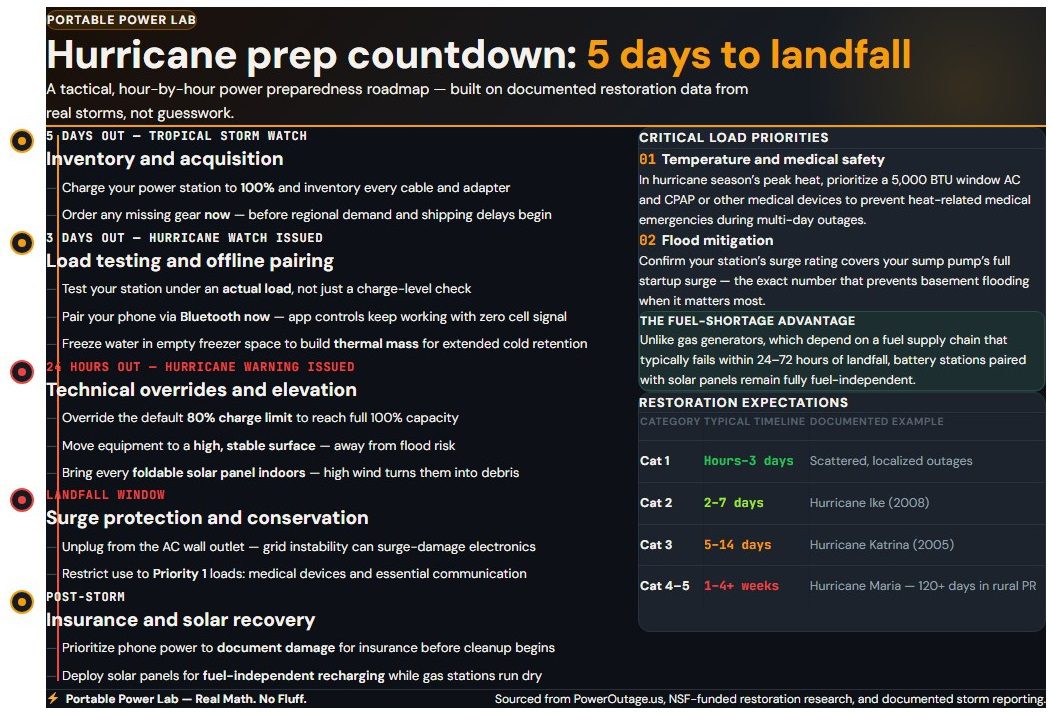
5 Days Out — Tropical Storm Watch or Early Advisory
- Confirm your power station is charged to 100% (this is the one time to override the usual 80% storage recommendation — see the pre-charge protocol below)
- Inventory your critical device list against your appliance wattage chart calculations
- Check that all cables, adapters, and extension cords are accounted for and functional
- If your power station or a needed accessory is not already owned, order now — this is before regional demand spikes and before shipping delays begin
3 Days Out — Hurricane Watch Issued
- Fully charge all secondary batteries, phone power banks, and backup devices
- Test your power station under an actual load (not just a charge-level check) to confirm it functions correctly
- Fuel any backup gas generator and review safe operating location — but see the section below on why battery power has a structural fuel-availability advantage in this exact window
- Begin freezing water in empty freezer space — ties directly into the thermal mass technique covered in our 12V fridge guide, and works identically for a standard chest or upright freezer to extend cold retention during an outage
- Test your power station under an actual load (not just a charge-level check) to confirm it functions correctly, and confirm your phone is paired to it via Bluetooth before you lose cell or WiFi service — see the offline control note below
Pro tip — offline app control: Cell towers and home internet both frequently fail during major hurricanes, which raises a reasonable concern: will you still be able to control your power station’s settings once that happens? For the units recommended throughout this site, the answer is yes. The EcoFlow and Jackery apps both connect via Bluetooth directly to the unit — not through the cloud or the internet — meaning charge limit adjustments, discharge floor settings, and real-time monitoring all continue working with zero cell signal or WiFi, as long as your phone is within Bluetooth range (roughly 30 feet) and was paired with the unit at some point beforehand. The only feature that genuinely requires an internet connection is firmware updates — irrelevant during an active outage. Pair your phone to your power station now, well before the storm, so the connection is already established when you need it.
24 Hours Out — Hurricane Warning Issued
- Position your power station in its final operating location — away from windows, on a stable elevated surface if storm surge or flooding is a risk in your area (see the flood protection section below)
- Set your power station’s app to disable the automatic charge-limit cap if one is normally set (many units default to an 80% daily storage limit for battery longevity — override this now to reach 100%)
- Charge all devices to 100%: phones, laptops, medical device batteries, radios
- Confirm your evacuate-or-shelter decision (see the framework below) — this determines which gear stays with you and which stays behind
- Bring all foldable solar panels indoors and fold flat for storage — do not leave any portable panel outside past this point, regardless of current conditions (see the complete panel wind safety protocol below)
Landfall Window — Storm Actively Passing
- Power station should already be positioned and connected; avoid moving or reconfiguring equipment during active high winds
- Keep the unit unplugged from any AC wall charging during active storm conditions if there is any risk of power surges from grid instability as the storm passes
- Conserve battery — this is not the window for non-critical loads
Solar Panel Wind Safety — When to Bring Them In
This guide emphasizes solar panels repeatedly as the post-storm recharging solution that gives battery power its structural advantage over gas. That advantage only exists if the panels themselves survive the storm — and this is a genuine physical safety issue this guide addressed too lightly on first pass.
Why Solar Panels Become Dangerous in High Wind
A folded or unfolded portable solar panel presents a large, lightweight, flat surface — exactly the shape that catches wind most efficiently and generates the most lift and drag force. At sustained winds as low as Category 1 hurricane strength (74+ mph), an unsecured panel left outside will not simply blow away. It becomes airborne debris capable of significant damage on impact — through a window, into a vehicle, or into a person. This is the same category of risk that drives standard hurricane guidance to secure or bring in patio furniture, trampolines, and other large lightweight outdoor items well before landfall; solar panels belong on that same list, and most hurricane prep content simply never mentions them in this context because portable solar is a relatively new category of household equipment.
Rigid roof-mounted panels (the type covered in our Delta Pro Ultra and preppers guides for permanent installations) are engineered and mounted specifically to withstand high wind loads and are not part of this specific warning — this section applies to foldable, portable panels that are not permanently secured to a structure.
The Panel Safety Protocol
By the 24-hours-out milestone in the countdown above: every foldable solar panel should be disconnected, fully folded, and brought entirely indoors — not left on a porch, balcony, or secured under any outdoor cover. No tie-down or weighting method reliably secures a lightweight foldable panel against sustained hurricane-force wind; indoor storage is the only genuinely safe option.
Do not redeploy panels until:
- The storm has fully passed through your specific location (confirmed by official advisory, not simply calm-seeming conditions in an eye passage — a hurricane eye produces temporary calm before winds resume from the opposite direction)
- Sustained wind speeds have dropped to a level generally considered safe for lightweight outdoor equipment — commonly cited general guidance is below roughly 20 mph sustained, though use your own judgment and official local guidance for your specific conditions
- You have visually inspected the deployment area for debris, downed lines, or standing water hazards
Buy on A,mazon – a Weatherproof Indoor Storage Case for Foldable Solar Panels
Evacuate or Shelter — The Decision That Changes Everything You Need to Buy
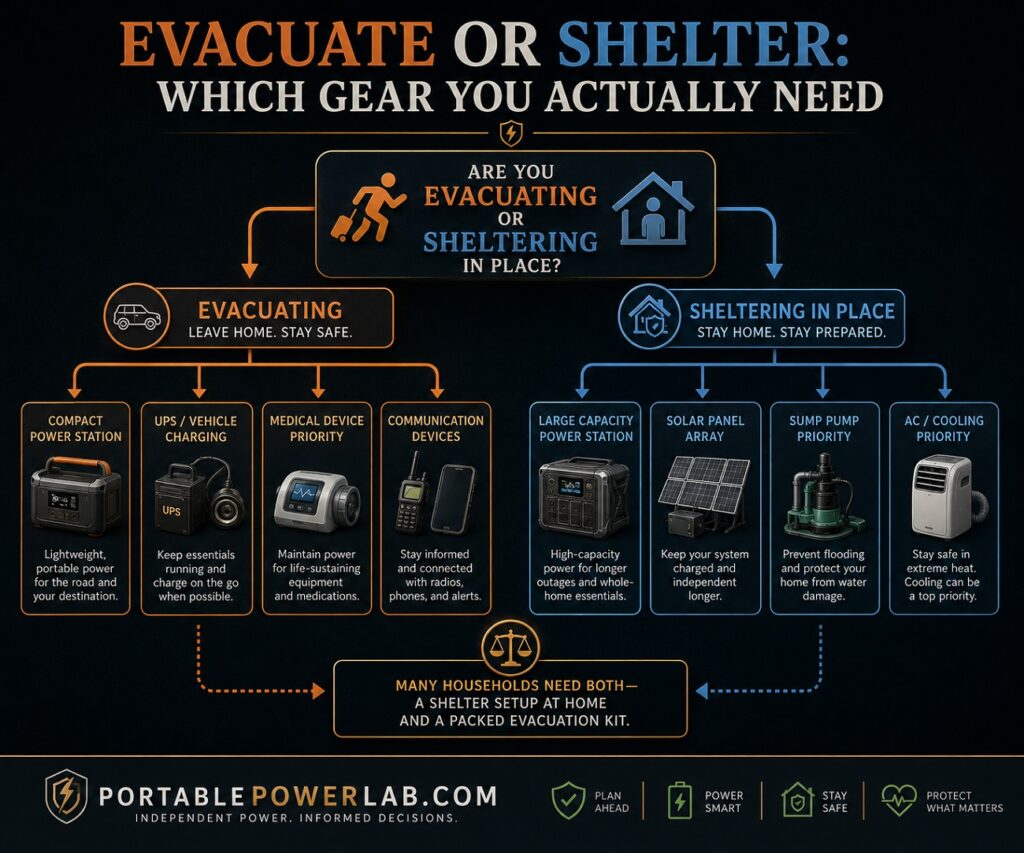
This is the single biggest branch point in hurricane power planning, and most buying guides never address it directly: the gear that serves you well if you shelter in place is often the wrong gear if you evacuate, and vice versa.
If You Are Sheltering in Place
Your priority shifts toward maximum capacity and sustained runtime, because you need to survive a multi-day outage inside your home. Weight and portability become secondary considerations — the unit is going to sit in one place for the duration.
- Prioritize capacity in the 1,000–3,600Wh range depending on your critical load list
- Solar panels become highly valuable, since you will have days to recharge between outage events or during a lull
- A larger, less portable unit (Jackery Explorer 2000 Plus, EcoFlow Delta Pro) is appropriate here
- Sump pump and window AC capability become genuinely critical, not optional — see the appliance-specific sections below
The Lab’s shelter-in-place pick: The EcoFlow Delta Pro or Jackery Explorer 2000 Plus — both sized for sump pump and window AC duty, the two hurricane-specific loads that make sheltering safe through an extended outage.
Buy the EcoFlow Delta Pro | Buy the Jackery Explorer 2000 Plus
If You Are Evacuating
Your priority flips entirely toward portability and multi-purpose flexibility, because the gear needs to travel in a vehicle, potentially get set up in an unfamiliar location (a relative’s house, a hotel, a shelter), and serve a much smaller device load — phones, a CPAP, essential communication.
- A compact 250–800Wh unit is often more appropriate than a large home-backup station
- Weight and physical footprint matter — you are packing a vehicle with far more than just power equipment
- UPS pass-through capability is valuable for maintaining charge on essential devices during the drive and at your destination
- Consider whether your evacuation destination will have grid power at all — if evacuating away from the storm’s path entirely, a smaller unit may be all you need; if evacuating to another at-risk area, size accordingly
The Lab’s evacuation pick: The EcoFlow River 2 or Jackery Explorer 300 Plus — both compact, genuinely portable, and sufficient for phones, communication devices, and a CPAP through a multi-day evacuation.
The Hybrid Reality — Many Households Need Both
A genuinely well-prepared household maintains a larger capacity-focused unit for sheltering scenarios and a smaller, portable unit specifically packed in an evacuation bag or vehicle kit — because the decision to evacuate is often made with only hours of notice, and you do not want your entire power preparedness strategy to depend on unplugging and repacking a 47-pound unit at the last minute.
The Hurricane-Specific Critical Load Priority List
Hurricane outages create specific, predictable dangers that differ meaningfully from a generic power outage — heat, flooding, and communication breakdown chief among them. Here is how to prioritize.
Priority 1 — Heat Management in Gulf and Southeast Storms
Hurricane season overlaps almost entirely with the hottest months of the year across the Gulf Coast and Southeast. A multi-day outage in 90°F+ heat with no air conditioning is a genuine medical emergency risk for elderly residents, young children, and anyone with a heat-sensitive health condition — not merely a comfort issue.
A 5,000 BTU window AC unit running even intermittently in one room can be the difference between a manageable outage and a dangerous one for vulnerable household members.
See the complete surge math and soft-starter guide for running AC during an outage: https://portablepowerlab.com/solar-generator-air-conditioner/
Priority 2 — Sump Pumps and Flood-Prone Areas
Hurricanes bring extreme rainfall, and a failed sump pump during a hurricane is not a minor inconvenience — it is the mechanism by which a manageable storm becomes a basement flood and a total loss of flooring, appliances, and stored belongings. If your home has a sump pump, its startup surge requirement should be the single specification that determines your minimum power station surge rating, full stop.
See the complete sump pump surge math by horsepower: https://portablepowerlab.com/solar-generator-sump-pump/
Priority 3 — Medical Devices, With No Margin for Error
CPAP machines, oxygen concentrators, and other medical devices cannot be treated as optional during hurricane season specifically because hurricane outages are, per the data above, statistically more likely to extend beyond a single night than a typical outage. Size medical device power capacity for your realistic worst-case outage duration for your specific location and storm category — not for a single overnight.
See the complete medical device power guide: https://portablepowerlab.com/best-portable-power-station-seniors/
Priority 4 — Communication and Situational Awareness
Cell towers themselves frequently lose power during major hurricanes, and cellular networks can become degraded or overloaded even where towers remain functional. A weather radio, a charged phone with offline map downloads, and — for more serious preparedness — a charged handheld radio are all part of the communication layer that keeps you informed as conditions change, including news of road closures, shelter locations, and the actual timeline for power restoration in your specific area.
Regional Risk Considerations — Your Storm Is Not Everyone’s Storm
Gulf Coast (Texas, Louisiana, Mississippi, Alabama, Florida Panhandle)
Highest storm surge risk of any US coastal region, combined with older grid infrastructure in many areas and, per the data above, some of the longest documented restoration times in the country. Storm surge flooding risk should directly inform equipment placement and elevation planning, covered in the section below.
Atlantic Coast (Florida Peninsula Through the Carolinas and Mid-Atlantic)
Higher population density in many areas generally correlates with faster urban restoration (per the urban/rural data above), but barrier islands and coastal communities specifically face both surge risk and, often, longer restoration due to bridge/causeway access limitations that slow repair crew mobilization.
Inland and Northern Extension Areas
Do not assume distance from the coast eliminates risk. Hurricane Helene’s catastrophic inland flooding in western North Carolina in 2024 — hundreds of miles from where the storm made landfall — is the clearest recent example that weakening tropical systems can produce severe, extended inland power and infrastructure damage through flooding and wind, even well after official hurricane-strength winds have subsided.
Sizing Your System — Matching Capacity to Your Real Restoration Timeline
Using the documented restoration data above, here is how to size your power station to your realistic scenario, cross-referenced against our broader tiered preparedness framework.
| Your Situation | Realistic Outage Range | Recommended Minimum Capacity | Cross-Reference |
|---|---|---|---|
| Urban/suburban, Cat 1-2 storm, no flooding | 24 hours – 3 days | 1,000–1,264Wh (EcoFlow Delta 2, Jackery 1000 Plus) | Aligns with Tier 1 in our prepper framework |
| Suburban, Cat 3 storm, or rural Cat 1-2 | 5–8 days | 2,000–3,600Wh + solar (Jackery 2000 Plus, EcoFlow Delta Pro) | Aligns with Tier 2 |
| Rural, coastal, or Cat 4-5 direct impact | 2–4+ weeks | 3,600Wh+ with expansion + solar array (EcoFlow Delta Pro + B300) | Aligns with Tier 2-3 |
| Barrier island, cooperative-served rural, catastrophic flooding scenario | 3+ weeks to months | Multi-tier system, portable + fixed combination | Aligns with Tier 3 |
See the complete tiered preparedness framework with full daily-load calculations for each tier: https://portablepowerlab.com/best-portable-power-station-preppers/
Calculate your specific household’s critical load before choosing a capacity tier: https://portablepowerlab.com/appliance-wattage-chart/
Storm Surge and Flood Protection for Your Equipment
A power station is only useful if it survives the storm itself. This is a distinct physical-safety topic from general indoor safety guidance, and it deserves specific attention for hurricane-prone households.
Elevation Is Non-Negotiable in Surge Zones
If you are in a mapped storm surge zone (check your local emergency management storm surge maps — evacuation zone designations typically correlate directly with surge risk), your power station should be stored and operated at the highest practical elevation in your home — an upper floor, or at minimum, well above ground-floor flood-line expectations for your specific zone.
Waterproof Storage Between Uses
When not actively in use, store your power station in a sealed, water-resistant container or bag, particularly if there is any chance it will be in a location exposed to roof leaks, wind-driven rain intrusion, or flooding. A power station’s electronics — inverter, BMS, charge controller — are not designed for water exposure even briefly, unlike the battery cells themselves in some cases.
Never Operate Near Standing Water
This should be self-evident, but it bears stating directly given how common flooding is during hurricane recovery: never operate a power station, run extension cords through, or place any electrical equipment in an area with standing water, regardless of how critical the need. Wait until the area is fully dry, or relocate the equipment and the load it is serving to a dry area instead.
Coastal Salt-Air Corrosion — The Slow Damage Nobody Notices Until It’s Too Late
Flooding and wind are the obvious hurricane threats to equipment. Salt-laden coastal air is a slower, quieter one — and it causes real, often irreversible damage well outside the storm window itself, simply from ordinary outdoor or semi-outdoor storage in a coastal environment.
Why this matters: Salt air is highly corrosive to exposed metal contacts, circuit board components, and copper wiring — the same reason marine electronics are built with specialized conformal coatings and sealed connectors that consumer power stations generally do not include. A power station stored on a coastal porch, balcony, or garage with regular salt-air exposure over months or years can develop corrosion on its port contacts and internal components well before any single storm event, degrading connection quality and, in serious cases, causing premature electronics failure.
Practical protection for coastal households:
- Keep all port covers closed when not actively in use. Every open port — AC outlets, DC input, USB — is a direct path for salt-laden air to reach internal contacts.
- Store indoors, in a climate-controlled space, whenever possible. A closet, interior utility room, or air-conditioned garage meaningfully reduces cumulative salt-air exposure compared to an open porch, breezeway, or non-climate-controlled garage with regular sea breeze airflow.
- Use a breathable equipment cover during any outdoor use. A breathable (not fully sealed plastic, which traps condensation) protective cover reduces direct salt-air contact during active use without creating a moisture-trapping problem of its own.
- Wipe down external surfaces periodically with a dry or barely damp cloth if the unit sees regular coastal outdoor use, removing accumulated salt residue before it has a chance to work into seams and port openings.
None of the power stations recommended throughout this site carry a specific marine-grade ingress protection certification, and none should be treated as suitable for direct, sustained outdoor coastal exposure without the precautions above.
Buy on Amazon – a Breathable Equipment Cover for Coastal Storage
See the complete indoor electrical safety guide, including extension cord gauge selection: https://portablepowerlab.com/portable-power-station-indoors/
The Post-Storm Fuel Shortage Reality — Why Battery Has a Structural Advantage
This is one of the most consistently under-discussed aspects of hurricane preparedness, and it is where portable battery power has a genuine, structural advantage over gas generators that has nothing to do with noise or emissions.
What Actually Happens to Fuel Supply After Landfall
Every well-documented major hurricane produces the same pattern: gas stations run dry within 24 to 72 hours of landfall, both from pre-storm evacuation demand and from post-storm generator refueling demand hitting simultaneously, while fuel delivery trucks face the same road closures, flooding, and debris obstacles as every other vehicle trying to move through the affected area. Stations that do have fuel frequently cannot pump it if they have lost power themselves — a genuinely circular problem in the exact scenario a gas generator owner is depending on fuel access to solve.
The practical result: A gas generator owner who did not stockpile substantial fuel before landfall — and most residential fuel storage limits (typically capped around 25 gallons under NFPA guidance) constrain how much can legally be stored regardless — frequently finds themselves with a functioning generator and no way to run it within days of the storm passing, at exactly the point when the outage is entering its second week and matters most.
A battery power station has no equivalent failure mode. Once charged, it has no ongoing fuel dependency. Recharging via solar panels — genuinely practical in the days immediately following a hurricane, since storms are typically followed by clear, sunny high-pressure conditions — requires no supply chain, no gas station, and no fuel truck at all.
See the complete 10-year cost and reliability comparison between battery and gas backup: https://portablepowerlab.com/portable-power-station-vs-gas-generator/
One provisioning tip worth the extra cost: A single 200W panel recharges efficiently under clear post-storm skies, which are common in the days immediately following a hurricane’s passage — but not guaranteed, since outer bands and residual cloud cover can linger. Pairing two 200W panels wired in parallel provides meaningful charging even under partial cloud cover, rather than leaving your entire recharge plan dependent on a single panel and perfect sun. For any household planning around a realistic multi-week restoration timeline, this is a worthwhile upgrade over a single-panel setup.
An Overlooked Power Use Case — Documentation and Insurance
Charging a phone to call family is an obvious power priority. Less obvious, but genuinely important: your phone and any other camera equipment need power to document storm damage thoroughly and promptly for insurance purposes. Insurance claims processes move faster and result in more complete settlements when supported by comprehensive photo and video documentation taken as close to the event as possible, before cleanup, temporary repairs, or continued weather exposure change the visible condition of the damage. Keep this specifically in mind when allocating your power budget in the days immediately following landfall — it is a genuinely practical, financially consequential use of stored power capacity that most preparedness checklists omit entirely.
The Insurance Documentation Kit
Since power for damage documentation is a genuinely overlooked priority covered above, here is the specific small kit that makes it practical even in wet, chaotic post-storm conditions.
| Item | Purpose | Link |
|---|---|---|
| Floating Waterproof Phone Dry Bag | Protects your phone while documenting flood damage in wet conditions | Check Price on Amazon |
| Rugged Outdoor Phone Case | Drop and water protection during debris-field documentation walks | Check Price on Amazon |
| High-Capacity Portable Power Bank (20,000mAh+) | Keep your phone charged for documentation without draining your main power station | Check Price on Amazon |
The Complete Hurricane Season Power Kit
The Essential Kit (Under $1,000)
| Item | Purpose | Link |
|---|---|---|
| EcoFlow Delta 2 or Jackery Explorer 1000 Plus | Core power — 1,000Wh+ class, handles fridge/medical/communication | Check Price on Amazon |
| 200W Foldable Solar Panel | Post-storm recharging without fuel dependency | Check Price on Amazon |
| 12-Gauge Extension Cord (25ft) | Safe power delivery to sump pump, AC, refrigerator | Check Price on Amazon |
| Weather Radio (battery/hand-crank) | Situational awareness independent of cell networks | Check Price on Amazon |
| Waterproof Storage Bag/Case | Equipment protection from flooding and rain intrusion | Check Price on Amazon |
The Extended Outage Kit ($1,500–$3,500)
| Item | Purpose | Link |
|---|---|---|
| Jackery Explorer 2000 Plus or EcoFlow Delta Pro | 2,000-3,600Wh — sump pump and window AC capable | Check Price on Amazon |
| Soft Starter (for window/RV AC) | Reduces AC startup surge 60% for safer margin | Check Price on Amazon |
| Expansion Battery Module | Extends runtime for multi-week restoration scenarios | Check Price on Amazon |
| 2x 200W Solar Panels | Sustains daily charge through extended outages | Check Price on Amazon |
Frequently Asked Questions
How long does power typically stay out after a hurricane?
It depends heavily on category and location. Documented data shows Category 1-2 storms in urban areas often restore power within 24-72 hours, while Category 3+ storms, rural areas, or storms causing significant flooding can extend restoration to one to four weeks. Over 90% of hurricane-related outages last more than 24 hours. Puerto Rico’s experience after Hurricane Maria, with some rural areas without power for over 120 days, represents the documented extreme end of this range.
When should I buy a power station before a hurricane?
As early in the season as possible, ideally before any specific storm is being tracked. Once a storm enters the 5-day forecast cone, regional demand typically spikes fast enough that in-stock inventory and delivery windows both become unreliable. Buying and testing your equipment during the calm part of the season, well before you need it, is the single most effective timing decision in this entire guide.
Should I evacuate with my power station or leave it at home?
This depends on your specific evacuation plan and destination. If sheltering in place is not an option and you are evacuating to an area likely to retain grid power, a smaller, portable unit for your vehicle and a few essential devices is usually sufficient. If your evacuation destination could also lose power, or if you have significant medical device needs, bring your full capacity setup. See the complete evacuate-vs-shelter framework above.
Is a gas generator or a battery power station better for hurricane season specifically?
Battery power stations have a structural advantage specific to hurricanes: no fuel dependency during the exact post-storm window (typically the first 24-72 hours after landfall) when gas stations are most likely to be non-functional or out of fuel. Gas generators can deliver higher sustained output for very large loads, but require a fuel supply that hurricanes specifically and predictably disrupt.
Is it safe to leave a solar panel outside during a hurricane?
No. Foldable, portable solar panels present a large, lightweight surface that can become airborne debris in hurricane-force wind, even at Category 1 strength. Bring all portable panels indoors by the 24-hours-out mark in your preparation countdown, and do not redeploy them until the storm has fully passed and sustained winds have dropped to a safe level. Permanently mounted rigid roof panels are engineered for wind load and are not subject to this same warning.
Will I still be able to control my power station if cell service goes down?
Yes, for the units recommended throughout this site. EcoFlow and Jackery power station apps connect via Bluetooth directly to the unit, not through the internet, so core functions — charge limits, discharge floor settings, real-time monitoring — continue working with zero cell signal or WiFi as long as your phone was previously paired and remains within Bluetooth range. Pair your device before the storm arrives so the connection is already established.
Does living near the coast damage a power station over time?
It can, through slow salt-air corrosion of port contacts and internal components rather than any single dramatic event. Keep port covers closed when not in use, store the unit indoors or in a climate-controlled space whenever possible, and use a breathable protective cover during outdoor use. None of the units covered on this site carry marine-grade ingress protection ratings.
See the complete home outage generator guide: https://portablepowerlab.com/best-solar-generator-power-outage/
Browse Hurricane Season Power Stations on Amazon
The Lab’s Verdict
Hurricane power preparedness fails most often not from lack of information, but from bad timing — waiting for certainty that a forecast cone will never fully provide, then competing with an entire region for the same limited inventory in the final 48 hours before landfall.
The single most valuable action this guide can prompt: buy and test your equipment now, during the calm part of the season, sized to the realistic restoration timeline for your specific category risk and location — not to a best-case guess, and not to unfounded worst-case panic. Use the countdown framework to convert the next watch or warning into calm, sequential action instead of a last-minute scramble. And remember that the decision to evacuate or shelter changes what “the right gear” even means — plan for both before you need to choose between them under pressure.
Read the Complete Emergency Power Checklist
Browse Power Stations for Hurricane Preparedness on Amazon
Portable Power Lab — Real Math. No Fluff. Independent since 2025.
SOURCING NOTE FOR PUBLISHER
Hurricane restoration timeline data compiled from documented outage-restoration analyses including PowerOutage.us storm preparedness data, NSF-funded academic research on Hurricane Irma restoration patterns by Florida county, satellite-based nighttime-lights analysis of Hurricane Maria’s Puerto Rico restoration (published research), and independent reporting on socioeconomic factors in hurricane restoration timing across eight major Atlantic hurricanes (2017-2020). Specific storm restoration figures (Irma, Harvey, Ike, Helene, Katrina, Maria) are drawn from documented public reporting and academic sources as cited; individual outage duration in any future storm will vary based on storm-specific damage, local grid condition, and utility response capacity, and should not be treated as a guarantee. Last verified May 2026.
Bluetooth offline app functionality for EcoFlow and Jackery power stations confirmed through direct product testing documented elsewhere on this site (see the EcoFlow River 2 vs. Jackery Explorer 300 Plus comparison). Solar panel wind-load risk and salt-air corrosion guidance reflects established general engineering principles for lightweight outdoor equipment and marine electronics environments rather than manufacturer-specific testing; no power station covered on this site carries a published ingress protection (IP) rating for coastal or wind exposure.