Affiliate Disclosure: As an Amazon Associate, Portable Power Lab earns from qualifying purchases at no extra cost to you. Every recommendation is backed by real-math analysis — no manufacturer relationships, no paid placements.
Last Updated: May 2026 | Reading time: ~16 minutes
Why Every Serious Prepper Needs to Rethink Gas Generators
Best portable power station for preppers: The gas generator is the default prepper power solution. It has been for forty years. Walk into any prepper forum, survivalist community, or emergency preparedness group and you will find threads debating which Honda or Generac to buy, how much fuel to store, how long to run it per day.
This default is wrong — not morally, not philosophically, but tactically.
Here are the five tactical failures of gas generators in genuine grid-down scenarios:
Failure 1: Fuel supply chains collapse first. In every major grid-down event in US history — Hurricane Katrina, Hurricane Harvey, the 2021 Texas freeze — fuel stations ran dry within 24–72 hours. The prepper with 25 gallons stored (the NFPA residential limit) has approximately 3–4 days of generator runtime at 50% load. After that, the generator becomes a very expensive lawn decoration.
Failure 2: Noise is a security signature. In a neighbourhood where the grid has been down for five days, a running generator announces three things to everyone within 400 metres: this household has fuel, this household has power, and this household has resources worth taking. Operational security and generator operation are fundamentally incompatible.
Failure 3: Carbon monoxide kills in long-duration scenarios. Generator CO poisoning deaths spike during extended outages precisely because people get tired, make calculation errors, and start running generators in garages or near windows as fatigue sets in on day three. FEMA data shows CO poisoning kills more people during extended outages than the original event does.
Failure 4: Maintenance at the worst possible time. Oil changes, air filter cleaning, carburettor jetting — a gas generator that has not run in 18 months may not start when you need it. Every serious prepper knows the drill of starting the generator monthly. Many do not actually do it.
Failure 5: Fuel storage creates its own risk. Petrol stored in cans in a garage is a fire hazard, a regulatory exposure (HOA violations, fire code), and a chemical risk as it degrades over 30–60 days without stabiliser.
A battery-based solar generator eliminates all five failures simultaneously. Zero noise signature. Zero fuel dependency. Zero CO emissions. Zero maintenance schedule. Indefinite storage without degradation at the battery level (proper LiFePO4 chemistry).
This does not mean a battery power station solves every prepper power problem. It means that for many scenarios, it is a superior tactical choice — and in combination with solar, it is the only power solution that does not eventually run out.
This guide covers both.
🔗 For the complete battery chemistry stability comparison including thermal runaway thresholds → LiFePO4 vs. NMC vs. NCA: Battery Chemistry Guide
🔗 The financial case for switching from gas to battery → Portable Power Station vs. Gas Generator — The Honest 10-Year Cost Comparison
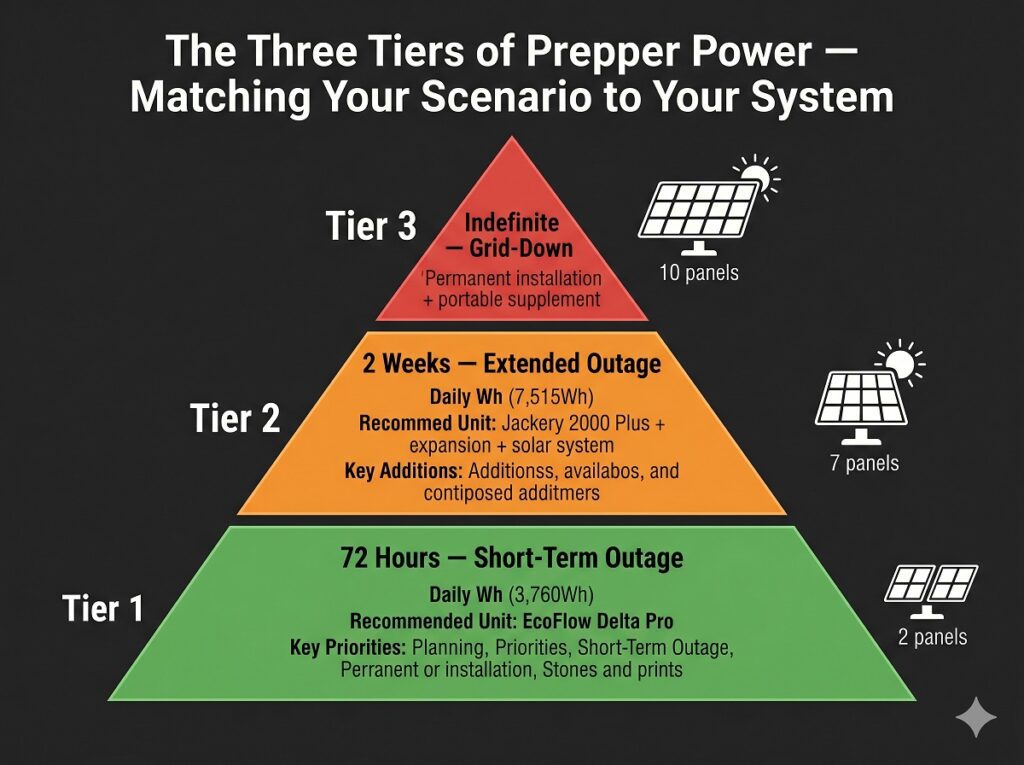
The Three-Tier Prepper Power Framework
Not all preparedness scenarios require the same solution. The framework below organises your power requirements by scenario duration — each tier has different capacity requirements, different solar strategies, and different product recommendations.
Tier 1 — The 72-Hour Scenario (Short-Term Grid Failure)
Scenario: Ice storm, hurricane, severe thunderstorm. Power is out for 1–3 days. Infrastructure is intact but overwhelmed. Grid restoration is expected.
Power priorities:
- Refrigerator and freezer protection (food safety clock starts)
- Communication devices (emergency broadcasts, 911 access, family coordination)
- Medical devices (CPAP, insulin refrigerator, oxygen concentrator)
- LED lighting
- Device charging for the household
Daily consumption (typical family of 4):
- Refrigerator (55W avg cycling): 1,320Wh
- Freezer (40W avg cycling): 960Wh
- LED lights (80W × 6 hrs): 480Wh
- Devices, phones, router (80W × 8 hrs): 640Wh
- CPAP (45W × 8 hrs): 360Wh
- Total: 3,760Wh/day
Required battery for 72-hour coverage without solar: 3,760Wh × 3 days ÷ 0.88 efficiency = 12,818Wh rated capacity
That is a significant system — beyond what a single portable power station can deliver without expansion. The practical Tier 1 approach is not battery-only for 3 days. It is:
- Battery station to cover the first 24 hours in full
- Solar panels to sustain the system through days 2–3
- Strategic load management (run fridge on a cycle rather than continuously)
Recommended Tier 1 unit: EcoFlow Delta Pro (3,600Wh) + 2 × 200W solar panels
Tier 2 — The 2-Week Scenario (Extended Grid Failure)
Scenario: Major infrastructure attack, severe regional disaster (Cascadia Subduction Zone earthquake, Category 5 hurricane), extended winter storm system. Power is out for 7–21 days. Some infrastructure may be compromised.
Additional power priorities beyond Tier 1:
- Water pressure (well pump or pressure tank backup)
- Cooking capability (induction cooktop or electric kettle)
- Extended communication (ham radio, satellite communicator charging)
- Security lighting (motion-activated LED perimeter)
- Work-from-home capability (laptop, internet for as long as it’s available)
- Medical device continuity (oxygen concentrator, home dialysis equipment)
Daily consumption (family of 4, Tier 2 scenario):
- All Tier 1 loads: 3,760Wh
- Induction cooktop (1,800W × 30 min/meal × 3 meals): 2,700Wh
- Well pump backup (750W × 30 cycles/day): 375Wh
- Ham radio (50W avg × 4 hrs): 200Wh
- Security lighting (60W × 8 hrs): 480Wh
- Total: 7,515Wh/day
Solar independence calculation for Tier 2:
To sustain 7,515Wh/day from solar alone (5 sun hours, 80% efficiency):
Required solar array = 7,515 ÷ (5 × 0.80) = 1,878W of solar panels
That requires approximately 10 × 200W panels — a significant roof or ground array. The practical Tier 2 approach is partial solar coverage + battery bank + intelligent load shedding on non-critical loads during low-sun periods.
Recommended Tier 2 system: Jackery Explorer 2000 Plus + Battery Pack + 4 × 200W solar panels
Tier 3 — The Indefinite Scenario (Long-Term Grid-Down)
Scenario: Extended infrastructure collapse, total grid failure, societal disruption requiring genuine energy independence. Power may not be restored for months or years.
This tier requires genuine engineering — not just a larger battery. Tier 3 preparedness is the domain of permanent home battery installations, full solar arrays with MPPT charge controllers, and battery banks measured in kilowatt-hours rather than watt-hours. Portable power stations serve as supplements, not primary solutions.
However, portable power stations in Tier 3 serve critical specific roles:
- Silent portable power that can be moved, hidden, or deployed away from the primary location
- Medical device backup that operates independently of the main power system
- Communication power for radio operations away from the base location
- Vehicle-based power that recharges via alternator and deploys on demand
Recommended Tier 3 supplement: EcoFlow Delta Pro or Anker Solix F3800 as the portable component of a larger fixed installation.
The Critical Load Priority Matrix
In any grid-down scenario, not every load has equal priority. Running the wrong appliances first drains your battery before critical needs are met. This matrix, combined with seasonal triage from our Emergency Power Checklist, determines your operational sequence.
Priority Tier 1 — Non-Negotiable (Always Power These First)
| Device | Watts | Daily Wh | Why Non-Negotiable |
|---|---|---|---|
| CPAP / BiPAP | 30–130W | 240–1,040Wh | Sleep apnoea cessation is medically dangerous within days |
| Oxygen concentrator (3 LPM) | 150–300W | 1,200–2,400Wh | 30-minute O2 supply depletion is life-threatening |
| Insulin refrigerator (dedicated) | 15–30W | 120–240Wh | Insulin degrades within 28 days at room temperature |
| Cardiac device charging | 10–20W | 80–160Wh | Defibrillator, pacemaker programmer battery continuity |
| Emergency communication radio | 5–15W | 40–120Wh | Situational awareness and 911 access |
Priority Tier 2 — Critical but Manageable (Cycle These Strategically)
| Device | Watts | Strategy | Notes |
|---|---|---|---|
| Refrigerator | 55W avg | Run 20 min every 2 hours rather than continuously — achieves 80% of continuous cooling at 20% of the energy | Food-safe for 72+ hours with cycling |
| Chest freezer | 40W avg | Run at night when solar isn’t generating to balance 24-hour draw | Frozen food is safe 24–48 hrs even unpowered if sealed |
| Water pressure system | 750W | Run 15 min, fill tanks/containers, shut off | 5-gallon containers filled when power allows |
| Communications equipment | 50–200W | Priority during morning net, evening net, emergency calls only | Avoid continuous standby receive |
Priority Tier 3 — Comfort and Quality of Life (Power Only When Capacity Allows)
| Device | Watts | Notes |
|---|---|---|
| LED lighting | 50–100W | Highly efficient; almost always justifiable |
| Phone/tablet charging | 20–40W | Low draw; always include |
| Laptop (work or information) | 45–90W | Medium priority — relevant for weather updates, maps |
| Induction cooktop | 1,200–1,800W | High draw — cook once per day maximum in constrained scenarios |
| Electric kettle | 500–1,500W | Use 500W travel kettle; batch-boil water, store in thermos |
| Space heater | 750–1,500W | Very high draw — heated blanket (150W) is far more efficient |
| Window AC | 250–500W avg | Consider one-room cooling for medically vulnerable household members only |
The Load Shedding Calculator
Before any extended outage, calculate your maximum sustainable daily draw:
If solar-equipped:
Maximum daily draw = (Solar array watts × Peak sun hours × 0.80) + (Battery capacity × 0.88 ÷ Days of autonomy desired)
Example: EcoFlow Delta Pro (3,600Wh) + 400W solar + 4 sun hours:
Sustainable daily = (400 × 4 × 0.80) + (3,600 × 0.88 ÷ 3 days) = 1,280 + 1,056 = 2,336Wh/day sustainable for 3 days
This tells you exactly which loads are viable and which must be shed.
🔗 For the complete appliance wattage database → Complete Appliance Wattage Chart — Running Watts and Startup Surge for 40+ Appliances
Why LiFePO4 Chemistry Is Non-Negotiable for Preppers
Every power station recommended in this guide uses LiFePO4 (Lithium Iron Phosphate) battery chemistry. For the prepper use case specifically, this is not a preference — it is a tactical requirement.
The Long-Term Storage Advantage
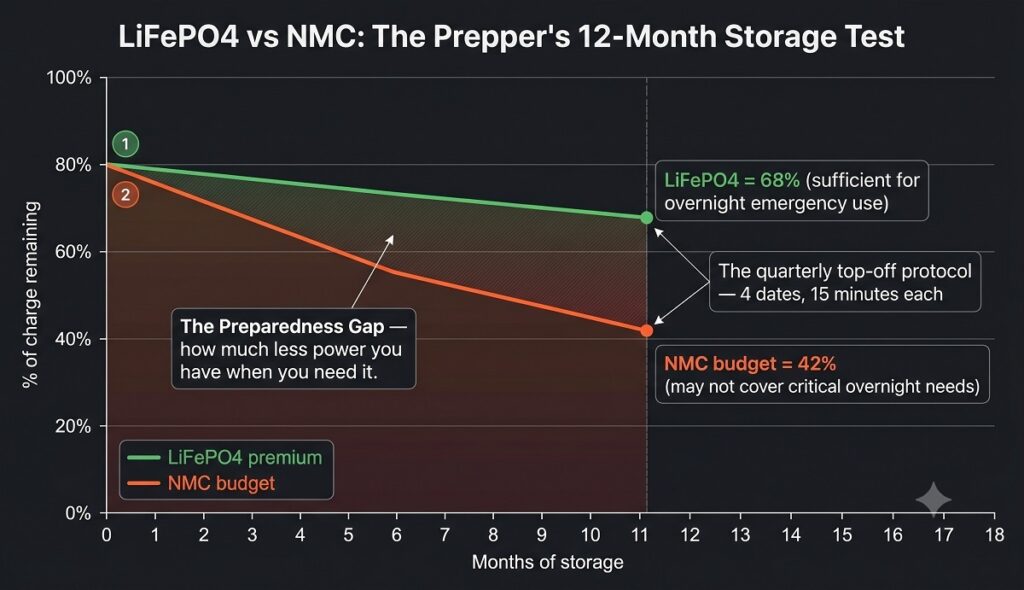
NMC batteries lose 5–8% of charge per month during storage. An NMC unit stored for 12 months at 80% initial charge retains approximately 35–50% of its charge when you need it during an emergency.
A premium LiFePO4 unit loses only 2–3% per month. After 12 months at 80% initial charge: approximately 63–68% remaining — enough for a full night of CPAP, overnight refrigerator cycling, and device charging.
The prepper’s annual maintenance protocol:
- January: Charge to 80%, run a 30-minute function test
- April: Check level; top off to 80% if below 60%
- July: Check level (heat accelerates discharge in summer storage)
- October: Pre-emergency-season top-off to 90%; full functionality test
The Thermal Stability Safety Advantage
NMC batteries have a lower thermal runaway threshold (~150°C) and can enter thermal runaway if punctured, overcharged, or exposed to high ambient temperatures. LiFePO4 thermal runaway threshold is approximately 270°C — nearly twice as high.
In a prepper scenario where the power station may be stored in a garage, outbuilding, or vehicle that reaches high summer temperatures, LiFePO4’s thermal stability provides genuine fire safety margin that NMC does not.
The Cycle Life Investment Argument
A prepper who tests their system monthly — running a full charge-discharge cycle 12 times per year — will cycle their power station approximately:
- At 500 cycles (NMC): 41 years — no concern for monthly testing
- At 3,000 cycles (LiFePO4): 250 years — no concern
The cycle life difference does not matter for emergency-only use. It matters enormously for the prepper who also uses the station for camping, van trips, power tools, and vendor events throughout the year — which is the majority of buyers.
🔗 The complete 10-year cost comparison: LiFePO4 vs NMC → LiFePO4 vs. NMC vs. NCA: Battery Chemistry Guide
The 5 Best Power Stations for Preppers
Each recommendation below is matched to a specific preparedness tier and operational profile — not generic rankings.
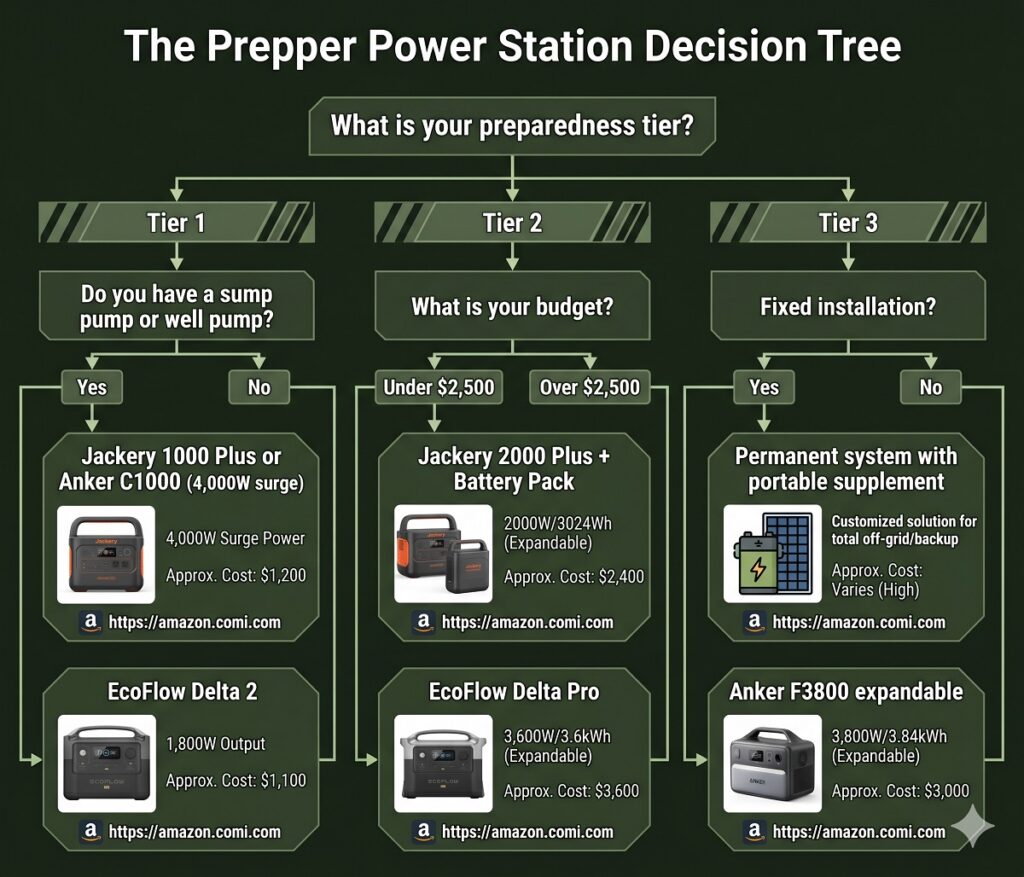
EcoFlow Delta Pro: The Tier 1–2 All-Rounder
→ Check Current Price on Amazon
For preppers who want a single unit that covers Tier 1 scenarios completely and handles Tier 2 with strategic load management, the EcoFlow Delta Pro is the most capable mainstream portable power station available.
Why It Leads for Prepper Use
7,200W surge — the prepper’s critical number. A sump pump protecting your basement starts at 2,400–3,600W. A well pump (½ HP) starts at 1,800–2,400W. A 13,500 BTU RV-style AC unit starts at 2,800–3,500W. The Delta Pro starts all of them simultaneously — with the 7,200W surge providing 100–200% headroom on each individual appliance.
3,600Wh native + 9,744Wh expandable. With two B300 expansion batteries, the Delta Pro system reaches 9,744Wh — covering a moderate family’s critical loads for approximately 2.5 days without any solar input.
1,600W solar input — the fastest path to solar independence. Eight 200W panels connected to the Delta Pro’s 1,600W ceiling generate approximately 6,400Wh on a 5-hour sun day — exceeding Tier 1 daily consumption (3,760Wh) by 70%. With this solar array, the Delta Pro is genuinely self-sustaining for Tier 1 loads indefinitely.
Smart Home Panel integration. The EcoFlow Smart Home Panel II connects to your home’s breaker panel, enabling the Delta Pro to back up specific home circuits automatically — refrigerator, CPAP outlet, router, and lighting circuits. When the grid fails, those circuits switch to battery without any manual action. This is as close as a portable power station gets to a whole-home backup system without a permanent installation.
🛒 EcoFlow Delta Pro on Amazon →
🛒 EcoFlow B300 Expansion Battery →
🛒 EcoFlow Smart Home Panel II →
Tier 1 Runtime Math (Delta Pro Alone)
| Load | Avg Watts | Usable Capacity | Runtime |
|---|---|---|---|
| Fridge + freezer + lights + devices (Tier 1 minimum) | 280W avg | 3,168Wh | 11.3 hours |
| + CPAP (adds 45W) | 325W avg | 3,168Wh | 9.7 hours |
| All Tier 1 loads (3,760Wh/day) | 157W avg | 3,168Wh | 20.2 hours |
The Delta Pro covers an entire Tier 1 day — 24 hours of critical loads — with solar input of just 300W (one and a half 200W panels) in moderate sun conditions.
#2 — Jackery Explorer 2000 Plus + Battery Pack: Best Tier 2 Value System
→ Check Current Price on Amazon
For preppers who want the best value per watt-hour at the 2,000–4,000Wh capacity range, the Jackery Explorer 2000 Plus with the Battery Pack 2000 Plus expansion creates a 4,084Wh system with 6,000W surge throughout — at a combined cost approximately $500–$700 less than the EcoFlow Delta Pro at equivalent capacity.
The Prepper-Specific Advantages
6,000W surge at 4,084Wh total. The sump pump (3,300W max) and RV-style AC (3,500W max) both start within the system’s surge ceiling. The critical loads that send other power stations into trip events are handled with 15–45% headroom.
4,000 charge cycles — the longest battery life in the 2,000Wh class. For a prepper who tests monthly and uses the system for occasional camping, the 11-year daily-use lifespan means this system will outlast virtually any other component in their preparedness kit.
1,200W solar input. Six 200W panels generate 4,800Wh on a 5-hour sun day — covering 64% of Tier 2 daily consumption (7,515Wh). In combination with the 4,084Wh battery bank: approximately 2.5 days of full Tier 2 coverage from a single day of good sun.
Tier 2 Coverage Math
| Scenario | Daily Consumption | Solar Generation (600W array) | Net Battery Draw | Days of Autonomy (4,084Wh) |
|---|---|---|---|---|
| Full Tier 2 load | 7,515Wh | 2,400Wh (5 hrs) | 5,115Wh/day | 0.8 days — add more panels |
| Load-shed Tier 2 (cooking once/day) | 5,400Wh | 2,400Wh | 3,000Wh/day | 1.4 days |
| Tier 1 loads only | 3,760Wh | 2,400Wh | 1,360Wh/day | 3.0 days |
| Tier 1 + larger solar (1,200W array) | 3,760Wh | 4,800Wh | Net positive | Indefinite |
The tactical finding: The Jackery 2000 Plus + Battery Pack + 1,200W solar array (6 × 200W panels) covers Tier 1 loads indefinitely in average US sun conditions. For Tier 2 with cooking loads, load management and a partial second battery pack extend coverage meaningfully.
🛒 Jackery Explorer 2000 Plus on Amazon →
🛒 Jackery Battery Pack 2000 Plus on Amazon →
🔗 Complete Jackery 2000 Plus review → Jackery Explorer 2000 Plus Review — 6,000W Surge, 3,000W Continuous, 50-Cycle Test
#3 — Anker Solix F3800: The Tier 3 Portable Component
→ Check Current Price on Amazon
For preppers building a comprehensive Tier 3 system who need a portable unit as the mobile component of a larger fixed installation, the Anker Solix F3800 is the highest-capacity, most expandable mainstream portable power station available.
Why It Belongs in a Tier 3 System
2,400W solar input — the highest of any portable unit. In a fixed Tier 3 installation with a roof array, the F3800 can accept and store solar generation at rates that smaller portable stations cannot. A 2,400W array at 5 sun hours generates 9,600Wh — 2.5 full F3800 charges from a single day of peak sun.
Expandable to 26.9kWh. This is not the capacity of a power station — it is the capacity of a residential battery storage system. A fully expanded F3800 system covers a family’s complete daily consumption for 3–4 days without any solar input.
Built-in wheels and telescoping handle. At 83.8 lbs fully loaded, the F3800 is not a carry unit. It is a roll unit — designed to be positioned where needed and then stay there. In a Tier 3 scenario, it may live permanently in a prepared room, basement, or vehicle.
EV and e-bike charging. As electric vehicles become more prevalent in preparedness communities, the F3800’s ability to recharge EVs (Level 1 charging) and e-bikes creates a bidirectional energy system — the vehicle’s battery can extend the power station’s effective energy storage through careful power management.
🛒 Anker Solix F3800 on Amazon →
#4 — Jackery Explorer 1000 Plus: The Tier 1 Essential Kit
→ Check Current Price on Amazon
For preppers building their first serious kit with a realistic budget — or adding a secondary unit to a larger system for medical devices, communication equipment, or bedroom deployment — the Jackery Explorer 1000 Plus is the optimal 1,000Wh preparedness station.
The Prepper-Specific Case
4,000W surge covers the sump pump. A ½ HP sump pump (the most common size in flood-prone homes) requires 1,800–2,400W startup. The Jackery 1000 Plus handles this with 40–55% surge headroom — reliably, every time, without the borderline-dangerous margins of units rated at 2,700W surge.
4,000 cycles — 11-year daily lifespan. A prepper who uses this unit during monthly tests and occasional camping events will cycle it approximately 20 times per year. At 4,000 cycles: 200 years of use at that rate. The unit simply will not die from cycling under any realistic usage pattern.
Simple interface — the right choice for secondary users. In a preparedness scenario, other household members may need to operate the power station without guidance. Jackery’s interface — two buttons and an LCD screen — is operable by anyone in the household on first contact.
🛒 Jackery Explorer 1000 Plus on Amazon →
🔗 Complete 1000 Plus review → Jackery Explorer 1000 Plus Review — 4,000 Cycles, 4,000W Surge, 800W Solar
#5 — Bluetti AC200L: Best Value Tier 2 Station
→ Check Current Price on Amazon
For preppers who want maximum watt-hours per dollar at the Tier 2 capacity level, the Bluetti AC200L consistently delivers 10–20% more capacity-per-dollar than equivalent competitors — with a free 5-year warranty that provides genuine financial protection on a preparedness investment.
Why the free 5-year warranty matters for preppers: A power station that sits in storage and is tested infrequently may develop issues that aren’t discovered until an emergency. The AC200L’s 5-year coverage (registered within 30 days of purchase) ensures that any manufacturing defect discovered during the storage period is covered — a unique protection for the preparedness use case.
4,800W surge handles every residential appliance in the preparedness priority matrix. The well pump, sump pump, and medical refrigerator all start within the AC200L’s surge envelope.
The Complete Prepper Power Station Comparison
| Station | Capacity | Surge | Solar In | Expandable | Max System | Cycles | Best Tier |
|---|---|---|---|---|---|---|---|
| EcoFlow Delta Pro | 3,600Wh | 7,200W | 1,600W | ✅ 9.7kWh | ~$3,500 | 3,500 | Tier 1–2 |
| Jackery 2000 Plus + Battery | 4,084Wh | 6,000W | 1,200W | ✅ | ~$2,300 | 4,000 | Tier 2 |
| Anker Solix F3800 | 3,840Wh | 6,000W | 2,400W | ✅ 26.9kWh | ~$2,500 | — | Tier 3 |
| Jackery Explorer 1000 Plus | 1,264Wh | 4,000W | 800W | ✅ | ~$950 | 4,000 | Tier 1 |
| Bluetti AC200L | 2,048Wh | 4,800W | 900W | ✅ 6.1kWh | ~$1,400 | 3,500 | Tier 1–2 |
The Solar Independence Strategy — Making Your System Truly Self-Sustaining
Battery capacity is finite. Solar makes it infinite. For serious preppers, the solar array is not an accessory — it is the system’s core.
The Solar Array Sizing Formula for Preppers
Required panel wattage = Daily load (Wh) ÷ (Peak sun hours × 0.80)
Tier 1 sustainability (3,760Wh/day, 5 sun hours):
3,760 ÷ (5 × 0.80) = 940W of solar panels needed
5 × 200W panels = 1,000W array — covers Tier 1 loads indefinitely in moderate sun.
Tier 2 sustainability (7,515Wh/day, 5 sun hours):
7,515 ÷ (5 × 0.80) = 1,879W of solar panels needed
10 × 200W panels — this is a serious array requiring a roof mount or large ground deployment.
The Multi-Input Redundancy Principle
A single charging input is a single point of failure. Serious preppers engineer redundancy:
| Input Source | Reliability | Charge Rate | Use When |
|---|---|---|---|
| Solar (primary) | Dependent on sun | 200–2,400W | Default — free, silent, indefinite |
| AC wall / shore power | Grid-dependent | 1,200–3,000W | When grid is briefly available; fastest recharge |
| Vehicle alternator | Fuel-dependent | 80–350W | Driving between locations; driving while charging |
| Petrol generator (emergency) | Fuel-dependent | Equal to AC input | Last resort when solar unavailable for 3+ days |
The prepper’s rule: Never depend on a single source. Design your system so any two of these four inputs can sustain your critical loads indefinitely if the third and fourth fail.
Panel Placement and Security Considerations
For preppers in high-risk scenarios, solar panel placement has operational security implications:
Ground deployment (portable foldable panels):
- Advantage: Can be deployed when power is needed, stored when not — no visible permanent installation
- Disadvantage: Requires someone to set up and monitor
Roof mount (rigid panels):
- Advantage: Passive generation all day without attention
- Disadvantage: Visible from outside; announces preparedness infrastructure to neighbours
Compromise approach: Permanent roof panels (2–4 × 200W) that look like a normal residential solar installation, supplemented by foldable panels deployed in the backyard or through a window when maximum generation is needed.
Physically Securing Your Power Station — Anti-Theft Protocol
In a prolonged grid-down scenario, a portable power station represents a high-value resource. A $2,799 EcoFlow Delta Pro or $2,499 Anker Solix F3800 is a visible, moveable target in a situation where conventional theft deterrents (police response, alarm monitoring) may be compromised.
Three layers of physical security address this for different threat levels:
Layer 1 — Cable Lock Through Handle (Immediate, Low Cost)
A heavy-duty steel cable lock threaded through the power station’s carry handle and anchored to a structural element (wall anchor, floor anchor, vehicle tie-down) makes opportunistic theft significantly more difficult. Most portable power stations cannot be carried without their handle — a cable lock eliminates the ability to carry the unit.
Recommended specification: Minimum 6mm hardened steel cable, combination or keyed lock rated at anti-cut resistance.
| Unit | Handle Diameter Clearance | Recommended Lock |
|---|---|---|
| EcoFlow Delta Pro | Handle loop ~18mm clearance | 10mm cable lock |
| Jackery 2000 Plus | Handle loop ~16mm clearance | 8mm cable lock |
| Anker Solix F3800 | Built-in telescoping handle | Cable through base frame loop |
| Any unit | Universal | Anchor chain + padlock |
🛒 Heavy-Duty 10mm Steel Cable Lock (6-foot, keyed) →
🛒 Floor/Wall Security Anchor (bolt-down, for cable attachment point) →
Layer 2 — Concealment (Best Security)
The most effective anti-theft measure is reducing visibility. A power station that no one knows exists cannot be targeted.
Practical concealment strategies:
- During extended outages, keep the unit in an interior room rather than visible near windows or doors
- Cover with a plain canvas or furniture cover when not in active use
- Do not discuss your power system capabilities outside your immediate trusted household
- In a vehicle: use cargo covers or keep the unit in a locked storage box rather than visible in the cargo area
🛒 Heavy-Duty Canvas Equipment Cover (power station storage) →
Layer 3 — GPS Tracking (Recovery Protocol)
For units that cannot be adequately secured or may be transported in vehicles, a hidden GPS tracker enables recovery.
🛒 Compact GPS Tracker (hidden, subscription-based recovery) →
🛒 4 × 200W Rigid Monocrystalline Solar Panels (roof mount) →
🛒 200W Foldable Solar Panel (ground deploy) →
Rigid vs. Foldable Solar Panels — The Long-Term Durability Decision Every Tier 2–3 Prepper Must Make
This distinction is rarely addressed in portable power station reviews because most reviewers are writing for campers and occasional users. For Tier 2 and Tier 3 preppers who may deploy solar panels continuously for weeks or months in an extended grid-down scenario, it is a critical engineering decision.
Foldable / Portable Panels (ETFE or PET Laminate)
These are the panels included with most Jackery, EcoFlow, and Bluetti panel bundles — lightweight, foldable, convenient, and appropriate for their intended use case.
Construction: Monocrystalline cells encapsulated in ETFE (Ethylene Tetrafluoroethylene) or PET (Polyethylene Terephthalate) film laminate bonded to a fabric backing. The folding mechanism uses hinged joints or fabric fold points.
The long-term durability problem:
| Failure Mode | Timeframe | Cause |
|---|---|---|
| ETFE/PET UV degradation | 2–4 years continuous outdoor exposure | UV radiation breaks down plastic laminate, reducing transparency and cell efficiency |
| Delamination | 1–3 years continuous outdoor exposure | Moisture infiltration at panel edges causes laminate to separate from cells |
| Hinge/fold wear | 6–24 months daily folding/unfolding | Mechanical stress fractures cells at fold lines with repeated use |
| Waterproofing failure | 1–2 years in rain exposure | Fabric backing and seams are not IP67 rated; prolonged rain exposure causes moisture infiltration |
Conclusion: Foldable panels are rated for deploy-and-retrieve use — deploying when generating, storing when not. They are not designed for permanent outdoor installation. Leaving a foldable panel outside in sun, rain, and temperature cycles for 6–12 months continuously will accelerate degradation significantly compared to manufacturer lifespan estimates.
Rigid Panels (Tempered Glass, Aluminium Frame)
Construction: Monocrystalline cells under tempered low-iron glass, sealed with EVA film, mounted in an extruded aluminium frame with junction box sealed to IP67 or IP68 standard.
Long-term durability:
- Tempered glass: Highly resistant to UV, moisture, and temperature cycling. Glass transmission characteristics are stable for decades.
- EVA laminate: UV-stabilised formulation rated for 25+ years continuous outdoor exposure
- Aluminium frame: Anodised aluminium resists corrosion indefinitely
- IP67/68 rating: Dust-tight and submersion-rated — withstands rain, snow, and humidity continuously
- Performance warranty: Most manufacturers warrant 80%+ output at 25 years
The 25-year warranty is not marketing language. It reflects genuine engineering for continuous outdoor deployment in all weather conditions. Rigid panels survive conditions that would destroy a foldable panel in months.
The Prepper Deployment Decision
| Scenario | Recommended Panel Type | Reasoning |
|---|---|---|
| Tier 1 (72 hours, deploy + retrieve) | Foldable | Short deployment, stored the rest of the time |
| Tier 2 (2 weeks, semi-permanent) | Foldable is acceptable; rigid preferred | 2-week continuous outdoor exposure approaches foldable limits |
| Tier 3 (months to indefinite, permanent) | Rigid only | Foldable will degrade in months under continuous outdoor exposure |
| Vehicle-based (deploy while stopped, store while driving) | Foldable | Appropriate use case for the format |
| Roof mount (permanent installation) | Rigid only | No foldable panel is designed for roof mounting |
The “Stealth Solar” Tactical Configuration for Tier 2–3:
Roof-mounted rigid panels (2–4 × 200W, permanently installed, passive generation 24/7) provide your baseline daily generation without requiring any action. Ground-deployed foldable panels (1–2 × 200W, used when maximum generation is needed) add flexible, concealable capacity that can be stored when not needed. Together, they create a layered system with both the reliability of rigid installation and the tactical flexibility of portable deployment.
🛒 200W Rigid Monocrystalline Solar Panel (25-year outdoor rated) →
🛒 200W Foldable Solar Panel (deploy-on-demand tactical panel) →
🛒 Solar Panel Mounting Brackets (roof/wall rigid panel mount) →
The Silent Operation Advantage — Operational Security in Detail
For preppers who take operational security seriously, the acoustic signature of their power system during a grid-down event is a genuine tactical consideration.
Noise Profile Comparison
| Power Source | Operating Noise | Distance Audible | OPSEC Rating |
|---|---|---|---|
| Gas generator (3,000W) | 65–75 dB | 400–800 metres | ❌ Compromising |
| Gas generator (inverter type, Honda) | 55–65 dB | 200–400 metres | ⚠️ Reduced risk |
| Battery station (light load, <100W) | 18–22 dB | <5 metres | ✅ Silent |
| Battery station (medium load, 300–600W) | 28–38 dB | <15 metres | ✅ Near-silent |
| Battery station (heavy load, 1,000W+) | 44–52 dB | <30 metres | ✅ Acceptable |
| Solar panels (any wattage) | 0 dB | 0 metres | ✅ Completely silent |
The tactical reality: At typical residential loads during a grid-down event (lights, devices, refrigerator), a battery power station is essentially acoustically invisible. No one beyond the walls of your building hears that you have power.
At heavy loads (air conditioner, electric cooking), the fan audibility extends to approximately 30 metres — still significantly better than any gas generator operating at equivalent wattage.
The Window and Ventilation Consideration
A battery power station can be operated in any room in the house — bedroom, kitchen, bathroom, basement. It produces no combustion gases and requires only minimal ventilation for fan cooling. This enables power to be deployed in interior rooms with no windows, no exterior access, and no external visibility — a capability that gas generators categorically cannot match.
Medical Device Power Planning for Preppers
Medical device power in a preparedness context is a life-safety issue requiring specific calculations.
Critical Medical Device Power Requirements
| Device | Running Watts | Surge | 24-Hour Wh | Station Required |
|---|---|---|---|---|
| CPAP (no humidifier) | 30–45W | None | 240–360Wh | Any station (River 2 covers 5+ hrs) |
| CPAP + heated humidifier | 90–130W | None | 720–1,040Wh | River 2 Pro minimum (768Wh) |
| BiPAP | 70–100W | None | 560–800Wh | River 2 Pro minimum |
| Oxygen concentrator (3 LPM) | 150–300W | None | 1,200–2,400Wh | Delta 2 minimum; Delta Pro for 24hrs |
| Oxygen concentrator (5 LPM) | 300–450W | None | 2,400–3,600Wh | Delta Pro required |
| Home haemodialysis | 800–1,200W | 1,200W | 4,800–7,200Wh | Delta Pro + expansion minimum |
| Insulin refrigerator | 15–30W | 100W startup | 120–240Wh | Any station (negligible draw) |
| Portable nebuliser | 100–200W | None | 200–400Wh | Any 300Wh+ station |
| Infusion pump | 20–60W | None | 160–480Wh | Any station (very low draw) |
The oxygen concentrator warning:
A 5 LPM concentrator at 450W requires 10,800Wh for a full 24-hour backup. No portable power station can deliver this battery-only — you need the EcoFlow Delta Pro (3,600Wh) with solar, or the EcoFlow Delta Pro expanded to 9,744Wh for approximately 21 hours of battery-only coverage.
For household members with oxygen dependency, preppers should also maintain a cylinder backup system — at least a 24-hour supply — that does not depend on electrical power at all. Battery power stations supplement cylinder backup; they should not replace it.
🔗 Medical device power planning in detail → Best Portable Power Station for Seniors — Medical Device Guide
Communication Power — Keeping Intelligence Flowing
Information is the most critical resource in any extended grid-down scenario. Maintaining communication equipment is a preparedness priority that many power station buyers underweight.
The Communication Equipment Power Budget
| Equipment | Running Watts | Daily Wh | Priority |
|---|---|---|---|
| Ham radio (HF/VHF, receive) | 15–25W | 180–300Wh | Highest |
| Ham radio (50W VHF, 25% TX) | 25–50W avg | 200–400Wh | Highest |
| Ham radio (100W HF, 25% TX) | 50–80W avg | 400–640Wh | High |
| GMRS handheld (charging, 2 radios) | 20W | 40Wh | High |
| Weather alert radio | 5W | 120Wh | High |
| Satellite communicator (Garmin inReach) | 5W charging | 10Wh | High |
| Shortwave receiver | 5–15W | 60–180Wh | Medium |
| Smartphone with emergency apps | 20W charging | 40–80Wh | High |
| Laptop (situation mapping, local comms) | 45–90W | 180–360Wh | Medium |
Total communication budget (full suite, 24-hour operation): approximately 1,500–2,500Wh/day
This is a significant portion of any portable station’s capacity. The DC direct connection strategy — powering radios from the 12V DC output rather than AC outlets — recovers 10–20% of this consumption, as documented in our ham radio guide.
🔗 DC direct connection efficiency math for amateur radio → Best Solar Generator for Ham Radio — TX Duty Cycle Math and DC Direct Connection Guide
🛒 Anderson PowerPole to 12V Cigarette Adapter (direct DC radio connection) →
The Cold Weather Preparedness Factor
Major grid-down events disproportionately occur in winter — ice storms, blizzards, and extreme cold events that stress the electrical grid to failure. The power system you depend on in an emergency will often be operating in the coldest conditions of the year.
Cold Weather Capacity Reduction Table
| Temperature | LiFePO4 Capacity | Real-World Implication |
|---|---|---|
| 32°F (0°C) | ~90% | Mild impact — plan for 10% less runtime |
| 14°F (-10°C) | ~75% | Significant — size system 33% larger than calculated |
| -4°F (-20°C) | ~60% | Major — double your calculated capacity requirement |
| -22°F (-30°C) | ~45% | Severe — triple capacity requirement or heat the storage location |
The cold weather preparedness rule: In any climate where temperatures reach 14°F (-10°C) or below, your calculated power system capacity should be sized 33% larger than your load analysis suggests to account for cold weather degradation.
Storage strategy for cold climates: Keep the primary power station inside the heated living space. An unheated garage or basement at 14°F cuts your battery to 75% — keeping it in a 65°F room and deploying cables through a window to connected devices eliminates this problem.
🔗 Complete cold weather capacity data by temperature → Do Portable Power Stations Work in Cold Weather? — Temperature vs. Capacity Guide
EMP and CME Protection — The Question Every Serious Prepper Is Asking
This section addresses the single most common question in prepper power communities that virtually no technical review site answers honestly: will an electromagnetic pulse destroy my solar generator?
The short answer: the battery cells will survive. The electronics controlling them may not — unless you take specific protective measures. Here is the complete technical picture.
What an EMP Actually Does to Electronics
An Electromagnetic Pulse (EMP) — whether from a high-altitude nuclear detonation (HEMP) or a severe solar Coronal Mass Ejection (CME) — creates rapidly changing electromagnetic fields that induce voltage surges in conductive materials. The damage mechanism is:
- Long conductors act as antennas. Power lines, antenna cables, and long extension cords pick up induced current and deliver it as voltage spikes to connected electronics.
- Solid-state semiconductors are the vulnerable components. Transistors, microprocessors, MOSFETs in inverters, and integrated circuits in BMS boards are destroyed by voltage spikes far below what would damage mechanical systems.
- The battery cells themselves are not electronics. A LiFePO4 cell is an electrochemical device — it stores charge in chemistry, not silicon. An EMP does not directly harm the cells. The cells will survive an EMP event.
What this means for your power station:
| Component | EMP Vulnerability | Notes |
|---|---|---|
| LiFePO4 battery cells | ✅ EMP resistant | Electrochemical — no semiconductors |
| Battery Management System (BMS) | ⚠️ Vulnerable | Contains MOSFETs and microprocessors |
| Inverter electronics | ⚠️ Vulnerable | High-density solid-state switching circuitry |
| Charge controller (solar MPPT) | ⚠️ Vulnerable | Semiconductor-based voltage regulation |
| LCD display / app module | ⚠️ Vulnerable | Microprocessor-driven display electronics |
| Solar panel cells | ✅ EMP resistant | Photovoltaic cells are not solid-state electronics in the same sense |
| Solar panel diodes | ⚠️ Moderately vulnerable | Bypass and blocking diodes may be damaged |
The practical conclusion: A direct HEMP or severe CME event could render your power station inoperable not because the battery was destroyed, but because the BMS and inverter were. The batteries would still hold charge — you simply could not access it through the damaged electronics.
The Realistic Threat Assessment — HEMP vs. CME vs. Local EMP
High-Altitude Nuclear EMP (HEMP): A single nuclear device detonated above 30km altitude generates an E1 pulse (0–1 microsecond, very high field strength) that can damage unprotected solid-state electronics across a continent-wide area. This is the scenario most preppers are planning for when they ask about EMP protection.
Coronal Mass Ejection (CME): A severe solar CME — similar to the 1859 Carrington Event — primarily generates E3-type geomagnetically induced currents through the Earth’s surface. It destroys power grid transformers and long-conductor infrastructure. Small standalone electronics not connected to the grid are significantly less vulnerable to CME than to HEMP. A Carrington-level CME is more likely to damage the power grid (and everything connected to it) than your stored portable power station.
The informed prepper’s prioritisation: Protection measures (below) address both threats. The CME scenario actually favours battery power stations — grid-dependent households have no power; battery stations that survived the event have power.
How to Protect Your Power Station — The Faraday Cage Protocol
A Faraday cage is a conductive enclosure that blocks electromagnetic fields from penetrating to the devices inside. For prepper power protection, three practical options exist:
Option 1 — EMP Protection Bags (Faraday Bags)
Military-grade EMP shielding bags made from multiple layers of conductive material provide 60–80 dB of RF attenuation — sufficient protection against most threat scenarios. These bags are available in sizes large enough to accommodate portable power stations.
| Product | Protection Level | Best For | Link |
|---|---|---|---|
| TitanRF Faraday Bag (Large) | 60–80 dB attenuation | Medium power stations (Jackery 1000, River 2 Pro) | Amazon → |
| Mission Darkness EMP Shield Bag (XL) | 60–80 dB attenuation | Larger units (EcoFlow Delta 2, Bluetti AC180) | Amazon → |
| EMP Faraday Bag Set (multi-size) | 60–80 dB | Phones, radios, small electronics alongside the station | Amazon → |
🛒 Military-Grade Faraday Bags for Electronics (multi-size set) →
Option 2 — Metal Ammo Cans (Practical and Affordable)
A sealed metal ammo can with a gasket creates a reasonable Faraday enclosure for smaller electronics: BMS spare boards, inverter fuses, charge controllers, communication equipment, and spare solar charge controllers. Attenuation level is lower than purpose-built EMP bags (30–50 dB) but meaningful against moderate EMP scenarios.
🛒 50-Caliber Metal Ammo Can (for electronics storage) →
Option 3 — DIY Nested Faraday Enclosure
For the power station itself (too large for standard bags), the practical approach is a nested enclosure:
- Wrap the power station in a non-conductive layer (plastic bubble wrap — electrical insulation layer)
- Wrap in aluminium foil (minimum 3 layers, no gaps)
- Seal in a galvanised metal trash can with tight-fitting lid
- Ground the trash can to a ground rod
This “nested Faraday” approach provides meaningful protection at minimal cost. The key is the non-conductive inner layer — the foil must not touch the device directly.
🛒 Galvanised Metal Trash Can (Faraday container, 20 gallon) →
The Spare Parts Strategy — What to Store in Your Faraday Container
For preppers planning for genuine long-term grid-down with EMP threat, storing functional replacement components is as important as protecting the primary unit.
Critical spare components to store in a Faraday container:
| Component | Why Store It | Approximate Cost | Link |
|---|---|---|---|
| MPPT Solar Charge Controller | Controls solar input; most vulnerable to EMP | ~$30–$80 | Amazon → |
| 12V Power Inverter (1,000W) | Basic AC output from battery if main inverter fails | ~$50–$120 | Amazon → |
| Handheld GMRS Radio (spare pair) | Communication backup if phone network is down | ~$40–$80/pair | Amazon → |
| USB battery bank (small, 20,000mAh) | Immediate phone charging if main station is EMP-damaged | ~$30–$50 | Amazon → |
| LED headlamps (spare × 4) | Basic lighting if all electronics are compromised | ~$15–$25 each | Amazon → |
The Lab’s EMP Readiness Recommendation:
Your primary power station serves daily preparedness and is acceptably at EMP risk during normal use. A secondary, smaller unit stored in a sealed Faraday enclosure — never connected to the grid, charged and sealed, awaiting an EMP event — is the technically correct solution. A Jackery Explorer 300 Plus (~$249) sealed in an ammo can at 80% charge and stored undisturbed provides a functional, EMP-protected power source after an event, at low cost.
🛒 Jackery Explorer 300 Plus (sealed EMP backup unit) →
The Complete Prepper Power Station Kit — Three Build Levels
Build Level 1 — The Essential Prepper Kit (~$1,400–$1,600)
For preppers starting their power preparedness journey or working with budget constraints.
| Item | Purpose | Link |
|---|---|---|
| Jackery Explorer 1000 Plus | Primary power — 4,000W surge, 11-yr LiFePO4, sump pump capable | Amazon → |
| 2 × 200W Foldable Solar Panels | Solar input — 400W array covers 48-hr Tier 1 sustainability | Amazon → |
| 12-Gauge 25ft Extension Cord | Safe high-current delivery to sump pump and fridge | Amazon → |
| Kill-A-Watt Meter | Measure actual appliance loads before emergency arrives | Amazon → |
| CO Detector | If household also has any gas backup equipment | Amazon → |
Build Level 2 — The Serious Prepper Kit (~$3,000–$3,500)
For preppers committed to multi-day Tier 2 coverage with genuine solar independence.
| Item | Purpose | Link |
|---|---|---|
| Jackery Explorer 2000 Plus | Primary power — 6,000W surge, 3,000W continuous, expandable | Amazon → |
| Jackery Battery Pack 2000 Plus | Expansion — doubles capacity to 4,084Wh total | Amazon → |
| 4 × Jackery SolarSaga 200W | 800W solar — covers Tier 1 loads indefinitely | Amazon → |
| Soft Starter (for RV/window AC) | Reduces AC surge 60% — enables 4,000W unit to start 8K BTU AC | Amazon → |
| Anderson PowerPole to 12V Adapter | Direct DC for ham radio operation | Amazon → |
| 500W Travel Electric Kettle | Silent cooking for hot food and water purification | Amazon → |
Build Level 3 — The Advanced Prepper System (~$5,500–$6,500)
The EcoFlow Smart Home Panel II — Why Tier 3 Preppers Need Automation
In a genuine emergency scenario, the last thing you want to do at 2 AM when the power goes out is walk to the garage, find the power station, manually route extension cords to critical appliances, and set up the system under stress. Automation eliminates that failure point entirely.
The EcoFlow Smart Home Panel II connects the EcoFlow Delta Pro to your home’s existing breaker panel — professionally installed by an electrician, typically in a 2–4 hour job. Once installed:
What happens when the grid fails:
- The Smart Home Panel II detects grid loss in milliseconds
- It automatically isolates the selected circuits from the grid
- The Delta Pro begins powering those circuits instantly — no manual action
- Your refrigerator, CPAP outlet, router, lighting circuit, and sump pump outlet are all powered before you’ve woken up
What happens when the grid restores:
- The Smart Home Panel II detects grid return
- It smoothly transfers circuits back to grid power
- The Delta Pro begins recharging from the grid
- The entire process is automatic, logged in the app, and requires no human intervention
The circuits you designate in advance (during normal times, when you can think clearly):
- Circuit 1: Refrigerator and kitchen essential outlets
- Circuit 2: Master bedroom (CPAP, bedside lamp, phone charger)
- Circuit 3: Network/router room (internet and communication)
- Circuit 4: Sump pump circuit (basement flood protection)
- Circuit 5: Optional — security lighting, medical device outlet
The economic argument:
EcoFlow Delta Pro alone: ~$2,799 Smart Home Panel II (professional install included): ~$800–$1,200
Total system: ~$3,600–$4,000
This is less expensive than most permanent whole-home generators — and provides automatic circuit-level protection that most whole-home generators require additional transfer switch installations to achieve.
For the prepper who has already committed to the Delta Pro: the Smart Home Panel II turns a preparedness investment into a seamlessly automated home protection system. It is the highest-ROI upgrade available for any EcoFlow Delta Pro owner.
🛒 EcoFlow Smart Home Panel II on Amazon →
🛒 EcoFlow Delta Pro (required base unit) →
| Item | Purpose | Link |
|---|---|---|
| EcoFlow Delta Pro | Primary power — 7,200W surge, Smart Home Panel capable | Amazon → |
| EcoFlow B300 × 2 | Expansion to 9,744Wh — near-3-day Tier 1 autonomy | Amazon → |
| 4 × 200W Rigid Roof Panels | Permanent 800W passive solar — always generating | Amazon → |
| 2 × 200W Foldable Panels | Ground-deployable additional 400W for peak generation | Amazon → |
| EcoFlow Smart Home Panel II | Circuit-level automatic failover — zero manual switching | Amazon → |
| Jackery 1000 Plus (secondary) | Dedicated medical device and communication station | Amazon → |
Frequently Asked Questions — Prepper Power Edition
Is a portable power station enough for SHTF preparedness?
For Tier 1 (72 hours) and managed Tier 2 (2 weeks with load discipline and solar): yes. For genuine Tier 3 indefinite independence: a portable power station is the portable component of a larger system — not the entire system. Any preparedness plan that relies on a battery-only portable station without solar for extended scenarios has a finite endpoint.
How long can I store a power station before it loses charge?
A premium LiFePO4 unit stored at room temperature at 80% charge loses approximately 2–3% per month. After 12 months: approximately 63–68% charge remaining — viable for emergency use. Check and top off every 3 months to maintain readiness. Never store below 40% charge.
Can I run a gas generator and a solar generator together?
Yes — and this is the optimal redundancy strategy. Run the gas generator when solar is insufficient (extended cloudy periods), use it to recharge the battery station quickly via its AC charging input, then run the battery station silently for normal operations. The gas generator becomes a fuel-efficient recharging tool rather than a continuous power source — significantly extending your fuel reserve.
What is the best power station for a prepper on a budget?
The Jackery Explorer 1000 Plus at approximately $949 — the best combination of 4,000W surge (covers sump pumps), 4,000 cycles (decade-plus lifespan), 800W solar input (path to solar independence), and simple interface. Budget below $949: the EcoFlow Delta 2 at ~$699 covers most Tier 1 loads but has lower surge (2,700W — borderline for heavy sump pumps).
Should I tell anyone I have a power station?
This is an operational security decision each prepper must make based on their threat assessment. The Lab takes no position on preparedness philosophy. What we can say technically: the acoustic advantage of battery power stations over gas generators substantially reduces the passive signature of your power system during grid-down events.
🔗 The complete seasonal emergency power checklist → Ultimate Emergency Power Checklist — 30-Minute Protocol, Seasonal Triage, and Storage Guide
🔗 The honest cost comparison between battery and gas → Portable Power Station vs. Gas Generator — 10-Year Cost Analysis
🛒 Browse Prepper Power Stations on Amazon →