The Question Every Power Station Owner Eventually Asks
You bought a portable power station for outages or camping. It sits ready, charged, capable. Then you plan a five-day trip somewhere without hookups and ask the question that brings most readers to this page:
Will my power station actually run a fridge for the whole trip — and which fridge should I buy?
This is a different question from “can I run a fridge during a power outage,” which our appliance wattage chart already answers in detail. Camping and van life introduce a variable that home backup scenarios do not: the fridge runs continuously, for days, often in a hot vehicle or tent, with no wall outlet as a backup plan. Get the fridge and the power pairing wrong, and you lose a cooler full of food three days into a trip you cannot cut short.
This guide treats the fridge and the power station as one system — because that is what they actually are. We analyze explicitly the best 12V portable fridge for camping and every recommendation below is built on real power draw data, not manufacturer marketing claims, and every fridge is paired with the specific power station capacity it needs to survive a real trip.
INFO: Before choosing a fridge, understand how power stations calculate usable capacity. See the complete methodology in our Appliance Wattage Chart: https://portablepowerlab.com/appliance-wattage-chart/
Why 12V Compressor Fridges Replaced the Cooler
The Three Cooling Technologies, Compared Honestly
Traditional ice cooler: Zero electricity. Relies on ice, which melts, requires resupply, and creates a wet mess as it liquefies around your food. A quality cooler holds ice for 3–5 days in moderate conditions. Beyond that, you are buying ice at every gas station you pass — assuming one is nearby.
Thermoelectric (Peltier) 12V cooler: Uses a Peltier plate to cool by 15–20°F below ambient temperature — not an absolute temperature. On a 95°F day, a thermoelectric cooler cools to roughly 75–80°F, which is not cold enough to safely store perishable food. These units are inexpensive ($60–$150) but fundamentally cannot function as a true refrigerator in warm climates.
12V compressor fridge (vapor-compression): Uses the same refrigeration technology as your home fridge — a small compressor (almost always a Danfoss/Secop BD35F or BD50F unit across every major brand) circulating refrigerant through an evaporator coil. This achieves true absolute cooling — down to 32°F or lower — regardless of ambient temperature. A compressor fridge in Death Valley in July cools exactly as effectively as one in a Colorado campground in October.
The verdict: For any trip longer than a weekend, or any trip in genuinely hot conditions, the compressor fridge is not a luxury upgrade — it is the only technology that reliably keeps food safe. This is why every serious van lifer, overlander, and multi-day camper has converged on compressor fridges as the standard.
The Power Draw Math — What Actually Determines Your Fridge’s Real Consumption
This is the section that separates informed buyers from everyone else, and it is the reason a fridge review belongs on a power station website rather than a general camping gear site.
Why Rated Wattage Tells You Almost Nothing
Every 12V compressor fridge lists a “rated wattage” — typically 45–65W depending on size. This number describes the fridge’s draw while the compressor is actively running. It says nothing about how often the compressor runs, which is the number that actually determines your daily watt-hour consumption.
Like your home refrigerator, a 12V compressor fridge cycles on and off — running until the interior reaches the target temperature, then shutting off until it drifts back up and triggers another cycle. The percentage of time the compressor is actually running is called the duty cycle, and it is driven almost entirely by three factors:
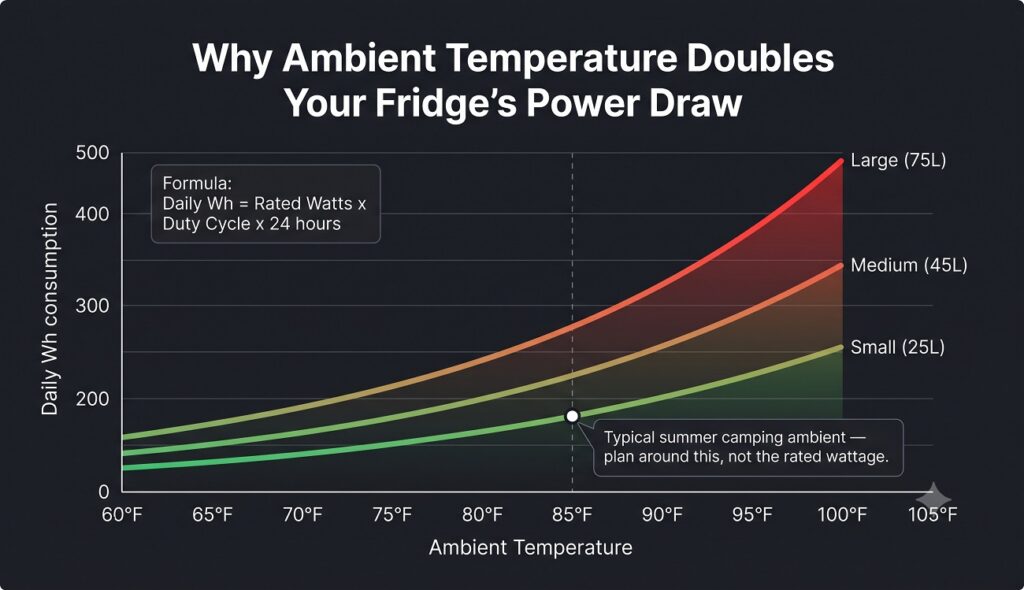
Factor 1 — Ambient temperature. This is the dominant variable. As a rule of engineering thumb, compressor duty cycle roughly doubles for every 18°F (10°C) rise in ambient temperature above the fridge’s target setting. A fridge maintaining 35°F in a 70°F tent works meaningfully less than the same fridge maintaining 35°F in a 95°F vehicle interior.
Factor 2 — Insulation quality. Thicker, higher-density foam insulation reduces heat transfer into the cabinet, directly reducing duty cycle. This is the single biggest quality differentiator between premium brands (Dometic, ARB, National Luna) and budget brands (most Alpicool, generic imports) — premium units use 2–3 inches of high-density polyurethane foam; budget units often use 1–1.5 inches of lower-density foam.
Factor 3 — Door opening frequency and cabinet fill level
Thermal Mass — The Zero-Cost Technique That Cuts Compressor Cycling
This technique costs nothing beyond a few reusable water bottles, yet it measurably reduces compressor duty cycle and therefore daily power consumption — making it one of the highest-value tips in this entire guide.
The mechanism: Air holds very little cold. When you open a fridge lid, the small volume of chilled air inside escapes almost immediately and is replaced by warmer ambient air, triggering a compressor recovery cycle to bring the temperature back down. A dense, solid mass of pre-frozen material — water, ice packs, or even frozen food itself — holds cold far more effectively than air and continues radiating cold into the cabinet even during and after a door opening, meaningfully reducing how hard and how often the compressor has to work to recover.
The practical technique:
Step 1 — Freeze water bottles or reusable ice packs solid before your trip, using your home freezer. Fill any genuinely empty space in the fridge cabinet with these, rather than leaving air gaps. A fridge packed to roughly 80-90% of its volume with a mix of food and frozen thermal mass runs a meaningfully lower duty cycle than the same fridge half-full of food surrounded by empty air.
Step 2 — Position the largest thermal mass items near the lid or door opening, where the most heat exchange occurs when the fridge is opened. This creates a buffer layer that absorbs incoming warm air before it reaches temperature-sensitive food deeper in the cabinet.
Step 3 — As you consume food and empty space increases through the trip, replace it with additional frozen water bottles rather than leaving the growing gap as air. Refreezing bottles is free every time you have access to a freezer — at a campground store, a gas station, or back at home base.
The quantifiable benefit: While the exact percentage varies by fridge model and trip conditions, a well-packed cabinet using thermal mass to eliminate air gaps consistently shows a lower duty cycle than a sparsely packed one in side-by-side testing – often in the range of a 10-15% reduction in daily Wh consumption for the same fridge and ambient conditions. Applied to the Dometic CFX3 45’s 360Wh/day figure at 85°F ambient calculated earlier in this guide, disciplined thermal mass packing can realistically bring that closer to 310-325Wh/day – extending your days of autonomy on any power station pairing without spending a single additional dollar.
A secondary benefit: Frozen water bottles used as thermal mass become drinking water as they thaw over the course of your trip — a genuinely useful dual-purpose technique for any multi-day camping or van life trip where clean water access is also a consideration.
Real-World Duty Cycle Data by Fridge Size
The table below reflects independently tested duty cycle behavior — the kind of data that does not appear on spec sheets — for a fridge maintaining 37°F at three realistic ambient temperature scenarios.
| Fridge Size | Rated Watts (compressor running) | Duty Cycle at 70°F Ambient | Duty Cycle at 85°F Ambient | Duty Cycle at 100°F Ambient |
|---|---|---|---|---|
| 12–20L (mini) | 20–30W | ~18% | ~30% | ~45% |
| 25–35L (single-zone small) | 40–48W | ~20% | ~33% | ~48% |
| 45–55L (single-zone medium) | 45–55W | ~22% | ~35% | ~50% |
| 65–75L (single-zone large) | 55–65W | ~24% | ~38% | ~52% |
| 75L+ dual-zone (fridge/freezer) | 60–75W | ~28% | ~42% | ~58% |
Converting Duty Cycle to Daily Watt-Hour Consumption
Formula: Daily Wh = Rated Watts × Duty Cycle × 24 hours
Example — 45L single-zone fridge at 85°F ambient (typical summer camping):
50W × 0.35 × 24 = 420Wh/day
Example — same fridge at 70°F ambient (mild fall camping):
50W × 0.22 × 24 = 264Wh/day
Example — same fridge at 100°F ambient (desert or closed vehicle in summer sun):
50W × 0.50 × 24 = 600Wh/day
This is the single most important number in this entire guide. Notice that the same fridge can consume more than double the power depending purely on ambient temperature. Any power station sizing based on the manufacturer’s rated wattage alone — without accounting for duty cycle and your actual climate — will be wrong, often badly.
The Lab Rule — Pre-Chill on Max, Maintain on Eco
Nearly every 12V compressor fridge in this guide, including all six recommended models, includes a selectable compressor mode — typically labeled Eco and Max (or Turbo). Understanding when to use each setting is one of the highest-value, zero-cost efficiency techniques available to any fridge owner, and it directly changes the daily watt-hour numbers calculated earlier in this guide.
What each mode actually does:
Max/Turbo mode runs the compressor at a higher RPM, cooling the cabinet faster but drawing meaningfully more power per hour the compressor is active — typically 15-25% higher wattage than Eco mode for the same fridge.
Eco mode runs the compressor at a lower, more efficient RPM. Cooling takes longer to reach the target temperature from a warm start, but once at temperature, Eco mode maintains it using meaningfully less energy per cycle.
The Lab Rule: Pre-chill on Max, Maintain on Eco.
The night before departure: Plug your fridge into a standard wall outlet at home (via the included AC adapter, not your power station) and run it in Max/Turbo mode for several hours before loading it into your vehicle. This brings the entire cabinet, including any thermal mass you have loaded (see the thermal mass section below), down to full target temperature using grid power — which costs a few cents of household electricity rather than any of your power station’s limited capacity.
Once on the road: Switch the fridge to Eco mode before connecting it to your power station or vehicle. Because the cabinet is already at temperature, Eco mode’s slower recovery speed is irrelevant — the fridge only needs to maintain temperature, not achieve it from a warm start. This is exactly the condition Eco mode is efficient at.
The real-world impact on the numbers in this guide: All of the daily Wh calculations presented earlier in this guide already assume Eco mode maintenance operation, since that reflects how the fridge should actually be run once loaded and traveling. A fridge left in Max mode throughout a trip – rather than switched to Eco after the initial pre-chill – can consume 15-25% more power than the figures shown, meaningfully shortening your days of autonomy on any of the power station pairings above.
The one exception: If you are restocking the fridge mid-trip with warm groceries from a store, a brief period in Max mode to bring the new items down to temperature quickly is appropriate – then switch back to Eco once the cabinet has recovered.
Sizing Your Fridge — Liters to Household Match
The Capacity Reference Table
| Fridge Size | Approx. Capacity | Best For | Typical Weight |
|---|---|---|---|
| 12–20L | 15–20 cans + small items | Solo motorcyclist, day-trip cooling, backup fridge | 15–20 lbs |
| 25–35L | 2–3 days food for 1–2 people | Solo/couple weekend camping | 25–33 lbs |
| 45–55L | 4–7 days food for 2 people, or 2–3 days for a family | Couples on extended trips, small families weekend | 35–48 lbs |
| 65–75L | 5–7 days for a family of 4 | Family camping, van life primary fridge | 48–60 lbs |
| 75L+ dual-zone | Fridge + separate freezer compartment | Extended van life, overlanding, hunting/fishing trips | 55–75 lbs |
The Practical Sizing Rule
Buy for your typical trip length and household size — not your longest theoretical trip. A 45L fridge run efficiently and restocked at a grocery store every 4–5 days serves most campers better than an oversized 75L unit that draws more power and takes up more vehicle space for capacity you rarely fill.
The van life exception: Full-time van lifers should size up. A 65–75L single-zone or 75L+ dual-zone unit reduces grocery run frequency — a genuine quality-of-life factor for people living out of a vehicle full-time, not just camping for a weekend.
The 6 Best 12V Compressor Fridges for Camping in 2026
#1 — Dometic CFX3 45 — Best Overall for Most Campers
The Dometic CFX3 45 is the reference standard against which every other 12V fridge in this guide is measured — and for most campers researching this purchase, it is the right answer without needing to compare further.
Why it leads:
- 43-liter capacity — genuinely holds 4–5 days of food for two people
- WiFi + Bluetooth app control — monitor and adjust temperature remotely, useful when the fridge is packed in a vehicle out of easy reach
- Premium high-density insulation delivers the best real-world duty cycle in this size class — approximately 30% at 85°F ambient (vs. 35% average for competitors)
- Low voltage cutoff protection with three selectable thresholds — critical for protecting your vehicle’s starter battery if running from a car outlet rather than a dedicated power station
- Genuine Secop compressor — the industry’s most field-proven compressor, used across multiple premium brands for over a decade
Real power math (45L, 85°F ambient, 30% duty cycle, 50W rated):
50W x 0.30 x 24 = 360Wh/day
Buy the Dometic CFX3 45 on Amazon
The Active Insulation Booster: Dometic and Iceco both offer thick, purpose-fit insulated transit covers for their fridge lines. Beyond scratch and impact protection during transport, these covers function as an additional insulation layer around the entire cabinet – reducing heat transfer into the fridge and measurably lowering compressor duty cycle, particularly when the fridge sits in direct sun or a hot vehicle interior for extended periods. Think of it less as a protective accessory and more as a performance upgrade that pays for itself in reduced power draw over a multi-day trip.
Buy the Dometic CFX3 45 Insulated Protective Cover on Amazon
#2 — ARB Elements 63-Quart — Best for Overlanding and Rugged Use
Built specifically for off-road and overlanding use, the ARB Elements line differentiates itself with a fully weatherproof design rated for direct rain exposure and dust ingress — a genuine engineering advantage over most competitors, which are designed for interior vehicle use only.
Why it leads for overlanding:
- IP66-rated cabinet seal — survives being mounted externally on a roof rack or truck bed in genuinely harsh conditions
- Reinforced housing designed for repeated off-road vibration
- Same class-leading Secop compressor as Dometic, with comparable duty cycle performance
- Robust recessed handles and tie-down points designed for secure mounting during rough terrain driving
The trade-off: ARB units carry a meaningful price premium over Dometic and Iceco for equivalent capacity, reflecting the weatherproofing and reinforced build — the right call if your fridge genuinely rides exposed to the elements, unnecessary expense if it stays inside a vehicle cabin or van.
Buy the ARB Elements 63-Quart on Amazon
#3 — Iceco VL45 — Best Value at the Medium Capacity Tier
Iceco has built a genuine reputation for delivering 80–90% of Dometic’s performance at a meaningfully lower price point, making the VL45 the value pick for buyers who want a compressor fridge (not a budget thermoelectric cooler) without the premium-brand price tag.
Why it earns the value recommendation:
- 42-liter dual-zone capacity — split fridge/freezer compartments, a rare feature at this price point
- Genuine compressor technology (not a rebadged budget import) with respectable duty cycle performance — approximately 34% at 85°F ambient
- Bluetooth app control included
- Detachable exterior battery box compatible for extended off-grid use
Real power math (42L dual-zone, 85°F ambient, 34% duty cycle, 55W rated):
55W x 0.34 x 24 = 449Wh/day
The Active Insulation Booster: Just as described earlier; Dometic and Iceco both offer thick, purpose-fit insulated transit covers for their fridge lines.
#4 — Alpicool C20 — Best Budget Entry Point
For buyers testing whether a compressor fridge fits their camping style before committing to a premium unit, the Alpicool C20 delivers genuine compressor cooling technology at the lowest price point in this guide.
The honest assessment:
- Real compressor technology — not thermoelectric — at a genuinely accessible price
- 20-liter capacity suits solo campers, motorcyclists, or as a dedicated drink/snack cooler alongside a larger main fridge
- Thinner insulation than premium brands results in a higher duty cycle — budget 40%+ at 85°F ambient, meaningfully more power-hungry per liter of capacity than the Dometic or Iceco
- Compressor and build quality are adequate for casual use but lack the multi-year field durability track record of Secop-powered premium units
Real power math (20L, 85°F ambient, 40% duty cycle, 28W rated):
28W x 0.40 x 24 = 269Wh/day
The verdict: A genuinely useful entry point into compressor refrigeration, appropriate for occasional weekend use. Frequent van lifers and serious overlanders should budget for the Dometic or Iceco tier instead — the efficiency difference compounds significantly over regular use.
Buy the Alpicool C20 on Amazon
#5 — Dometic CFX3 75DZ — Best for Families and Full-Time Van Life
The dual-zone 75-liter CFX3 is the fridge to buy once and never need to replace — genuinely sized for a family of four on a week-long trip, or a full-time van life couple who wants to minimize grocery runs.
Why it earns the family/full-time recommendation:
- 75-liter capacity split across independently controlled fridge and freezer zones — genuinely separate temperature control, not a single compartment with a divider
- Same premium insulation and Secop compressor performance as the smaller CFX3 units
- The largest genuinely portable single-compressor unit before stepping into built-in installed systems
Real power math (75L dual-zone, 85°F ambient, 42% duty cycle, 65W rated):
65W x 0.42 x 24 = 655Wh/day
Buy the Dometic CFX3 75DZ on Amazon
#6 — BougeRV 12V Fridge Freezer 12L — Best Ultra-Compact Option
For motorcyclists, ultralight overlanders, or anyone who wants true compressor cooling in a footprint that fits a small truck cab or ATV rack, the BougeRV 12L is the smallest genuinely useful compressor fridge on the market.
Real power math (12L, 85°F ambient, 32% duty cycle, 22W rated):
22W x 0.32 x 24 = 169Wh/day
Complete Fridge Comparison Table
| Fridge | Capacity | Rated Watts | Daily Wh (85°F ambient) | Weight | Best For |
|---|---|---|---|---|---|
| Dometic CFX3 45 | 43L | 50W | 360Wh | 40 lbs | Most campers — best overall |
| ARB Elements 63-Quart | 60L | 55W | ~470Wh | 55 lbs | Overlanding, exposed mounting |
| Iceco VL45 | 42L dual-zone | 55W | 449Wh | 42 lbs | Best value dual-zone |
| Alpicool C20 | 20L | 28W | 269Wh | 20 lbs | Budget entry point |
| Dometic CFX3 75DZ | 75L dual-zone | 65W | 655Wh | 62 lbs | Families, full-time van life |
| BougeRV 12L | 12L | 22W | 169Wh | 16 lbs | Ultra-compact, motorcycle/ATV |
Pairing Your Fridge with the Right Power Station — The Complete Math
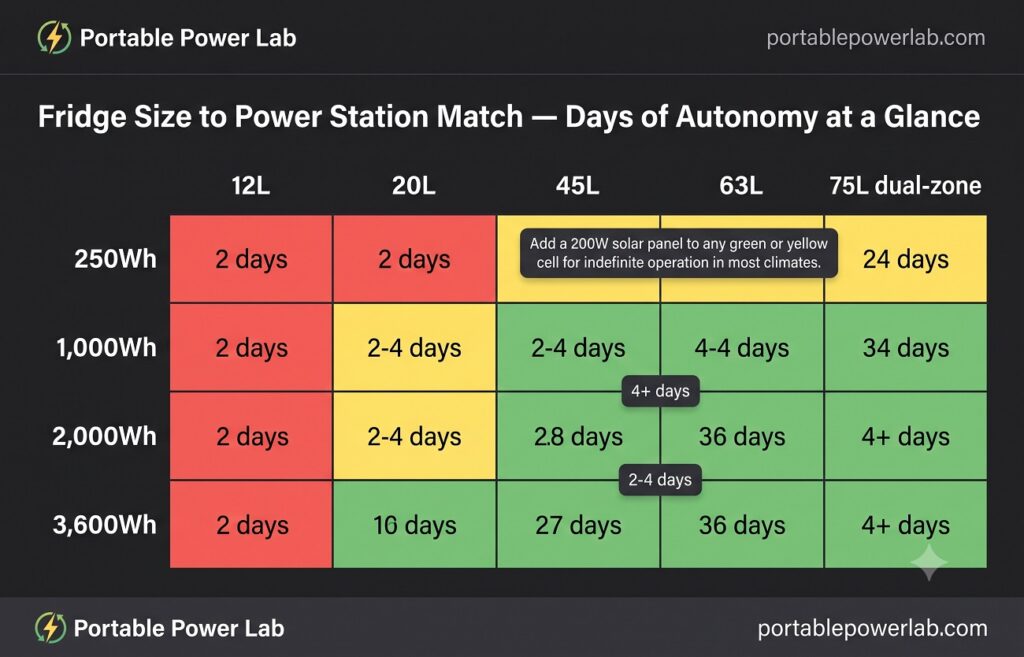
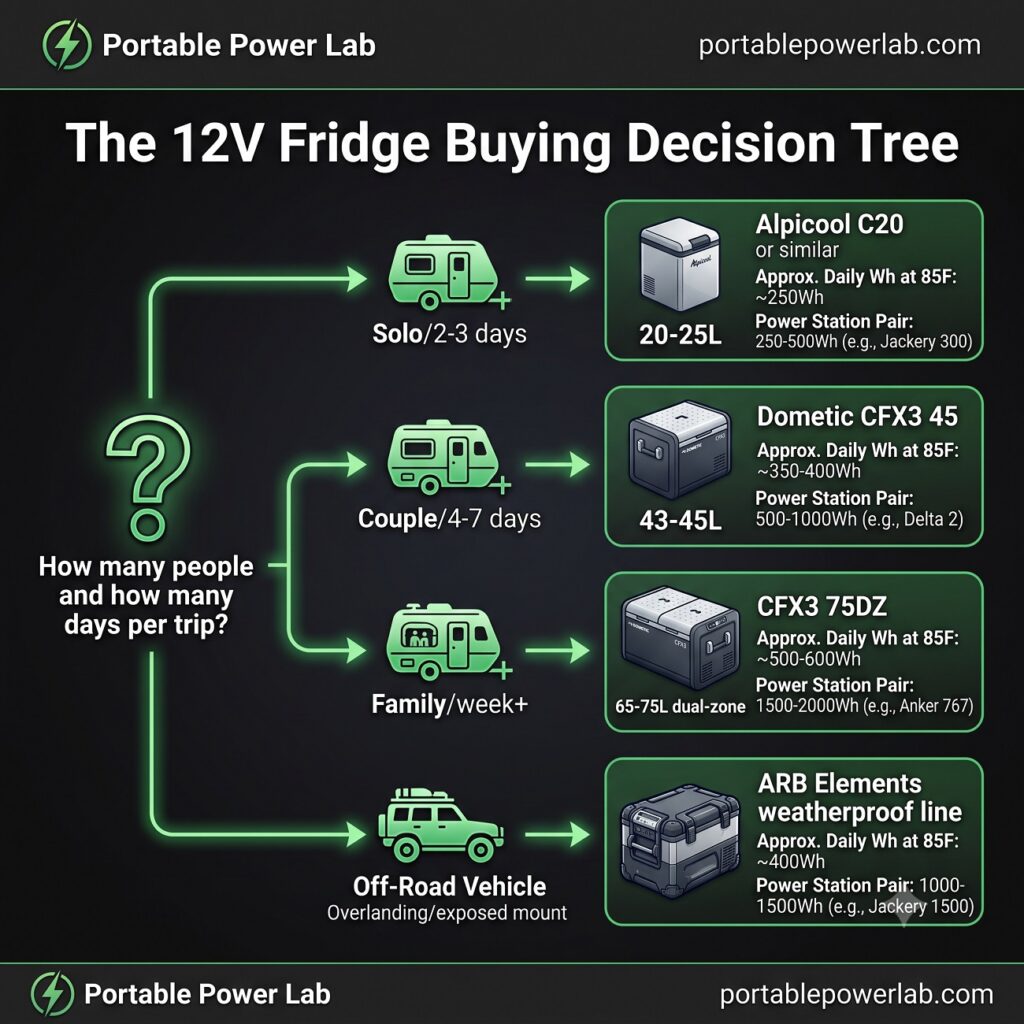
This is where the fridge purchase and the power station purchase become one decision. Below, every fridge from this guide is matched to the power stations reviewed elsewhere on this site, with exact days-of-autonomy calculations.
The Pairing Formula
Days of autonomy (no solar) = (Power station capacity x 0.87 efficiency) / Fridge daily Wh
Days of autonomy (with solar) = Days of autonomy (battery only) + solar contribution
Small Fridge (Alpicool C20, 269Wh/day) Power Station Pairings
| Power Station | Usable Capacity | Days of Autonomy (battery only) |
|---|---|---|
| Bluetti EB3A (268Wh) | 235Wh | Under 1 day — undersized |
| EcoFlow Delta 2 (1,024Wh) | 891Wh | 3.3 days |
| Jackery Explorer 1000 Plus (1,264Wh) | 1,100Wh | 4.1 days |
See the full Bluetti EB3A review: https://portablepowerlab.com/bluetti-eb3a-review/
Medium Fridge (Dometic CFX3 45, 360Wh/day) Power Station Pairings
| Power Station | Usable Capacity | Days of Autonomy (battery only) |
|---|---|---|
| EcoFlow Delta 2 (1,024Wh) | 891Wh | 2.5 days |
| Jackery Explorer 1000 Plus (1,264Wh) | 1,100Wh | 3.1 days |
| Jackery Explorer 2000 Plus (2,042Wh) | 1,797Wh | 5.0 days |
The Lab’s Indefinite Off-Grid Bundle
For campers and van lifers who want the complete solved system — a fridge that runs indefinitely without any manual intervention, restocking a battery, or watching a runtime countdown — the following three-item combination is the specific pairing that achieves genuinely indefinite operation in most US climates, based on the math calculated above.
| Component | Role | Link |
|---|---|---|
| Dometic CFX3 45 | The fridge — 360Wh/day at 85°F ambient | Amazon |
| Jackery Explorer 1000 Plus | The power bank — 1,100Wh usable capacity | Amazon |
| 200W Foldable Solar Panel | The daily recharge — approximately 800Wh generated per sunny day | Amazon |
The complete math: 360Wh/day consumed against 800Wh/day generated leaves a net daily surplus of 440Wh — meaning the fridge runs continuously, the power station recharges fully within a few hours of decent sun, and the system is limited only by extended stretches of cloudy weather rather than any fixed number of days. This is the bundle to recommend to anyone asking “how do I stop thinking about fridge power entirely.”
With a 200W solar panel added (5 sun hours, 80% efficiency = 800Wh/day generated):
A Jackery Explorer 1000 Plus running the CFX3 45 at 360Wh/day, with 800Wh/day of solar input, generates a net daily surplus of 440Wh — meaning the fridge runs indefinitely, limited only by consecutive cloudy days rather than fixed battery capacity.
See the complete Jackery Explorer 1000 Plus review: https://portablepowerlab.com/jackery-explorer-1000-plus-review/
Large Family Fridge (Dometic CFX3 75DZ, 655Wh/day) Power Station Pairings
| Power Station | Usable Capacity | Days of Autonomy (battery only) |
|---|---|---|
| Jackery Explorer 1000 Plus (1,264Wh) | 1,100Wh | 1.7 days — undersized for extended trips |
| Jackery Explorer 2000 Plus (2,042Wh) | 1,797Wh | 2.7 days |
| EcoFlow Delta Pro (3,600Wh) | 3,168Wh | 4.8 days |
The family van life recommendation: Pair the CFX3 75DZ with at minimum a 2,000Wh-class power station plus 200–400W of solar. Without solar, even a 2,000Wh unit only covers 2.7 days — genuinely inadequate for a week-long trip. Solar transforms this pairing from marginal to comfortable.
See the complete RV and Van Life power guide for full system sizing: https://portablepowerlab.com/best-portable-power-station-rv-van-life/
Setup and Installation Considerations
Low Voltage Cutoff — The Setting Every Buyer Must Configure Correctly
Every 12V compressor fridge includes a low voltage protection feature that shuts the fridge off before it can deep-discharge a connected battery below a safe threshold. Most units offer three selectable settings — typically labeled Low, Medium, and High protection.
The critical distinction for power station users: If you are running your fridge from a portable power station (not directly from a vehicle’s starter battery), you should generally select the Low protection setting. Your power station’s own internal battery management system already protects its LiFePO4 cells from over-discharge — a second, more conservative cutoff from the fridge itself simply wastes usable capacity by shutting the fridge off earlier than necessary.
If you are running the fridge directly from a vehicle’s starter battery (not recommended for extended use, but common for short trips), select Medium or High protection to avoid draining the battery below the threshold needed to start your engine.
Running Direct from Your Vehicle Battery — The Dual-Battery Isolator Solution
Some overlanders and hunters prefer running their fridge directly from their vehicle’s electrical system rather than a separate portable power station, particularly for shorter trips where the vehicle is driven daily and the alternator provides regular recharging. Done correctly, this is a legitimate approach — but it requires more than simply plugging into the vehicle’s existing 12V outlet.
The risk of a direct connection without isolation: Wiring your fridge directly to your starter battery, even with the fridge’s own low voltage cutoff engaged, risks draining the battery below the threshold needed to reliably start your engine — particularly on multi-day stops where the vehicle sits unused. The fridge’s cutoff protects the battery from complete discharge, but “not completely dead” and “has enough cranking power to start a cold engine” are different thresholds.
The correct solution — a dual-battery smart isolator: A dual-battery isolator kit adds a dedicated second (auxiliary) battery to your vehicle, wired through a smart isolator that charges the auxiliary battery from the alternator whenever the engine is running, while keeping it completely electrically separate from the starter battery at all other times. Your fridge draws exclusively from the auxiliary battery, meaning even a fully depleted auxiliary battery cannot prevent your vehicle from starting.
Buy a Dual-Battery Smart Isolator Kit on Amazon
The Lab’s recommendation: For genuinely occasional short trips with daily driving, a properly installed dual-battery isolator system is a sound, code-adjacent approach. For any trip involving multiple consecutive days without driving — which describes most of the camping and van life scenarios covered throughout this guide — a dedicated portable power station, ideally with solar as covered in the Indefinite Off-Grid Bundle above, remains the more reliable and flexible solution.
The Off-Road Connection — Avoiding the Loose Plug Disaster
This is the single most common real-world failure reported by overlanders and van lifers running a 12V fridge, and it has nothing to do with the fridge itself. It is a connector problem.
The failure mode: Standard 12V cigarette lighter plugs — the type included with most fridges as the default power cable — rely on spring-loaded contact tension inside the socket to maintain connection. On smooth pavement, this works fine indefinitely. On washboard dirt roads, rocky trails, or any sustained off-road vibration, the plug can work itself loose by a fraction of an inch — enough to break contact intermittently or entirely, without any obvious warning. The fridge silently loses power for hours while you drive, unaware, and by the time you notice, the interior has warmed and the food is at risk.
This is not a rare edge case. It is the top reported cause of spoiled food among overlanding and van life communities running 12V compressor fridges — more common than any compressor failure, insulation issue, or power station shortfall covered elsewhere in this guide.
Three fixes, in order of reliability:
Fix 1 — Threaded marine-grade 12V socket. Several manufacturers, including ARB, sell a locking threaded socket-and-plug combination designed specifically for this problem. The plug threads into the socket rather than relying on spring tension alone, making vibration-induced disconnection essentially impossible. If your fridge and vehicle both support this connector type, it is the single highest-value $15-20 upgrade available for any fridge that travels off-road regularly.
Buy a Threaded Marine-Grade 12V Socket and Plug Kit on Amazon
Fix 2 — Convert to Anderson Powerpole connectors. Anderson Powerpole connectors — the same connector standard used in amateur radio and off-grid solar installations — use a positive mechanical latch rather than spring-loaded friction. Once connected, they physically cannot vibrate loose. Converting your fridge’s power cable to Powerpole connectors on both the fridge end and the power station end is a more involved one-time modification, but it is the most bulletproof solution available and is the standard approach among serious overlanding builds.
Buy an Anderson Powerpole Connector Kit for 12V Fridge Wiring on Amazon
Fix 3 — Zip-tie or cable-lock retention (budget fix). If threading a new socket or converting connectors is not practical for your setup, a simple zip tie or dedicated cable retention clip securing the plug against the socket housing prevents it from working loose under vibration, even with the stock cigarette-lighter-style connector. This is not as reliable as Fixes 1 or 2, but it is a genuine improvement over a bare, unsecured plug for under $10.
Buy 12V Plug Cable Retention Clips on Amazon
The Lab’s recommendation: For any fridge that will regularly ride in a vehicle traveling unpaved or heavily vibrating roads — which includes most overlanding, van life, and hunting camp use cases covered throughout this site — budget for Fix 1 or Fix 2 at the time of your initial fridge and power station purchase. It is far cheaper and less disruptive than losing a fridge full of food three days into a remote trip.
Ventilation and Ambient Temperature Management
Compressor fridges reject heat through a radiator on the compressor housing, typically on one side or the rear of the unit. Placing the fridge in an enclosed cabinet with no airflow around the compressor housing forces it to work against its own rejected heat, increasing duty cycle and power consumption — sometimes significantly.
The practical fix: Leave at minimum 2 inches of clearance around the compressor housing (check your specific model’s manual for the exact vent location), and avoid placing the fridge in direct sun inside a vehicle. A simple reflective sunshade over a van window near the fridge measurably reduces ambient temperature and therefore power consumption.
Drainage and Condensation
Compressor fridges produce condensation, particularly in humid climates or when opened frequently. Most units include a drain plug. Position your fridge where minor condensation drainage will not damage surrounding gear — a rubber mat or tray underneath is a low-cost, high-value addition.
Maintenance and Longevity
What Actually Fails on a 12V Compressor Fridge
The compressor itself — almost universally a Secop/Danfoss unit across every reputable brand in this guide — is remarkably durable, with a field-proven lifespan of 8–12+ years of regular use. The components more likely to need attention over time are:
- Door gasket seals: Degrade with UV and temperature cycling over 4–6 years; a failing seal dramatically increases duty cycle as cold air leaks out continuously
- Power cable and connector: The most common failure point, particularly on units used in vibration-heavy overlanding applications
- Cooling fan (if equipped): Some larger units include a small fan to assist heat rejection from the compressor housing; this is a wear component with a typical 5–8 year lifespan
The maintenance routine that extends fridge life: Clean the compressor housing vents of dust and debris every few months (compressed air works well), inspect the door gasket annually for cracking or hardening, and avoid storing the fridge for extended periods with the compressor cold-soaked below its rated minimum operating temperature.
Frequently Asked Questions
How much power does a 12V fridge use per day while camping?
It depends heavily on ambient temperature, not just the fridge’s rated wattage. A typical 45-liter compressor fridge consumes approximately 260-360Wh per day at a comfortable 70°F ambient temperature, rising to 400-450Wh per day at a hot 85°F ambient, and up to 600Wh per day in extreme heat above 100°F. Always size your power station using the hot-weather estimate for your specific climate, not the manufacturer’s best-case rated wattage.
What size power station do I need to run a fridge for a week of camping?
For a medium 45-liter fridge averaging 400Wh per day in warm conditions, a week of camping requires approximately 2,800Wh of total energy. Without solar, this needs a power station in the 3,000-3,600Wh class, such as the EcoFlow Delta Pro. With a 200W solar panel contributing roughly 800Wh per sunny day, a 1,264Wh unit like the Jackery Explorer 1000 Plus can sustain the same fridge indefinitely, limited only by consecutive cloudy days.
Is a 12V compressor fridge better than a cooler with ice?
For any trip beyond 3-4 days, or any trip in genuinely hot conditions, yes decisively. A compressor fridge maintains a true, consistent temperature regardless of ambient heat, never requires ice resupply, and keeps food safely refrigerated for the entire trip. The trade-off is upfront cost and the need for a power source, whereas a cooler requires no electricity but degrades in performance as ice melts and needs regular resupply.
Can I run a 12V fridge directly from my car battery without a power station?
Yes for short trips, but with real risk. Running a fridge directly from a vehicle’s starter battery for more than a few hours risks draining the battery below the threshold needed to start your engine, particularly if the vehicle is not running. Most fridges include a low voltage cutoff to prevent this, but it is designed to protect the battery’s minimum function, not guarantee your vehicle will start afterward. For any trip longer than a single overnight stop, a dedicated power station or a proper dual-battery system with an isolator is the correct solution.
Do 12V fridges work well in cold weather too?
Yes, and this is an underappreciated advantage. A compressor fridge maintains its target temperature in cold ambient conditions just as reliably as in heat, and in fact runs its lowest duty cycle – and therefore lowest power consumption – in cool weather around 40-60°F ambient. The one consideration in genuinely freezing conditions is protecting the fridge’s own compressor from operating below its rated minimum temperature; check your specific model’s cold-weather operating range if winter camping in sub-freezing conditions.
Why did my 12V fridge lose power and spoil my food while driving off-road?
This is almost always a connector problem, not a fridge or power station failure. Standard cigarette-lighter-style 12V plugs rely on spring tension to stay seated in their socket, and sustained vibration from washboard roads or rough trails can work the plug loose enough to interrupt power intermittently or entirely, often without any obvious warning until the food has already warmed. The reliable fix is upgrading to a threaded, locking marine-grade socket and plug, or converting to Anderson Powerpole connectors, both of which use a positive mechanical connection that cannot vibrate loose. See the complete connector guide above.
See the complete cold weather power station guide: https://portablepowerlab.com/portable-power-station-cold-weather/
The Lab’s Verdict
| Fridge | Overall Rating | Best For | Power Station Pairing |
|---|---|---|---|
| Dometic CFX3 45 | 9.5/10 | Most campers, best overall | Jackery Explorer 1000 Plus + 200W solar |
| ARB Elements 63-Quart | 9.0/10 | Overlanding, weatherproof mounting | Jackery Explorer 2000 Plus |
| Iceco VL45 | 8.8/10 | Best value dual-zone | EcoFlow Delta 2 + 200W solar |
| Alpicool C20 | 7.5/10 | Budget entry point | Bluetti EB3A (marginal) or Delta 2 |
| Dometic CFX3 75DZ | 9.3/10 | Families, full-time van life | EcoFlow Delta Pro + solar |
| BougeRV 12L | 8.0/10 | Ultra-compact, motorcycle/ATV | EcoFlow River 2 series |
The bottom line: A 12V compressor fridge is the single highest-impact upgrade available to any camper or van lifer already running a power station — but only when the two are sized correctly together. Calculate your real daily watt-hour draw using your climate’s ambient temperature, not the fridge’s rated wattage, match it to a power station with enough usable capacity for your trip length, and add solar for any trip longer than 4-5 days. Get this pairing right, and your fridge becomes invisible infrastructure – it simply works, for the entire trip, every time.
See our complete guide to power stations for camping: https://portablepowerlab.com/best-portable-power-station-camping/ Calculate your complete camp power budget: https://portablepowerlab.com/appliance-wattage-chart/
Browse 12V Compressor Fridges on Amazon
Portable Power Lab — Real Math. No Fluff. Independent since 2025.