Affiliate Disclosure: As an Amazon Associate, Portable Power Lab earns from qualifying purchases at no extra cost to you.
Last Updated: April 2026 | Reading time: ~11 minutes
Here’s the job site reality that nobody in portable power marketing wants to talk about.
A $149 cordless drill doesn’t replace a corded circular saw. And a 1,000Wh portable power station doesn’t replace a gas generator for sustained heavy-tool use on a remote job site.
But here’s what’s also true — and what this guide will prove with math:
For the majority of trade and contractor scenarios, a properly-sized portable power station does the job better than a gas generator. Quieter neighborhoods. No exhaust in enclosed spaces. No $5/gallon fuel runs. No pull-cord that won’t start at 7 AM in January.
The key phrase is “properly-sized.” Most contractors who tried a power station and gave up bought the wrong unit for their actual tool load.
This guide fixes that.
Understand running watts vs startup surge before buying
The Job Site Power Challenge: Why Tools Are Hard
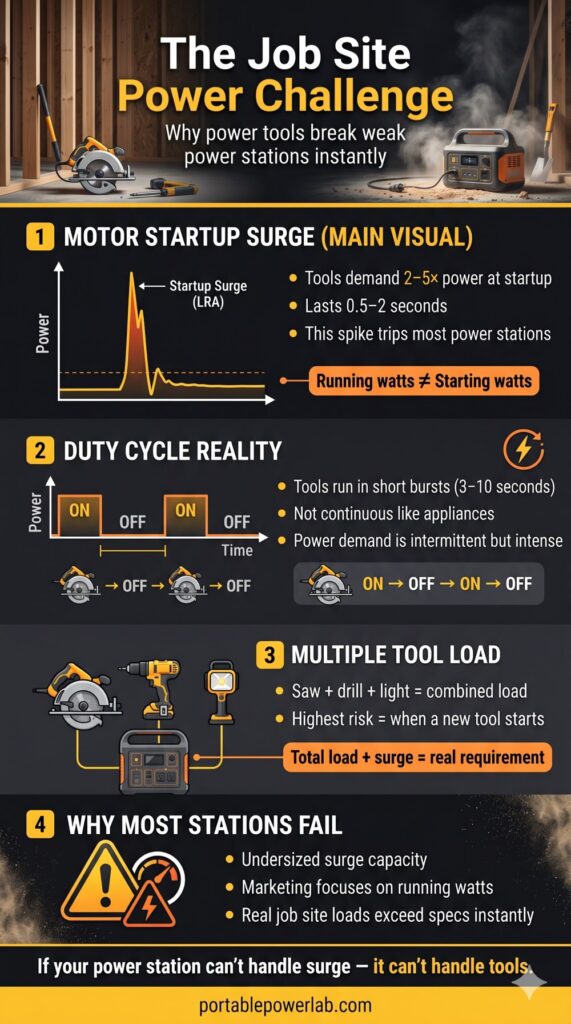
Portable power station specs are set in offices by engineers who’ve never framed a house. Here’s the real-world challenge:
Motor startup surge: Power tools with motors (circular saw, drill, air compressor) demand 2–5× their running wattage for 0.5–2 seconds at startup. This is the Locked Rotor Amperage (LRA) that most power station buyers ignore and most retailers never mention.
Duty cycle: On a real job site, tools don’t run continuously. A circular saw runs for 3–10 seconds per cut, then stops. This dramatically changes the power math compared to appliances that run continuously.
Multiple simultaneous tools: Running a saw, a drill, and a work light simultaneously requires a station that can handle the combined running load plus the surge of whichever tool starts last.
Job Site Tool Wattage: The Real Numbers
These are the numbers you actually need for job site power planning:
| Tool | Running Watts | Startup Surge | Duty Cycle | Avg Draw |
|---|---|---|---|---|
| Corded Drill (½ inch) | 500–700W | 1,000–1,400W | ~20% | 100–140W |
| Circular Saw (7¼ inch) | 1,200–1,800W | 2,400–3,600W | ~15% | 180–270W |
| Jigsaw | 400–600W | 800–1,200W | ~25% | 100–150W |
| Reciprocating Saw | 700–1,100W | 1,400–2,200W | ~20% | 140–220W |
| Belt Sander | 600–1,000W | 1,200–2,000W | ~30% | 180–300W |
| Angle Grinder (4½ inch) | 600–900W | 1,200–1,800W | ~20% | 120–180W |
| Orbital Sander | 200–400W | 400–800W | ~40% | 80–160W |
| Router | 800–1,800W | 1,600–3,600W | ~25% | 200–450W |
| Table Saw (10 inch, portable) | 1,200–1,800W | 3,600–5,400W | ~15% | 180–270W |
| Air Compressor (1 HP) | 1,200–2,000W | 4,800–6,000W | ~30% | 360–600W |
| Air Compressor (¾ HP) | 900–1,500W | 3,600–5,500W | ~30% | 270–450W |
| Shop Vac (6 gallon) | 800–1,200W | 1,600–2,400W | ~20% | 160–240W |
| LED Work Light (500W equiv.) | 50–80W | None | 100% | 50–80W |
| Job Site Radio | 15–30W | None | 100% | 15–30W |
| Battery Charger (power tool) | 100–150W | None | ~50% | 50–75W |
The critical insight: Despite their terrifying startup surges, power tools have low average draws because of their duty cycle. A circular saw averaging 15% duty cycle draws only 180–270W average — about the same as a laptop. This is why a properly-sized power station can run a full day of intermittent tool use on a single charge.
The exception: Air compressors. Their duty cycle combined with high surge makes them the hardest job site load by far. For sustained air compressor use (finish nailer, spray painter), gas remains more practical.
The Generator Compatibility Chart: Which Station Runs Which Tools
| Power Station | Surge Rating | Circular Saw? | Table Saw? | Air Compressor (¾ HP)? | Recommended For |
|---|---|---|---|---|---|
| EcoFlow River 2 | 600W | ❌ No | ❌ No | ❌ No | LED lights, charging only |
| Jackery 300 Plus | 600W | ❌ No | ❌ No | ❌ No | Lighting, device charging |
| Bluetti AC180 | 3,600W | ✅ Yes | ⚠️ Borderline | ❌ No | Light tools, drills, sanders |
| EcoFlow Delta 2 | 2,700W | ✅ Yes | ❌ No | ❌ No | Saws, drills, small compressors |
| Jackery 1000 Plus | 4,000W | ✅ Yes | ⚠️ Borderline | ❌ No | Most hand tools |
| Anker Solix C1000 | 4,000W | ✅ Yes | ⚠️ Borderline | ❌ No | Most hand tools |
| Bluetti AC200L | 4,800W | ✅ Yes | ⚠️ Borderline | ❌ No | All hand tools + small compressors |
| EcoFlow Delta Pro | 7,200W | ✅ Yes | ✅ Yes | ✅ ¾ HP | Professional contractor use |
| Jackery 2000 Plus | 6,000W | ✅ Yes | ✅ Yes | ⚠️ ¾ HP | High-power contractor use |
🏆 The 4 Best Portable Power Station for a Job Site in 2026
#1 — EcoFlow Delta Pro: The Professional Contractor’s Choice
→ Check Current Price on Amazon
The Delta Pro is the only mainstream portable power station that legitimately replaces a gas generator for heavy contractor use. Its 7,200W peak surge handles table saws, ¾ HP air compressors, and high-draw routers.
Why contractors choose the Delta Pro:
- 7,200W surge — starts a 10-inch table saw (3,600–5,400W surge) with room to spare
- 3,600W continuous — runs multiple tools simultaneously without throttling
- 3,600Wh capacity — at 200W average job site draw: 16+ hours of use per charge
- 1,600W solar input — on a south-facing roof rack, can recharge significantly during the workday
- Silent — work in noise-restricted areas, occupied buildings, and residential neighborhoods without permits or complaints
Job site runtime calculation: Circular saw (180W avg duty) + LED work lights (80W) + battery charger (75W) + shop vac (160W avg) = 495W average load
(3,600Wh × 0.88) ÷ 495W = 6.4 hours of sustained tool use
For most job sites, that’s a full workday. Add a 400W solar setup on your truck roof and you’re extending into 8-hour territory.
See how battery power stations compare to gas generators on cost

🛒 EcoFlow Delta Pro on Amazon →
🛒 EcoFlow 400W Solar Panel Set →

#2 — Jackery Explorer 2000 Plus: Best All-Round Contractor Station
→ Check Current Price on Amazon
At 6,000W surge and 2,042Wh capacity, the Jackery 2000 Plus handles most contractor tools at a meaningfully lower price point than the Delta Pro.
What it handles vs. the Delta Pro:
- ✅ Circular saw (3,600W surge max): Yes
- ✅ Jigsaw, belt sander, grinder: Yes
- ⚠️ 10-inch table saw (4,000–5,400W surge): Borderline — starts on new blades, may trip on hard cuts
- ⚠️ ¾ HP air compressor (5,500W surge): Borderline
- ❌ 1 HP air compressor (6,000W surge): At absolute limit — unreliable
Best for: Finish carpenters, tile setters, electricians, painters, and most residential trade contractors who don’t need sustained air compressor power.
Runtime (400W average job site load): (2,042Wh × 0.88) ÷ 400W = 4.5 hours
With 800W solar panels at 5 hours sun: +3,200Wh generated. Extends runtime to 12+ hours — all day.
🛒 Jackery Explorer 2000 Plus on Amazon →
#3 — Anker Solix F3800: Best Future-Proof Investment
→ Check Current Price on Amazon
The Anker Solix F3800 is a 3,840Wh, 6,000W surge monster that splits the difference between portable power station and home backup system. For contractors who also want to use their job site power for home emergency backup, it’s the most versatile investment.
The F3800’s job site advantages:
- 3,840Wh at 6,000W surge — true all-day job site power
- Handles table saw, compressor, and all hand tools
- Expandable to 26.9kWh — grows with your needs
- EV charging capability — charge an electric work truck from the job site
🛒 Anker Solix F3800 on Amazon →
#4 — EcoFlow Delta 2 + Jackery Explorer 1000 Plus: Best for Light Trade Contractors
For electricians, plumbers, painters, and finish contractors who primarily use drills, reciprocating saws, and sanders — not circular saws or compressors — the Delta 2 or Jackery 1000 Plus covers the job site load at half the cost of the Delta Pro.
Jackery 1000 Plus (4,000W surge) handles:
- ✅ Any corded drill
- ✅ Circular saw (starts cleanly up to 7¼ inch)
- ✅ Jigsaw, reciprocating saw, grinder
- ✅ Shop vac
- ✅ LED work lighting array
- ⚠️ Small pancake air compressor (dependent on model — test first)
EcoFlow Delta 2 (2,700W surge) handles:
- ✅ Drills, sanders, jigsaws
- ✅ LED lighting
- ⚠️ Circular saw — borderline; works on clear cuts, may trip on hard cross-grain cuts
- ❌ Air compressors
🛒 Jackery Explorer 1000 Plus on Amazon →
🛒 EcoFlow Delta 2 on Amazon →
💰 Job Site Power Station vs. Gas Generator: The True Cost
| Category | Gas Generator (3,500W) | Battery Station (Delta Pro) |
|---|---|---|
| Purchase price | ~$600–$1,200 | ~$2,500–$3,000 |
| Fuel per 8-hour day | ~4 gallons × $4 = $16/day | $0 (solar recharge) |
| Annual fuel (200 working days) | $3,200/yr | $0 |
| Annual maintenance | ~$200/yr | ~$0 |
| Noise citations/restrictions | Real risk in residential areas | Zero |
| EPA emission permits | Required in some jurisdictions | Not applicable |
| 5-year total cost | ~$8,600 | ~$3,000 |
The math is decisive for contractors who work in residential areas. At 200 job days/year, the Delta Pro pays for itself in fuel savings in under 2 years — and you never have to ask a homeowner if it’s okay to run a generator.
Job Site Power Station Setup Guide
For maximum job site effectiveness:
- Charge at home overnight — all major units charge to full in 1–3 hours at home
- Mount panels on your truck/van roof — 200–400W of roof-mounted panels recharge the station while you drive to the site and during the workday
- Use a 12-gauge extension cord — 25 feet minimum, 50 feet for larger sites. Wire gauge matters on 1,800W+ tool draws.
- Keep the station in shade — battery temperature affects capacity; don’t leave it baking in the truck
- Run one high-surge tool at a time — don’t start the circular saw and the compressor simultaneously
🛒 12-Gauge Heavy-Duty Extension Cord (50 ft) →
🛒 200W Roof-Mountable Solar Panel →
Can a portable power station run a circular saw?
Yes, with the right unit. You need at minimum 2,700W surge (EcoFlow Delta 2) for a 7¼-inch circular saw. For reliable performance through hard cuts, choose a unit with 4,000W+ surge (Jackery 1000 Plus, Anker C1000, or above).
Can a portable power station run an air compressor?
Most cannot run a standard 1 HP air compressor reliably. The 6,000W+ startup surge exceeds all but the largest portable stations (Delta Pro, Jackery 2000 Plus). Pancake compressors rated ½ HP or smaller work with 4,000W+ surge units.
How long will a power station run job site tools?
At 400W average job site draw (circular saw + drill + lights, duty-cycle adjusted): an EcoFlow Delta 2 (1,024Wh) runs 2 hours; a Delta Pro (3,600Wh) runs 8 hours. Add 400W of solar panels to extend indefinitely in good sun.
Is it worth getting a power station over a gas generator for a job site?
For most residential contractors: yes, within 2 years in fuel savings. For jobs requiring sustained air compressor use or table saw operation in remote areas: gas remains more practical for the heaviest loads.