Affiliate Disclosure: As an Amazon Associate, Portable Power Lab earns from qualifying purchases at no extra cost to you.
Last Updated: April 2026 | Reading time: ~13 minutes
When you’re shopping for a portable power station, you’ll encounter three acronyms that most buyers ignore — and most sales pages deliberately obscure:
LiFePO4 vs NMC vs NCA.
These aren’t marketing terms. They’re the fundamental chemistry of your battery — and they determine how long it lasts, how safe it is, whether it still works reliably after 3 years, and what happens to it when it finally reaches the end of its useful life.
Here’s the plain-English guide every buyer should read before spending $200–$3,000 on a portable power station.
Before comparing chemistry, know your appliance wattage needs
🔋 Battery Storage Decay Visualizer
See exactly how much charge your power station retains over time — by chemistry type and storage conditions.
The Three Battery Chemistries: What They Actually Are
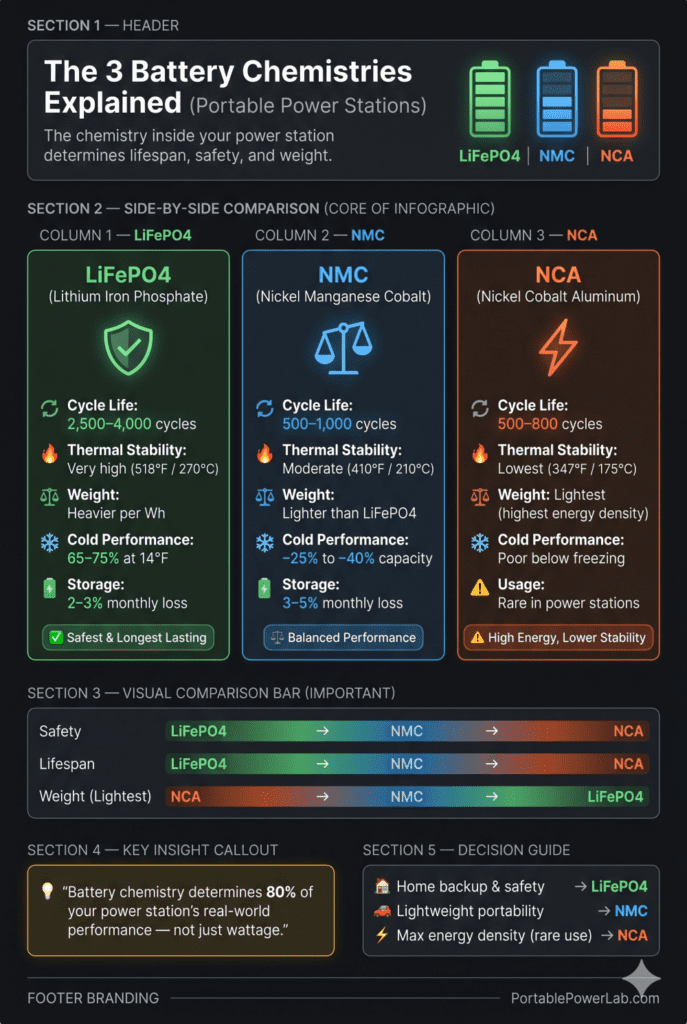
LiFePO4 (Lithium Iron Phosphate)
LiFePO4 uses an iron-phosphate cathode. The iron-phosphate chemical bond is inherently stable — it doesn’t break down easily under heat or electrical stress. This stability is why LiFePO4 dominates the premium portable power station market in 2026.
Real-world characteristics:
- Cycle life: 2,500–4,000 cycles
- Thermal runaway temperature: 518°F (270°C) — very difficult to ignite
- Energy density: Lower (heavier per watt-hour than NMC)
- Cold weather: Maintains ~65–75% capacity at 14°F (-10°C)
- Self-discharge rate: ~2–3% per month (excellent long-term storage)
NMC (Nickel Manganese Cobalt)
NMC uses a nickel-manganese-cobalt cathode. Higher energy density means more watt-hours per pound — making units lighter — but the chemistry is less stable under heat and electrical stress.
Real-world characteristics:
- Cycle life: 500–1,000 cycles
- Thermal runaway temperature: 410°F (210°C) — can ignite under certain failure conditions
- Energy density: Higher (lighter per watt-hour than LiFePO4)
- Cold weather: Loses 25–40% capacity at 14°F (-10°C)
- Self-discharge rate: ~3–5% per month
NCA (Nickel Cobalt Aluminum)
NCA uses a nickel-cobalt-aluminum cathode. Tesla pioneered its use in EVs. Highest energy density, but most thermally sensitive of the three.
Real-world characteristics:
- Cycle life: 500–800 cycles
- Thermal runaway temperature: 347°F (175°C) — requires active thermal management
- Energy density: Highest (lightest per watt-hour)
- Cold weather: Significant capacity loss below freezing
- Note: Rarely used in portable power stations — primarily found in EV batteries
The Numbers That Change Your Purchase Decision
Cycle Life Comparison — The Only Math That Matters for Long-Term Value
| Chemistry | Rated Cycles | Daily Use Lifespan | Cost per Cycle ($800 purchase) |
|---|---|---|---|
| NMC (budget units) | 500 | 1.4 years | $1.60 per cycle |
| NMC (premium units) | 1,000 | 2.7 years | $0.80 per cycle |
| LiFePO4 (standard) | 3,000 | 8.2 years | $0.27 per cycle |
| LiFePO4 (Jackery 1000 Plus) | 4,000 | 11 years | $0.20 per cycle |
The 10-year true cost of an $800 NMC unit vs. an $800 LiFePO4 unit:
| Scenario | NMC (500-cycle unit) | LiFePO4 (3,000-cycle unit) |
|---|---|---|
| Units purchased over 10 years | 7 replacements | 1 unit |
| Total 10-year spend | $5,600 | $800 |
| Cost advantage | — | $4,800 savings |
LiFePO4 is 700% more cost-effective over a decade of daily use. This is the statistic that should precede every power station purchase decision.
See which brands deliver genuine LiFePO4 at every price tier
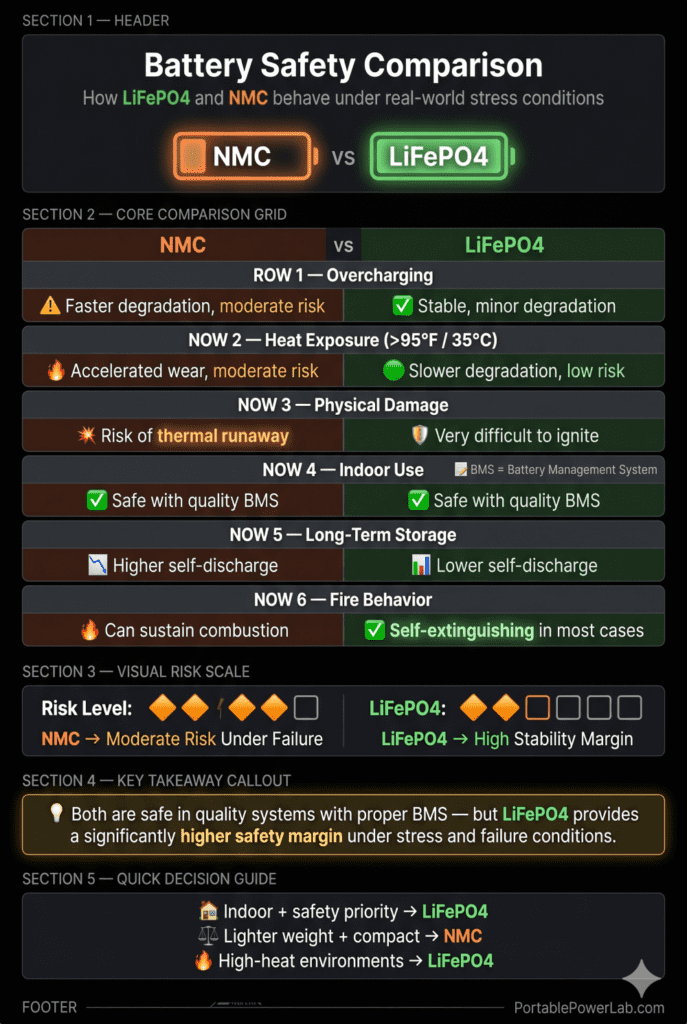
Safety Comparison: What Happens When Things Go Wrong
| Scenario | NMC | LiFePO4 |
|---|---|---|
| Overcharging to 100% | Degrades faster, moderate risk | Safe, minor degradation |
| Prolonged heat exposure (>95°F) | Accelerated degradation, moderate risk | Slower degradation, low risk |
| Physical damage to cells | Risk of thermal runaway | Very difficult to ignite |
| Indoor use | Safe with quality BMS | ✅ Safe with quality BMS |
| Long-term storage (months) | Higher self-discharge | Lower self-discharge |
| Fire behavior in thermal event | Can sustain combustion | Self-extinguishing in most cases |
The safety bottom line: Both chemistries are safe in quality products from established brands with proper BMS systems. LiFePO4 has a meaningful safety margin over NMC in failure scenarios — it’s simply harder to ignite and more self-extinguishing.
Cold Weather Performance: The Winter Outage Reality
| Temperature | NMC Capacity | LiFePO4 Capacity | Real-World Impact |
|---|---|---|---|
| 77°F (25°C) — room temp | 100% | 100% | No difference |
| 32°F (0°C) — freezing | ~85% | ~90% | Minor difference |
| 14°F (-10°C) — cold winter | ~65% | ~75% | LiFePO4 runs 15% longer |
| -4°F (-20°C) — extreme cold | ~45% | ~60% | LiFePO4 runs 33% longer |
Critical cold-weather note: Never charge LiFePO4 batteries below 32°F (0°C). Charging below freezing causes lithium plating on the anode — permanent, irreversible cell damage. All quality brands (EcoFlow, Jackery, Bluetti, Anker) include BMS protection that prevents charging at sub-freezing temperatures. Do not attempt to override this protection.
🗓️ Self-Discharge During Storage: The Factor That Matters for Emergency-Only Buyers
The chemistry comparison above focused on cycle life — relevant if you’re using your power station regularly. But there’s a large category of buyers who purchase a power station primarily for emergencies: a once-a-year hurricane, an occasional ice storm, a “just-in-case” preparedness item.
For these buyers, self-discharge rate during storage may matter more than cycle life. Here’s why: if you charge your power station in October and don’t use it until the following October, how much charge will actually be there when you need it?
Self-Discharge Rate by Chemistry
| Chemistry | Monthly Self-Discharge | After 3 Months | After 6 Months | After 12 Months |
|---|---|---|---|---|
| LiFePO4 (premium BMS) | 1–3% | 88–94% | 78–88% | 62–78% |
| LiFePO4 (budget BMS) | 2–5% | 78–88% | 60–78% | 38–62% |
| NMC (premium BMS) | 3–5% | 82–88% | 68–78% | 44–62% |
| NMC (budget BMS) | 5–8% | 70–82% | 46–66% | 10–42% |
The emergency preparedness reality:
A premium LiFePO4 unit stored for 12 months at 80% initial charge (recommended storage level):
80% × 0.85 average retention = ~68% charge remaining after one year
On a 1,000Wh unit: 680Wh available → 680 × 0.87 efficiency = 592Wh usable when you finally need it.
That’s enough for a full-night CPAP, overnight refrigerator cycling, and device charging — meaningful emergency backup even after a year of storage.
The same scenario with a budget NMC unit:
80% × 0.72 average NMC retention = ~58% charge remaining after one year
On a 1,000Wh unit: only 504Wh usable — 15% less than the LiFePO4 unit — and it’ll only get worse as NMC cells age faster.
Storage Capacity Retention Chart
| Storage Period | LiFePO4 Premium | LiFePO4 Budget | NMC Premium | NMC Budget |
|---|---|---|---|---|
| Stored at: | 80% charge | 80% charge | 80% charge | 80% charge |
| After 1 month | ~78–79% | ~76–78% | ~76–77% | ~73–75% |
| After 3 months | ~75–77% | ~70–74% | ~72–74% | ~62–68% |
| After 6 months | ~70–73% | ~62–68% | ~65–70% | ~50–60% |
| After 12 months | ~63–68% | ~50–60% | ~52–60% | ~35–50% |
Assumes storage at 60–77°F (15–25°C). Heat dramatically accelerates self-discharge.
The Emergency Preparedness Protocol
For emergency-only buyers, follow this protocol to maximize charge available when you need it:
- Charge to 80% (not 100%) — slightly counterintuitive, but 80% is the electrochemically stable storage level for LiFePO4
- Check every 3 months — plug in and top off to 80% if below 60%
- Store at room temperature — garages that exceed 90°F in summer dramatically accelerate discharge
- Test quarterly — plug in a device for 30 minutes to confirm the unit works and the BMS is healthy
The annual “emergency check” calendar:
- January: Charge to 80%, test function
- April: Check level, top off if below 60%
- July: Check level (heat accelerates discharge), top off
- October: Pre-storm season — charge to 90–100% for active readiness
The complete emergency power checklist for long-term storage
Which Products Use Which Chemistry
LiFePO4 Products (Recommended for Most Buyers)
| Brand | LiFePO4 Models | Amazon |
|---|---|---|
| Jackery | All Explorer Plus series | Shop Jackery → |
| EcoFlow | Delta 2, Delta 2 Max, Delta Pro, River 2 series | Shop EcoFlow → |
| Bluetti | AC180, AC200L, AC300, EB3A | Shop Bluetti → |
| Anker Solix | C300, C800, C1000, F3800 | Shop Anker → |
| Goal Zero | Yeti Pro series only | Shop Goal Zero → |
NMC Products (Acceptable for Occasional Use Only)
- Goal Zero Yeti 200X, 500X, 700 (entry/mid range — NMC, not LiFePO4)
- Most no-name/budget brands
- Older Jackery Explorer V series (not the Plus series)
The Lab Rule: Never buy NMC if you plan to use your power station more than 2–3 times per week. The cycle life math makes NMC a false economy within 18 months of regular use.
The BMS: Why Chemistry Alone Isn’t the Full Story
Battery Management System (BMS) quality matters as much as chemistry. A poor BMS on a LiFePO4 battery can deliver worse real-world performance than a premium BMS on NMC.
What a quality BMS does for you:
| BMS Function | Why It Matters |
|---|---|
| Temperature monitoring (continuous) | Prevents charging below 32°F — stops lithium plating |
| Cell balancing | Ensures all cells charge and discharge evenly — prevents one weak cell from degrading the whole pack |
| Overcharge protection | Cuts charging at full capacity — prevents heat buildup and chemical stress |
| Over-discharge protection | Disconnects at ~10–15% — prevents irreversible deep discharge damage |
| Short circuit protection | Trips within milliseconds — prevents thermal events from external faults |
| State of Health tracking | Reports actual capacity vs. original spec — tells you when degradation is occurring |
BMS quality indicators to look for:
- Brand reputation and track record (Jackery, EcoFlow, Bluetti, Anker)
- Third-party safety certifications (UL Listed, ETL Certified)
- App transparency: does the app show battery temperature, cell voltage, state of health?
No-name brands often use cheap BMS hardware that undermines good chemistry. This is why brand selection matters as much as chemistry selection.
The Buying Decision Matrix
| Your Use Case | Chemistry | Why | Best Option |
|---|---|---|---|
| Daily home backup | LiFePO4 | Cycle life is the defining factor | EcoFlow Delta 2 → |
| Camping (weekly) | LiFePO4 | Better; NMC barely acceptable at this frequency | Jackery 1000 Plus → |
| Cold climate use | LiFePO4 | Better cold weather capacity retention | Bluetti AC200L → |
| Emergency only (monthly) | Either | NMC acceptable at this low frequency | EcoFlow River 2 → |
| Medical device backup | LiFePO4 | Safety and reliability demand the best chemistry | Jackery 1000 Plus → |
| Budget constrained | LiFePO4 budget models | EcoFlow River 2, Bluetti EB3A at ~$199 | EcoFlow River 2 → |
♻️ End-of-Life: How to Responsibly Recycle Your Power Station Battery
This section addresses what 99% of portable power station guides never mention — and what an increasing number of environmentally conscious buyers specifically search for before making their purchase.
Lithium batteries contain materials including lithium, cobalt, nickel, and manganese that require proper handling at end of life. They should never go in household trash or standard recycling bins. A damaged or improperly disposed lithium battery is a fire and contamination risk.
The Good News: LiFePO4 Is the Most Recyclable Chemistry
LiFePO4 contains no cobalt — the most ethically and environmentally problematic element in NMC and NCA batteries. This makes LiFePO4:
- Less toxic to recycle
- More straightforward to process
- Free from the supply chain concerns associated with cobalt mining
LiFePO4 also has a longer service life (3,000–4,000 cycles), meaning fewer units end up in the waste stream per year of service compared to NMC.
How to Recycle Your Power Station Battery
Option 1: Manufacturer Takeback Programs
Several major brands offer end-of-life recycling:
- Jackery: Has a recycling program; contact customer support for current options
- EcoFlow: Accepts units for recycling through their US service centers
- Bluetti: Working with certified recyclers; check their support page for current program
- Goal Zero / NRG Energy: Established recycling partnership program
Option 2: Call2Recycle (US National Program)
Call2Recycle is the most comprehensive US lithium battery recycling network. They accept portable lithium batteries including power station packs at thousands of drop-off locations nationwide.
Find your nearest drop-off location at: call2recycle.org (search by zip code)
Option 3: Earth911 Recycler Search
Earth911 maintains a searchable database of recyclers that accept lithium batteries.
Search at: earth911.com/recycling-guide/how-to-recycle-lithium-batteries/
Option 4: Best Buy, Home Depot, Staples
Major retailers accept lithium batteries for recycling in-store. Large format batteries (portable power station size) may require special arrangement — call ahead.
Safe Storage Before Recycling
If you’re not ready to recycle immediately:
- Store at 20–40% charge (not 0%, not 100%)
- Keep in a cool, dry location away from flammable materials
- Do not store damaged units indoors — fire risk from compromised cells
- For damaged units: place in a non-flammable container (metal bucket with dry sand) and contact a local hazardous waste facility for disposal guidance
What Happens to Recycled Lithium Batteries?
Recovered materials from lithium batteries include:
- Lithium: Reprocessed into new battery-grade lithium carbonate
- Iron/phosphate (LiFePO4): Used in steel manufacturing and agricultural products
- Cobalt (NMC): Highest-value recovered material; used in new battery production
- Aluminum, copper, steel: Recovered as scrap metals
Battery recycling recovers approximately 75–95% of the raw materials by weight when processed by certified recyclers — giving your old power station a legitimate second life.
The Lab’s Chemistry Verdict
Always buy LiFePO4. The price premium at entry level ($30–$80 over comparable NMC units) pays for itself within 18 months of regular use, delivers better cold-weather performance, operates more safely, and results in fewer units entering the waste stream due to dramatically longer service life.
When your LiFePO4 unit eventually reaches end of life — likely 8–11 years from now — the recycling infrastructure will be even more developed than today. You’ll be returning a unit that contains no cobalt, is straightforward to process, and can have 80%+ of its materials returned to the supply chain.
🛒 Shop LiFePO4 Power Stations on Amazon →
Is LiFePO4 better than lithium-ion?
LiFePO4 is a lithium-ion chemistry — specifically a lithium iron phosphate variant. Compared to NMC lithium-ion, LiFePO4 offers 5–8× longer cycle life and better thermal stability, at the cost of slightly lower energy density (heavier for same capacity).
Does LiFePO4 work in cold weather?
Yes, better than NMC. LiFePO4 retains ~75% capacity at 14°F (-10°C); NMC retains only ~65%. However, charging LiFePO4 below 32°F (0°C) causes permanent damage — most quality BMS systems prevent this automatically.
How do I dispose of a portable power station battery?
Never in household trash. Use manufacturer takeback programs, Call2Recycle drop-off locations, or contact your local hazardous waste facility. LiFePO4 batteries are the most environmentally benign lithium chemistry — no cobalt, lower toxicity, highly recyclable.
What power stations have LiFePO4 batteries?
All of EcoFlow’s Delta and River 2 series, Jackery’s Explorer Plus series, Bluetti’s AC and EB3A series, and Anker’s Solix series use LiFePO4. Always verify — the spec page must explicitly state “LiFePO4” or “LFP.”