Affiliate Disclosure: As an Amazon Associate, Portable Power Lab earns from qualifying purchases at no extra cost to you.
Last Updated: May 2026 | Reading time: ~18 minutes
Portable Power Station vs Tesla Powerwall – The Comparison Nobody Has Done Honestly
Search “Tesla Powerwall alternative” and you get two kinds of results. The first is Tesla’s own marketing pages and installer-partner content, which naturally does not compare Powerwall against anything unfavorably. The second is generic “best home batteries” roundups that treat every fixed battery system as interchangeable and never seriously consider that a portable, modular system might be the better engineering choice for a specific homeowner.
Neither of these serves the person actually trying to decide between a $10,000-plus wall-mounted battery installation and a $6,000 portable power system that does much of the same job while remaining, at its core, portable.
This guide does the comparison honestly, with current 2026 numbers, including a critical piece of information that most sites covering this topic have not caught up to yet: the federal tax credit that made home batteries meaningfully cheaper no longer exists for either option. That single fact changes the entire cost calculation for anyone researching this purchase right now, and getting it wrong costs readers real money.
INFO: This guide focuses specifically on the EcoFlow Delta Pro Ultra — the only portable power system with native 240V output, whole-home Smart Panel integration, and capacity genuinely comparable to a Powerwall installation. See the complete unit review: https://portablepowerlab.com/ecoflow-delta-pro-ultra-review/
What Each System Actually Is — The Architecture Difference
Tesla Powerwall 3 — A Fixed, Installed Home Appliance
The Powerwall 3 is a wall or ground-mounted lithium battery with a built-in hybrid inverter, professionally installed as a permanent fixture on your property. It connects to your home’s electrical system through a Tesla Gateway (or the newer Backup Switch, which mounts behind your utility meter) and, if you have solar, manages both solar charging and battery discharge through the same integrated hardware.
Once installed, a Powerwall is not going anywhere. It is bolted to a wall or a ground pad, wired into your home’s electrical infrastructure, and permitted by your local jurisdiction as a fixed installation — functionally similar in permanence to a central air conditioning condenser or a water heater.
EcoFlow Delta Pro Ultra — A Portable System That Can Also Be Installed
The Delta Pro Ultra is, at its core, a large battery on wheels with a built-in inverter and native 240V output. It can be used exactly like a Powerwall — connected to a home’s electrical panel through the EcoFlow Smart Home Panel II for automatic whole-home circuit protection — or it can be disconnected in minutes and used as a completely standalone power source: at a job site, in an RV, at a remote cabin, or loaned to a neighbor during an emergency.
This is not a minor footnote. It is the single most important architectural difference between these two products, and it shapes nearly every other comparison point in this guide.
See the complete transfer switch and Smart Home Panel installation guide: https://portablepowerlab.com/how-to-wire-transfer-switch-portable-power-station/
Solar Compatibility — Will It Pair With Your Existing Roof Panels?
This distinction matters enormously for the large number of homeowners who already have solar installed and are now considering battery storage as a separate, later purchase — and it is a nuance most comparison content skips entirely.
The core technical distinction:
DC-coupled systems connect solar panels directly to the battery’s own internal charge controller and inverter, with the DC-to-AC conversion happening once, inside the battery system itself. This is generally the more efficient architecture for new installations designed from scratch.
AC-coupled systems connect an already-installed, already-converting solar system (one with its own inverter, such as most Enphase microinverter installations or a standard string-inverter setup) to the battery on the AC side — the battery essentially receives already-converted household AC power and stores it, requiring a second conversion step.
Tesla Powerwall 3: Includes a built-in hybrid inverter specifically engineered to support direct DC-coupled solar input — the optimal configuration for a new, clean-sheet solar-plus-battery installation. Tesla’s system can also be configured to integrate with certain existing AC-coupled solar setups, but DC-coupling is the architecture the Powerwall 3 is fundamentally built around, and it delivers the best efficiency and “solar clipping” avoidance in that configuration.
EcoFlow Delta Pro Ultra: Accepts up to 5,600W of solar input through its own dedicated DC charge controller — panels wire directly into the unit via standard solar connectors (MC4 or compatible, with adapters as needed). This is a DC-coupled architecture for panels wired directly to the Delta Pro Ultra itself. It is not natively designed to integrate with an existing, already-installed AC-coupled grid-tied solar system the way Tesla’s hybrid inverter can.
A homeowner with an existing Enphase or string-inverter solar array typically cannot simply “plug in” that existing array to the Delta Pro Ultra’s solar input — the existing AC-coupled system and the Delta Pro Ultra would generally need to operate as two more loosely connected systems (existing solar continuing to serve the home/grid as before, with the Delta Pro Ultra charged separately via its own dedicated panels or via its AC charging input) rather than one fully integrated DC-coupled system.
The practical takeaway:
| Your Situation | Better Fit |
|---|---|
| No existing solar, planning a new install | Either system works well; Tesla’s integrated inverter simplifies a from-scratch install |
| Existing AC-coupled solar (Enphase, most string inverters) | Tesla Powerwall 3 integrates more natively; Delta Pro Ultra typically requires dedicated separate panels |
| Want a battery-only system with its own dedicated small panel array | EcoFlow Delta Pro Ultra’s direct DC solar input is simple and effective for this use case |
| Off-grid or partially grid-independent goals | Either system can serve this, with different integration complexity |
For homeowners with an existing AC-coupled solar array specifically evaluating whether to add battery storage, this is worth discussing directly with an installer for both systems before purchasing, as exact integration options continue to evolve.
Whole-Home Service Disconnect vs. 12-Circuit Sub-Panel — What “Whole-Home” Actually Means for Each System
Both systems are frequently marketed using “whole-home backup” language. The underlying hardware reality differs in a way that matters for sizing your system correctly, and glossing over it risks buyer’s remorse.
Tesla Powerwall (via Gateway or Backup Switch): Functions as a true service-entrance-level disconnect. During an outage, it isolates your entire home’s main panel from the grid and can attempt to power any circuit in that panel — not a pre-selected subset — up to the system’s total continuous output ceiling (11.5 kW per unit, more with multiple units). You are not required to pre-select which specific circuits get backup power; the whole panel is live, constrained only by your total available output.
EcoFlow Delta Pro Ultra (via Smart Home Panel II): The Smart Home Panel II is a dedicated sub-panel supporting up to 12 individual branch circuits — confirmed directly from EcoFlow’s own product specifications. You physically select up to 12 circuits during installation (refrigerator, HVAC, well pump, select outlets, lighting circuits, and so on) that route through the Smart Home Panel II for backup protection. Any circuit not among those 12 selected circuits does not receive backup power during an outage, regardless of the Delta Pro Ultra’s available capacity.
What this means in practice: A typical home has 20–40+ individual circuit breakers in its main panel. Backing up “everything” with the Smart Home Panel II is generally not physically possible — you are selecting your 12 highest-priority circuits, not backing up the whole panel. For most households, 12 well-chosen circuits (refrigerator, a few lighting zones, the router, the furnace blower, the sump pump, a handful of general-use outlets, and possibly one AC/heating circuit) cover the genuinely critical loads. But if your goal is literally powering every circuit in your home — including ones you have not thought to prioritize — during an extended outage, a Tesla Powerwall’s true whole-panel architecture is structurally better suited to that goal without requiring circuit-by-circuit selection.
Scaling beyond 12 circuits with EcoFlow: Multiple Delta Pro Ultra units can connect to an expanded Smart Home Panel II configuration for larger installations, but this meaningfully increases both cost and installation complexity, and does not fully replicate the simplicity of Tesla’s single-panel, whole-service approach.
The honest sizing advice: Before purchasing either system, walk your home’s electrical panel and count how many individual circuits you would genuinely want backed up during a multi-day outage. If that number is comfortably at or under 12, the Smart Home Panel II’s selective approach works well and may even be preferable — you get more granular per-circuit visibility and control in the EcoFlow app than Tesla’s simpler whole-panel approach provides. If your list runs well past 12, or if you specifically do not want to make that prioritization decision at all, weight this factor toward the Powerwall.
See the complete circuit-mapping worksheet and priority framework: https://portablepowerlab.com/how-to-wire-transfer-switch-portable-power-station/
The Real 2026 Cost Comparison — Post-Tax-Credit Reality
This is the section most comparison articles get wrong, because most were written or last updated before the tax credit landscape changed in 2026.
The Tax Credit Actually Expired — For Both Systems
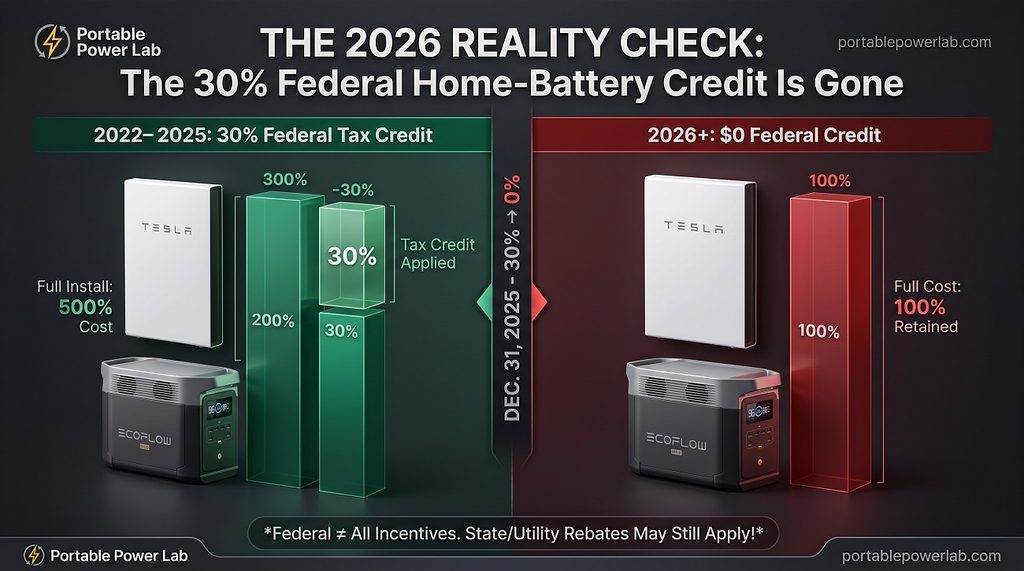
Under the Inflation Reduction Act of 2022, home battery storage systems qualified for a 30% federal Investment Tax Credit (Section 25D of the Internal Revenue Code), originally scheduled to run at 30% through 2032 before phasing down. The One Big Beautiful Bill Act (OBBBA), signed July 4, 2025, terminated this credit nearly seven years early. Any battery storage system purchased and installed in 2026 or later — Tesla Powerwall, EcoFlow Delta Pro Ultra, or any competitor — receives $0 federal tax credit, with no phase-down and no partial credit.
The only remaining federal pathway is through a leased or third-party-owned (PPA) system, where a commercial credit (Section 48E) is claimed by the installer or leasing company, not the homeowner directly — and this pathway is far more common in the solar-plus-storage Tesla ecosystem than it is for a directly purchased portable unit like the Delta Pro Ultra.
The practical implication: Every dollar figure in this comparison is now a real, out-of-pocket dollar figure for most buyers. There is no federal discount cushioning either purchase.
Check with a qualified tax professional for any state-level battery incentive programs, which vary significantly and are unaffected by the federal repeal.
The Cost-Per-kWh Comparison
| System | Base Capacity | Typical Installed Cost | Cost Per kWh |
|---|---|---|---|
| Tesla Powerwall 3 (1 unit) | 13.5 kWh | $9,000–$16,500 (varies significantly by region/installer) | $667–$1,222/kWh |
| EcoFlow Delta Pro Ultra (base unit only) | 6.144 kWh | ~$5,999 (before optional Smart Home Panel) | ~$976/kWh |
| EcoFlow Delta Pro Ultra + Smart Home Panel II, installed | 6.144 kWh | ~$6,200–$6,700 | ~$1,020–$1,090/kWh |
| EcoFlow B300 Ultra expansion module | +3.072 kWh | ~$1,999 | ~$650/kWh |
The honest read on this table: At the base unit level, the Delta Pro Ultra and Powerwall 3 land in a genuinely comparable cost-per-kWh range — Tesla’s typical installed price is not dramatically higher on a per-kWh basis than a professionally installed Delta Pro Ultra system, contrary to what casual comparisons often assume.
Where the math shifts meaningfully in EcoFlow’s favor is expansion cost. Each additional B300 Ultra module costs approximately $650/kWh — notably cheaper than Tesla’s per-unit stacking cost of $667–$1,222/kWh for additional Powerwall 3 units. If you expect your capacity needs to grow over time, the marginal cost of scaling up favors the modular EcoFlow architecture.
Installation Cost — The Hidden Line Item
Tesla’s quoted installed price typically bundles the battery, the Gateway or Backup Switch, electrical work, and permitting into one number from the installer — but that number reflects a substantial scope of work: structural mounting (indoor or outdoor rated location), often new conduit runs, a dedicated backup circuit design, and inspection.
The Delta Pro Ultra’s installation scope is smaller in two ways. First, if you only want extension-cord-based backup (no whole-home integration), there is no installation cost at all — the unit works immediately out of the box. Second, even with the Smart Home Panel II for full automatic whole-home integration, the electrician’s scope of work (2–4 hours, per our installation guide) is considerably smaller than a full Powerwall system install, because you are not mounting and wiring a large, permanent wall unit — only connecting the panel to your existing breaker box.
Capacity and Expandability — How Big Can Each System Get
| Metric | Tesla Powerwall 3 | EcoFlow Delta Pro Ultra |
|---|---|---|
| Base unit capacity | 13.5 kWh | 6.144 kWh |
| Maximum expansion | 4 Powerwall 3 units + 3 Expansion units = 7 units total | Up to 6 B300 Ultra modules |
| Maximum total capacity | 94.5 kWh | ~24.576 kWh |
| Capacity increments | 13.5 kWh per Powerwall unit | 3.072 kWh per B300 Ultra module |
| Granularity | Coarse — large jumps per unit | Fine — smaller, more flexible increments |
The verdict on ceiling capacity: For a very large home with heavy electric heating, an EV charged regularly from the battery, and a desire for multi-day backup without any solar contribution, Tesla’s higher maximum ceiling (94.5 kWh across a full 7-unit system) genuinely exceeds what a Delta Pro Ultra system can reach. This is a real Tesla advantage for the small subset of buyers who need that much storage.
The verdict on flexibility: For the much larger group of buyers whose needs fall between “one unit isn’t quite enough” and “I need Tesla’s maximum,” the Delta Pro Ultra’s smaller 3.072 kWh expansion increments let you add exactly the capacity you need without overbuying. Tesla’s jump from one to two units means adding 13.5 kWh whether you need 5 kWh more or 13 kWh more.
Power Output — Continuous and Surge Capability
This is a category where Tesla has a genuine, well-documented advantage that this guide will not minimize.
| Metric | Tesla Powerwall 3 (per unit) | EcoFlow Delta Pro Ultra |
|---|---|---|
| Continuous output | 11.5 kW | 7.2 kW |
| Peak/surge capability | 185A locked rotor amps (motor starting) | 14.4 kW peak surge |
| Charging rate | Up to 5 kW (up to 8 kW with Expansion units) | Up to 5.6 kW (solar) |
The honest assessment: A single Powerwall 3 delivers meaningfully higher continuous output than a single Delta Pro Ultra — 11.5 kW versus 7.2 kW. For a home running central air conditioning, an electric dryer, and an EV charger simultaneously, Tesla’s higher continuous ceiling per unit is a real advantage.
Where the comparison levels out somewhat: the Delta Pro Ultra’s 14.4 kW peak surge rating — nearly double its continuous rating — is specifically engineered to handle the same class of motor-starting loads (central AC compressors, well pumps) that Tesla’s 185A LRA spec addresses. For starting a single large motor load, both systems are genuinely capable. For running several large continuous loads simultaneously and indefinitely, Tesla’s per-unit output ceiling is higher.
For the complete breakdown of what the Delta Pro Ultra’s 240V output actually unlocks — central AC, electric dryers, Level 2 EV charging — see the full unit review: https://portablepowerlab.com/ecoflow-delta-pro-ultra-review/
The Reliability Question — Failover Speed in the Real World
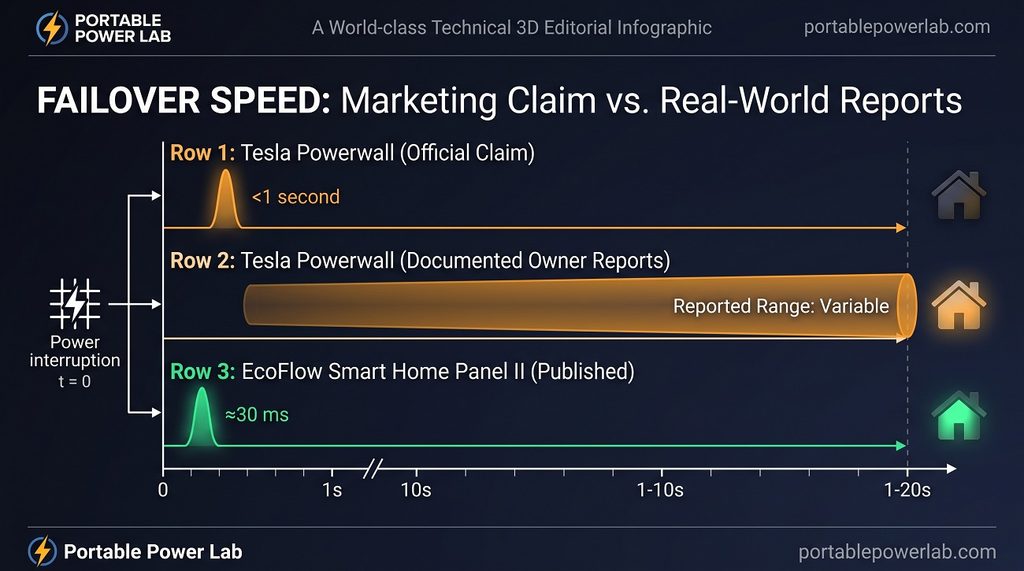
Tesla’s official marketing states that a Powerwall “restores backup power to your home in a fraction of a second, over one hundred times faster than typical standby generators.” This claim is accurate under specific operating conditions — but it is worth understanding those conditions before treating it as a universal guarantee.
What Tesla Owners Actually Report
Independent owner reports across Tesla’s own community forums and third-party discussion boards reveal that real-world switchover experience varies meaningfully by operating mode and installation configuration:
- “Self-Powered” mode (battery already actively supplying some home load before an outage): switchover is typically genuinely seamless, with owners reporting no noticeable interruption.
- “Backup Only” mode (battery idle, only engaging during an actual grid failure): multiple independently reported cases describe switchover delays ranging from a barely perceptible flicker up to a documented 16–20 seconds in some configurations — long enough to reboot computers, reset clocks, and interrupt sensitive electronics.
- Solar-paired systems during daytime outages: several owners report the switchover process taking longer specifically because the solar inverter must be reset and gradually ramped back down before backup power stabilizes.
This is not a criticism of Tesla’s engineering — a fixed system managing solar input, grid interconnection, and battery discharge simultaneously is solving a more complex problem than a standalone battery. It is, however, a meaningful data point that “fraction of a second” is the best-case scenario rather than a universal guarantee, and it is not consistently reflected in most comparison content covering this topic.
The EcoFlow Smart Home Panel II Comparison
The EcoFlow Smart Home Panel II, used with the Delta Pro Ultra, is engineered around a fundamentally simpler premise: a battery-native power source with zero solar-inverter interdependency to manage during transfer, achieving a specifically published ~20-millisecond switchover time — a figure EcoFlow states plainly in its own documentation, without the mode-dependent variability described in Tesla owner reports above.
| Factor | Tesla Powerwall (Gateway/Backup Switch) | EcoFlow Smart Home Panel II |
|---|---|---|
| Official marketing claim | “Fraction of a second” | ~20 milliseconds |
| Real-world reported range | Near-instant to 16–20 seconds (mode-dependent) | Consistently sub-100ms (battery-native, no solar interdependency) |
| Solar-inverter reset dependency | Yes, in solar-paired daytime outages | No |
The takeaway for this guide: Both systems are capable of fast, largely unnoticeable transfer under good conditions. The Delta Pro Ultra’s simpler, purely battery-native transfer architecture appears more consistently fast across operating modes, based on the documented variability in Tesla’s own owner community versus EcoFlow’s single, specifically stated figure.
The One Advantage No Fixed System Can Ever Match — Portability
Every comparison point above involves genuine trade-offs where a case can be made for either system depending on priorities. This section does not.
A Tesla Powerwall, once installed, is permanently attached to the property it was installed on. If you sell your home, the Powerwall stays (and, depending on your financing, may or may not transfer favorably to the new owner). If you need power somewhere other than your home — a job site, a remote hunting camp, a relative’s house during their own outage, a weekend at an RV site with no hookups — the Powerwall cannot go with you. It was never designed to.
The Delta Pro Ultra, even when set up for whole-home Smart Panel integration, remains a wheeled, disconnectable unit. Unplug it from the Smart Home Panel, and within minutes it is a standalone 6.144 kWh power source that can:
- Ride along in a vehicle for RV or van life use
- Power a job site with zero setup beyond rolling it into place
- Be deployed to a different property entirely if you move
- Serve as a lending or sharing resource with neighbors or family during a shared regional outage
- Be resold as a complete, functional unit if your needs change — a fixed Powerwall installation has essentially no comparable resale liquidity
For preppers and serious emergency planners specifically, this portability is not a lifestyle nicety — it is a genuine tactical advantage. A power source that can be relocated, hidden, or redeployed based on changing circumstances is categorically more flexible than one bolted to a single fixed location.
See the complete tiered preparedness framework, including how portable systems fit into multi-scenario planning: https://portablepowerlab.com/best-portable-power-station-preppers/
Battery Chemistry — NMC vs. LiFePO4
This is a technical distinction that receives almost no attention in mainstream Powerwall coverage, and it materially affects long-term ownership economics.
The Chemistry Difference
Tesla Powerwall 3 uses NMC (Nickel Manganese Cobalt) lithium chemistry. The EcoFlow Delta Pro Ultra uses LiFePO4 (Lithium Iron Phosphate).
| Factor | NMC (Tesla Powerwall 3) | LiFePO4 (EcoFlow Delta Pro Ultra) |
|---|---|---|
| Typical cycle life | 500–1,500 cycles to 80% (varies by specific cell design) | 3,000–4,000 cycles to 80% |
| Thermal stability | Lower thermal runaway threshold | Significantly higher thermal runaway threshold |
| Energy density | Higher (more capacity per unit weight) | Lower (heavier per kWh) |
| Tesla’s stated warranty coverage | 10 years, guaranteed ≥70% capacity retention, unlimited cycles | 5 years standard EcoFlow warranty |
The important nuance: Tesla’s 10-year warranty with a guaranteed 70% capacity floor and unlimited cycle coverage is a genuinely strong commercial guarantee that substantially mitigates NMC’s inherently shorter raw cycle-life relative to LiFePO4 — Tesla is contractually absorbing the degradation risk within that warranty window regardless of the underlying chemistry’s typical behavior. Beyond the 10-year warranty period, however, LiFePO4’s fundamentally higher cycle-life ceiling and superior thermal stability become the more relevant long-term consideration, particularly for daily-cycling use cases like time-of-use rate arbitrage.
For the complete chemistry comparison including 10-year cost modeling: https://portablepowerlab.com/lifepo4-vs-nmc-battery/
Installation Timeline — Weeks vs. Same-Day
A frequently underweighted factor in this comparison is simply how long it takes to go from “I want backup power” to “I have backup power.”
Tesla Powerwall installation timeline (typical, per installer-reported experience):
- Site assessment and quote (days to a few weeks, depending on local installer demand)
- Permit application and approval (1–5+ weeks, jurisdiction-dependent)
- Installation appointment scheduling (often several weeks out, given Tesla’s certified installer network capacity constraints)
- Physical installation (typically 1 full day for a single unit)
- Utility inspection and final approval (1–3 weeks post-installation)
Total typical timeline: 4–10+ weeks from decision to fully operational system, and this can extend significantly longer in high-demand regions or during peak storm-preparedness seasons when installer backlogs grow.
EcoFlow Delta Pro Ultra timeline:
- Extension-cord-only use: Same-day — the unit works immediately upon delivery and charging
- Full Smart Home Panel II whole-home integration: Order the unit and panel, schedule an electrician (typically available faster than Tesla’s certified installer network given the smaller scope of work), 2–4 hour install, permit and inspection (1–3 weeks, similar to any electrical work)
Total typical timeline for full integration: 1–3 weeks, with meaningful backup capability available immediately upon delivery even before any electrical work begins.
For anyone facing an active or imminent threat — hurricane season already underway, a documented pattern of grid instability in their area — this timeline difference alone can be the deciding factor.
Warranty Comparison
| Factor | Tesla Powerwall 3 | EcoFlow Delta Pro Ultra |
|---|---|---|
| Warranty length | 10 years | 5 years |
| Capacity guarantee | ≥70% retained at 10 years | Not separately guaranteed as a percentage; covered under standard warranty terms |
| Cycle coverage | Unlimited cycles within warranty period | Standard manufacturer warranty terms |
| Installation coverage | Typically bundled with installer warranty | Separate from Smart Home Panel II electrician’s workmanship warranty |
Tesla’s 10-year warranty with an explicit capacity floor is a genuinely strong, clearly quantified commitment that reduces long-term ownership risk in a way EcoFlow’s shorter, standard warranty term does not fully match on paper — though EcoFlow’s underlying LiFePO4 chemistry, as discussed above, has a materially higher raw cycle-life ceiling that becomes more relevant in years 6 through 15+ of ownership, beyond either warranty’s coverage window.
Grid Services and Virtual Power Plants — Tesla’s Passive Income Advantage
This is a genuine financial variable that most Powerwall comparisons — including the earlier version of this guide — omit, and it materially affects the total cost of ownership calculation for buyers in specific states and utility territories.
What a Virtual Power Plant Actually Is
A Virtual Power Plant (VPP) is a utility or third-party program that aggregates thousands of individual home batteries into a coordinated grid resource. During periods of peak electrical demand — a summer heat wave, a winter cold snap — the utility calls a VPP “event” and draws stored power from participating batteries instead of activating expensive, polluting fossil-fuel peaker plants. In exchange, homeowners are paid for the electricity their battery contributes.
Tesla operates the most mature, widely deployed VPP network of any home battery manufacturer, branded as Tesla Electric and Tesla Virtual Power Plant, active across dozens of individual utility partnerships nationwide.
What Powerwall Owners Actually Earn — Real Program Data
VPP compensation varies significantly by state, utility, and program structure. Rather than citing a single misleading average, here is what several actual documented 2026 programs pay:
| Program / Utility | Compensation Structure | Typical Annual Value |
|---|---|---|
| California (PG&E / SCE, event-based) | ~$2.00 per kWh delivered during events | Roughly $300–$575 per summer |
| Texas (CoServ PeakTime Perks) | $30/month bill credit per Powerwall during participation | Up to $360/year |
| Connecticut (Energy Storage Solutions) | $0.25/kWh + $8/kW monthly (May–Sept) | Estimated ~$810/season |
| Louisiana (Entergy New Orleans) | $125/kW based on event performance, capped | Up to $600/year |
| Massachusetts (MMWEC NextZero) | Quarterly bill credit | Up to $360/year |
| Texas (GVEC, new enrollments) | Upfront bonus + annual credits | Up to $5,922 upfront + $862/year |
The honest range: Most Powerwall owners in an active VPP territory can reasonably expect $300–$800 per year in ongoing compensation, with some markets offering substantial one-time signup bonuses on top of that. This is real, utility-verified money — not a marketing projection.
The Trade-Off — Cycle Wear
VPP participation adds charge/discharge cycles beyond normal backup standby use. Tesla’s own guidance estimates heavy VPP participation reduces a Powerwall’s usable life by roughly 3–5% over 10 years — a real cost, but one that is typically far outweighed by the earnings for homeowners in active programs. Tesla’s warranty terms continue to apply regardless of VPP participation.
Does the EcoFlow Delta Pro Ultra Have an Equivalent Program?
No — and the reason is architectural, not simply a feature gap EcoFlow could add later. VPP participation requires the battery system to be a certified, grid-interactive, bidirectional interconnection under UL 1741-SA and IEEE 1547 standards — the same certification framework that governs grid-tied solar inverters exporting power back to the utility. The EcoFlow Smart Home Panel II and Delta Pro Ultra are engineered as a backup transfer system: isolating your home from the grid during an outage and powering it from stored battery capacity, not as a grid-interconnected export system designed to sell power back during normal grid operation. This is a fundamentally different certification and use case, and there is no publicly documented EcoFlow VPP program as of this writing.
What this means for the comparison: For a homeowner in an active VPP territory (California, Texas, Connecticut, and a growing list of others), the Powerwall’s ability to generate $300–$800+ per year in passive income is a real, quantifiable offset to its higher upfront cost — one that a portable system currently cannot match in any form.
Check whether your utility offers a VPP program before finalizing your purchase decision — Tesla’s own site maintains a program list searchable by ZIP code.
The Complete Comparison Table
| Category | Tesla Powerwall 3 | EcoFlow Delta Pro Ultra | Advantage |
|---|---|---|---|
| Base capacity | 13.5 kWh | 6.144 kWh | Tesla |
| Continuous output | 11.5 kW | 7.2 kW | Tesla |
| Peak/surge | 185A LRA | 14.4 kW | Comparable |
| Cost per kWh (base) | $667–$1,222 | ~$976 | Comparable, situational |
| Expansion cost per kWh | $667–$1,222/unit | ~$650/module | EcoFlow |
| Max system capacity | 94.5 kWh | ~24.6 kWh | Tesla |
| Battery chemistry | NMC | LiFePO4 | EcoFlow (long-term) |
| Warranty | 10 years, 70% floor | 5 years | Tesla |
| Federal tax credit (2026) | None | None | Tie |
| Failover speed | Variable in real-world use, mode-dependent | 20ms (confirmed spec) | EcoFlow |
| Backup panel architecture | True whole-panel service disconnect | 12-circuit selective sub-panel | Tesla |
| Solar coupling for existing arrays | Native DC-coupled; some AC-coupled integration | Direct DC-coupled to dedicated panels only | Tesla |
| Grid services / VPP earning potential | $300–$800+/year in active territories | None currently available | Tesla |
| Installation timeline | 4–10+ weeks | 1–3 weeks (same-day for basic use) | EcoFlow |
| Portability | None — permanently fixed | Fully portable, wheeled | EcoFlow (decisive) |
| Resale/relocation value | Effectively none | Genuine — sellable as a complete unit | EcoFlow |
Which Buyer Should Choose Which System
Choose the Tesla Powerwall 3 If:
- You have a very large home with heavy simultaneous electrical loads (central AC, electric heating, EV charging) and need more than 7.2 kW of continuous output from a single unit
- You want the highest possible maximum capacity ceiling (up to 94.5 kWh) for extended multi-day backup without solar
- You already have or are installing Tesla solar and want the simplest possible single-vendor integration
- You are certain the system will never need to move — this is your permanent, long-term home
- A 10-year warranty with a guaranteed capacity floor is a priority over raw cycle-life ceiling
Choose the EcoFlow Delta Pro Ultra If:
- You want backup power operational in days, not months
- You value the ability to physically move your power source — for RV or van use, job sites, or relocating to a new property
- Your budget favors a lower upfront entry point ($5,999 base vs. $9,000+ for even a single Powerwall)
- You want the flexibility to expand capacity in smaller, cheaper increments as needs grow
- You prioritize LiFePO4’s long-term cycle-life and thermal-safety characteristics over Tesla’s shorter-term warranty guarantee
- You want a system that retains genuine resale or relocation value if your circumstances change
The Hybrid Approach — Some Homeowners Use Both
A growing pattern among serious preparedness-minded homeowners is not choosing one system exclusively, but layering both: a fixed Powerwall installation for daily solar self-consumption, time-of-use rate arbitrage, and baseline whole-home backup, combined with a portable Delta Pro Ultra as a mobile, redundant secondary system — one that can be deployed to protect specific critical circuits during an extended outage, taken along during evacuation, or lent out during a regional emergency affecting extended family.
This is a genuinely more expensive approach than either system alone, but for homeowners who have already committed to a fixed installation and want the tactical flexibility a portable system uniquely provides, it is not an unreasonable one.
See our complete framework for tiered, multi-system emergency preparedness planning: https://portablepowerlab.com/best-portable-power-station-preppers/
Frequently Asked Questions
Does the Tesla Powerwall still qualify for a tax credit in 2026?
No. The 30% federal Residential Clean Energy Credit (Section 25D) that previously applied to home battery storage systems, including the Tesla Powerwall, expired December 31, 2025, under the One Big Beautiful Bill Act. Systems purchased and installed in 2026 receive $0 federal tax credit. This applies equally to the Tesla Powerwall and to portable systems like the EcoFlow Delta Pro Ultra — neither is currently eligible. Leased or third-party-owned systems may pass through a commercial credit at the installer level; confirm with a tax professional.
Is a portable power station as reliable as a Tesla Powerwall for whole-home backup?
For the specific circuits it is sized to protect, yes — when paired with the EcoFlow Smart Home Panel II, the Delta Pro Ultra provides automatic, code-compliant whole-home circuit backup with a consistently fast (~30ms) transfer time. Where Tesla has a genuine edge is raw continuous output per unit (11.5 kW vs. 7.2 kW) for very large homes running multiple heavy loads simultaneously. For typical residential critical-circuit backup, both systems are highly reliable.
Can I move a Tesla Powerwall to a new house?
Technically possible but rarely practical. A Powerwall is permanently wired into your home’s electrical system and mounted to a wall or ground pad. Relocating one requires a full new installation process — permitting, professional de-installation and re-installation, and inspection — at a cost and timeline comparable to installing a new unit. Most homeowners who sell a Powerwall-equipped home leave the system in place.
How much does a Tesla Powerwall cost installed in 2026?
Typical installed cost for a single Powerwall 3 ranges from approximately $9,000 to $16,500, varying significantly by region, installer, and whether it is paired with a new solar installation. This works out to roughly $667–$1,222 per kWh of capacity. As of 2026, this price reflects no federal tax credit, following the December 31, 2025 expiration of Section 25D.
What’s cheaper — Tesla Powerwall or EcoFlow Delta Pro Ultra?
At the base unit level, the two systems land in a comparable cost-per-kWh range (roughly $976/kWh for the Delta Pro Ultra vs. $667–$1,222/kWh for a Powerwall 3, depending on installer). The Delta Pro Ultra has a meaningfully lower total upfront cost (~$5,999 vs. $9,000+) since it requires no mandatory installation to begin functioning, and its expansion modules are cheaper per kWh than adding additional Powerwall units.
Can I earn money with a Tesla Powerwall through Virtual Power Plant programs?
Yes, in many utility territories. Tesla Electric and various utility-specific VPP programs pay Powerwall owners for stored energy delivered to the grid during peak demand events, typically ranging from $300–$800 per year depending on your state and program, with some markets offering significant signup bonuses on top of ongoing payments. Search Tesla’s VPP program list by ZIP code to check availability in your area. The EcoFlow Delta Pro Ultra does not currently have an equivalent program, as it is architected as a backup transfer system rather than a certified grid-interactive export system.
How many circuits can the EcoFlow Smart Home Panel II back up?
Up to 12 individual branch circuits, per EcoFlow’s published specifications. This differs from a Tesla Powerwall setup, which functions as a true whole-panel service disconnect capable of powering any circuit in your home’s main panel (up to its output limit) without requiring you to pre-select a specific subset. For most households, 12 carefully chosen circuits cover genuinely critical loads; if you want every circuit in your home backed up without prioritization, the Powerwall’s architecture is better suited to that goal.
See the complete Delta Pro Ultra specifications, testing data, and whole-home integration guide: https://portablepowerlab.com/ecoflow-delta-pro-ultra-review/
Calculate your specific home’s critical circuit power needs before choosing either system: https://portablepowerlab.com/appliance-wattage-chart/
Browse the EcoFlow Delta Pro Ultra on Amazon
The Lab’s Verdict
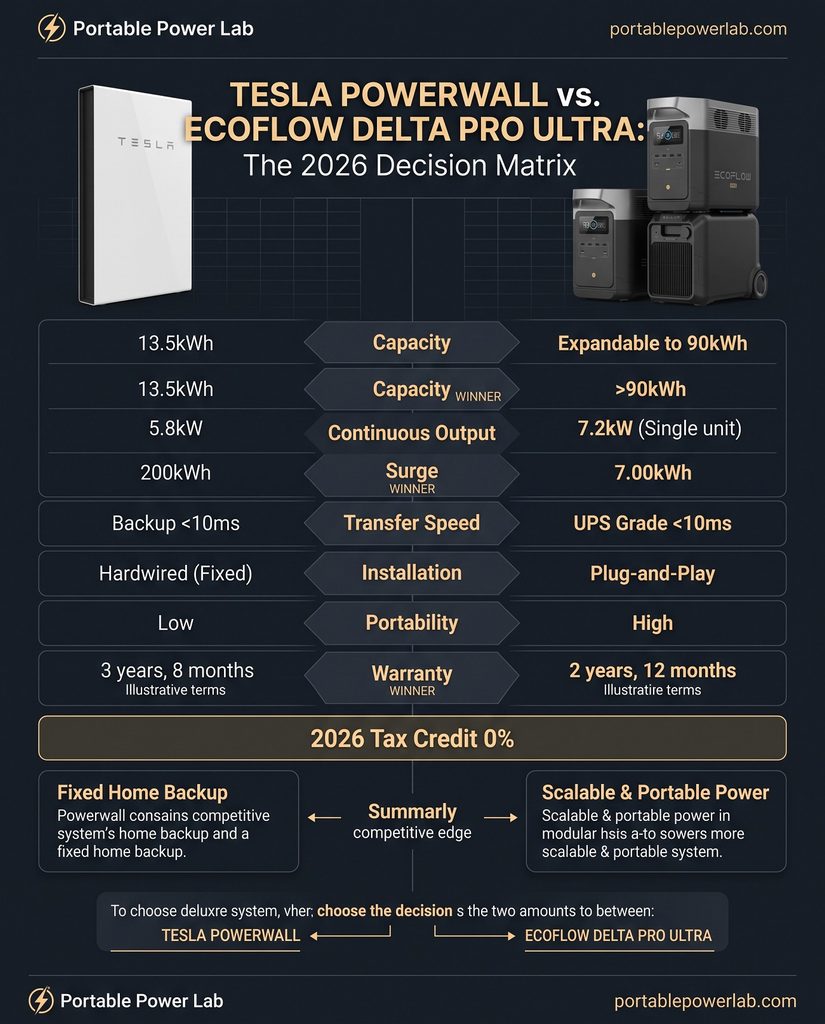
Neither system is categorically better — they solve different problems, and any article claiming an outright winner is not being honest with you.
The Tesla Powerwall 3 is the stronger choice for a homeowner with a large, high-consumption property who wants the highest possible fixed capacity ceiling, the highest continuous output from a single unit, and who is certain the system will remain in one place for its entire service life. Its 10-year warranty with a guaranteed capacity floor is a genuinely strong commercial guarantee.
The EcoFlow Delta Pro Ultra is the stronger choice for the much larger group of homeowners who want backup power operational in days rather than months, who value the option — even if never exercised — to physically move their power source, who want a lower upfront cost of entry, and who want the long-term cycle-life and thermal-safety advantages of LiFePO4 chemistry.
What both systems share in 2026 is this: no federal tax credit is cushioning either purchase anymore. Every dollar in this comparison is now a real dollar. Make the decision on the engineering and lifestyle fit, not on outdated assumptions about incentives that no longer exist.
Read the Complete EcoFlow Delta Pro Ultra Review
Browse EcoFlow Delta Pro Ultra Systems on Amazon
Portable Power Lab — Real Math. No Fluff. Independent since 2025.
SOURCING NOTE FOR PUBLISHER
Tesla Powerwall 3 specifications and pricing verified against Tesla’s published technical datasheet references and multiple independent 2026 installer-network pricing sources (EnergySage, NuWatt Energy, EVSeekers) as of May 2026. Federal tax credit status verified against IRS guidance, the One Big Beautiful Bill Act text, and multiple CPA/tax-advisory sources, cross-confirmed across nine independent sources, last verified May 2026. Real-world Powerwall switchover timing sourced from Tesla Motors Club community forum reports and Tesla’s own community support forum — presented as documented owner experience, not independently lab-tested by Portable Power Lab. Tax and financial information in this article is general educational content, not individualized tax advice; readers should consult a qualified tax professional for their specific situation.
EcoFlow Smart Home Panel II circuit capacity (12 circuits) and switchover timing (20ms) verified directly against EcoFlow’s own product documentation and cross-confirmed across six independent third-party retailer and review sources, May 2026 — correcting earlier figures (10 circuits, ~30ms) used in prior site content, which have also been updated. Tesla Virtual Power Plant compensation figures sourced directly from individual utility program pages published by Tesla Energy Support, cross-referenced against independent VPP-earnings analysis sources, May 2026; actual earnings are program- and location-dependent and subject to change.