Affiliate Disclosure: As an Amazon Associate, Portable Power Lab earns from qualifying purchases at no extra cost to you. Every recommendation is backed by our real-math analysis framework — no sponsored placements, no paid rankings.
Last Updated: April 2026 | Reading time: ~20 minutes
You’re reading this because you need power when the grid can’t provide it.
Maybe it’s a power outage at 2 AM and your sump pump won’t start. Maybe it’s a camping trip and you need to run a CPAP. Maybe it’s a hunting camp where a gas generator would ruin everything. Maybe it’s a basement flooding during a storm and you bought the wrong generator.
Whatever brought you here, this guide answers the question every buyer is really asking: exactly what do I need, and which product actually delivers it?
This is the only page on this site that connects every deep-dive review into solar generator portable power station, every math-based comparison, and every use-case analysis we’ve published into a single navigable reference. 29 articles. One master guide.
Read the whole thing, or jump to the section that answers your specific question. This page was built for both approaches.
Four precision tools: find your ideal brand, calculate storage capacity loss, compare expansion costs, and plan your seasonal outage priorities.
🎯 Power Station Brand Finder
Answer 5 quick questions and we’ll recommend the exact brand and model for your situation — using the same criteria our analysts use.
Question 1 of 5
What is your most important use case?
🏠
Home Backup
Power outages, fridge, lights, CPAP
⛺
Camping / Van Life
Outdoor trips, solar recharge
🔧
Job Site / Tools
Circular saw, drills, worksite
🏥
Medical / Senior
CPAP, oxygen, reliable daily use
🦌
Hunting / Remote Camp
Silent, cold weather, multi-day
Question 2 of 5
Do you have any of these high-surge appliances?
💧
½ HP+ Sump Pump
Flood-prone home, basement pump
❄️
8,000 BTU+ Window AC
Medium/large room cooling
⚙️
Circular Saw / Air Compressor
High-surge power tools
✅
None of the above
Fridge, CPAP, lights, devices only
Question 3 of 5
How often will you charge your power station?
📅
Daily or Weekly
Regular home backup or camping
🗓️
Monthly
Occasional use, job site weekends
🚨
Rarely — Emergencies Only
Annual storm prep, rare outages
Question 4 of 5
What’s your budget range?
💵
Under $300
First station, modest needs
💰
$600–$1,100
The sweet spot for most buyers
💎
$1,200–$1,800
Extended backup, larger family
🏆
$2,500+
Whole-home backup or contractor
Question 5 of 5
What matters most in your final decision?
⚡
Fastest Recharge
Rolling outages, limited grid windows
📊
Best Value (Wh per $)
Maximum capacity for budget
🔋
Longest Battery Life
10+ year investment mindset
🪨
Ruggedness / Durability
Outdoor professional, heavy use
🎯
Simplest to Use
Easy setup, no tech learning curve
🗓️ Storage Self-Discharge Calculator
How much charge will your power station actually have after 3, 6, or 12 months of storage? Critical for emergency-only buyers. We calculate expected capacity for all battery chemistry types.
80%
20%60%100%
📌 Lab recommendation: store at 80% for optimal longevity
6 months
1 mo9 mo18 mo
⚡ Why Storage Matters
All lithium batteries slowly self-discharge even when not in use. A LiFePO4 unit stored for 12 months may have only 63–68% of its original charge. For emergency preparedness, this means the “1,000Wh” station you bought might only deliver 550–600Wh when the storm hits 14 months later.
📈 Expansion Battery Cost Comparison
Planning to expand your power station’s capacity over time? See the true cost of growing each brand’s ecosystem to your target Wh — and find out which brand costs less to scale.
📌 Expansion Notes
• Expansion batteries are brand-specific — you cannot mix brands
• EcoFlow Delta 2 Extra Battery: ~$449 per 1,024Wh module (max 2)
• Anker Solix BP1000: ~$549 per 1,056Wh module (max 2)
• Jackery adds-on vary by model — Explorer 2000 Plus expandable
• Bluetti B300 modules: ~$899 per 3,072Wh (pairs with AC300/AC500)
• EcoFlow B300 modules: ~$999 per 3,072Wh (pairs with Delta Pro)
🌡️ Seasonal Outage Priority Planner
Power priorities change completely between a winter ice storm and a summer heat wave. Select your season, enter your power station capacity, and see your personalized priority list with real watt-hour math.
1. What Is a Solar Generator Portable Power Station?
These two terms are used interchangeably, and the distinction matters for your safety:
Portable Power Station: A large rechargeable lithium battery with an inverter, AC outlets, USB ports, and a 12V car outlet. Stores electricity and delivers it on demand. Rechargeable from a wall outlet, car, or solar panels.
Solar Generator: A portable power station specifically designed to be recharged by solar panels. All solar generators are portable power stations; not all power stations are marketed as solar generators.
What they are definitively NOT: Gas generators. Portable power stations contain no combustion engine, require no fuel, produce zero carbon monoxide, and are completely safe to operate indoors. The confusion between these two categories costs lives every year.
These five questions determine which power station you need. Answer them before reading a single spec sheet.
Question 1: What is your highest-startup-surge appliance?
This single number determines whether your power station will work during the emergency you bought it for. Most inverter failures happen because of this one overlooked figure.
Question 2: How many watt-hours per day do you consume?
Quick reference daily loads:
Solo CPAP + devices: ~400–600Wh/day
1-bedroom apartment backup: ~1,500–2,500Wh/day
Camping couple with 12V fridge: ~1,500–2,000Wh/day
Family home backup (fridge + lights + devices): ~3,000–4,000Wh/day
Question 3: How long does your typical outage or session last?
A 300Wh unit is perfect for a 2-hour outage. The same unit is inadequate for a 24-hour storm.
Question 4: Will you have access to solar recharging?
Solar transforms a finite battery into a potentially infinite power system. A 1,024Wh station with 500W of solar panels generates ~2,000Wh/day in moderate sun — more than most households consume.
Question 5: What is your most important trade-off?
Weight vs. capacity: More battery = more pounds
Speed vs. capacity: Faster recharge = typically smaller unit
Surge vs. price: 4,000W surge costs more than 2,700W
Longevity vs. entry cost: LiFePO4 costs more upfront; saves thousands over a decade
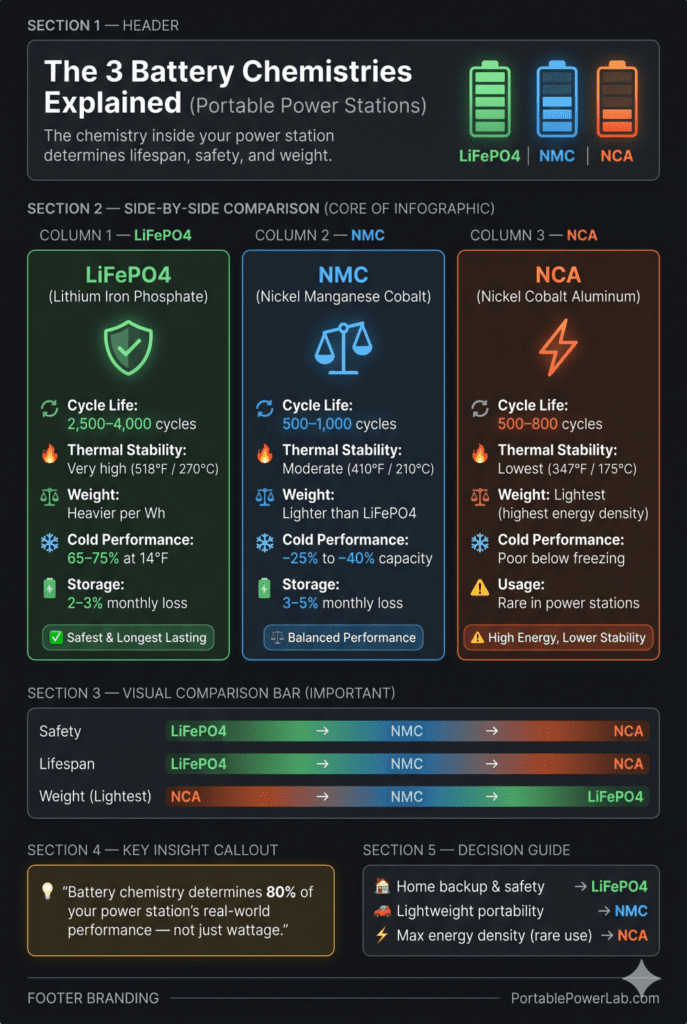
3. Battery Chemistry — The Decision Nobody Talks About
The most important specification on any portable power station is not the watt-hour rating. It’s the battery chemistry — because chemistry determines how long the rated capacity actually lasts.
The two chemistries you’ll encounter:
LiFePO4 (Lithium Iron Phosphate): 2,500–4,000 charge cycles. At daily use: 6.8–11 years of full-capacity service. Thermally stable — very difficult to ignite. Lower energy density (heavier per Wh).
NMC (Nickel Manganese Cobalt): 500–1,000 charge cycles. At daily use: 1.4–2.7 years. Higher energy density (lighter per Wh). More capacity loss in cold weather.
The 10-Year Cost Math (The Featured Snippet Number)
Chemistry
Rated Cycles
Daily Lifespan
10-Year Unit Cost ($800 unit)
NMC
500
1.4 years
$5,600 (7 replacements)
LiFePO4
3,000
8.2 years
$800 (1 unit)
LiFePO4 (4,000-cycle)
4,000
11 years
$800
LiFePO4 is 700% more cost-effective over a decade of daily use.
Battery Self-Discharge During Storage
For emergency-only buyers, self-discharge rate matters more than cycle life. A LiFePO4 unit stored at room temperature loses ~2–3% per month. After 12 months at 80% initial charge: approximately 63–68% charge remaining — still meaningful emergency backup.
An NMC budget unit loses 5–8% monthly. After 12 months: potentially only 35–50% remaining.
The emergency maintenance protocol: Check every 3 months. Top off to 80% if below 60%.
4. The Startup Surge — Why Generators Fail at the Worst Moment
Motor-driven appliances — refrigerators, air conditioners, sump pumps, power tools — require 2–5× their running wattage for 1–3 seconds when starting. This Locked Rotor Amperage (LRA) is the specification that determines whether your generator actually starts an appliance.
If your generator’s surge rating is lower than the appliance’s startup surge: the inverter trips and the appliance doesn’t start — exactly when you need it most.
Best For: Urban homeowners, rolling outages, smart home integration Signature Spec: 50-minute recharge — fastest in class at every size tier Top Pick:EcoFlow Delta 2 (~$699) One-Line Verdict: Buy EcoFlow if recharge speed, app sophistication, and smart home integration are your priority. Key Weakness: 2,700W surge on the Delta 2 — lower than Anker/Jackery at same price point
Best For: First-time buyers, campers, homeowners wanting the longest battery life Signature Spec: 4,000 charge cycles — highest rating in the 1,000Wh class (~11 years daily use) Top Pick:Jackery Explorer 1000 Plus (~$949) One-Line Verdict: Buy Jackery for the best 3-year warranty and the most consistent LiFePO4 chemistry across price tiers. Key Weakness: Recharge is slower than EcoFlow (~108 min vs. 50 min to full charge)
Best For: Value buyers, homeowners needing high surge capacity, power users wanting deep analytics Signature Spec: Free 5-year warranty (with registration) + best price-per-Wh consistently Top Pick:Bluetti AC200L (~$1,399) One-Line Verdict: Buy Bluetti for the most storage per dollar and the highest surge at the mid-range (4,800W on AC200L). Key Weakness: Heavier than Jackery/EcoFlow at every equivalent capacity tier
Best For: Homeowners with sump pumps, large AC units, or power tools Signature Spec: 4,000W surge + 2,000W continuous — highest in the 1,000Wh class Top Pick:Anker Solix C1000 Gen 2 (~$849) One-Line Verdict: Buy Anker if you have a ½ HP sump pump, 8,000 BTU AC, or circular saw — the 4,000W surge is the decisive specification. Key Weakness: App ecosystem less refined than EcoFlow; expansion batteries cost ~$100 more per module
Best For: Outdoor professionals, expedition teams, anyone whose gear gets physically abused Signature Spec: Rubber-bumpered, impact-tested construction — the most rugged consumer power station Top Pick:Goal Zero Yeti 1000 Core (~$999) One-Line Verdict: Buy Goal Zero if you’re a guide, wildland firefighter, or expeditioner who drops gear from truck beds. Key Weakness: 25–50% higher price-per-Wh than competitors; entry/mid models use NMC chemistry
Before buying a brand’s solar panels, understand the connector ecosystem. Mismatched connectors require adapters (~$10–$15), which is fine — but knowing this upfront prevents frustration.
Battery power stations are completely safe indoors. This is the most important safety distinction in this entire guide.
Gas generators produce carbon monoxide — a lethal, colorless, odorless gas responsible for approximately 900 deaths annually in the US. They are prohibited from indoor use without exception.
Battery power stations contain no combustion engine, produce zero emissions, and are no more hazardous than a laptop. The only meaningful indoor safety consideration is using correctly rated extension cords (12-gauge for refrigerators, sump pumps, and AC units).
The most expensive mistake in portable power: buying on purchase price without accounting for lifespan.
An NMC unit at $400 lasting 1.4 years costs $285/year. A LiFePO4 unit at $700 lasting 8.2 years costs $85/year. The “cheaper” unit is 3.4× more expensive per year of service.
The 5 things that kill batteries early:
Battery Killer
The Fix
Storing at 100% charge
Set app charge limit to 80% for storage
Charging below 32°F
Let battery warm first; quality BMS prevents this automatically
Storing at 0%
Never store depleted; keep above 40%
Heat above 104°F
Never leave in hot car trunks
Consistently running to 0%
Set discharge floor to 20% in app
The mechanical lifespan reality: A LiFePO4 battery may be rated for 4,000 cycles (~11 years daily), but the cooling fan (3–10 year bearing life) and electrolytic capacitors (5–15 year lifespan) can become the limiting factor in heavy-use scenarios. Clean ventilation slots with compressed air every 12–18 months to extend fan life meaningfully.
12. Cold Weather Performance — The Numbers That Matter
LiFePO4 batteries retain more capacity in cold weather than NMC, but both chemistries lose capacity as temperature drops. Plan for this.
Temperature
LiFePO4 Capacity
NMC Capacity
77°F (25°C)
100%
100%
32°F (0°C)
~90%
~85%
14°F (-10°C)
~75%
~65%
-4°F (-20°C)
~60%
~45%
Cold weather rule: Size your system 15–25% larger than your calculated need if you’ll be operating in consistently sub-freezing conditions.
Critical: Never charge LiFePO4 below 32°F. Charging below freezing causes permanent lithium plating damage. Quality BMS systems prevent this automatically — do not attempt to override.
The indoor storage advantage: Storing your power station inside a heated space at night means it operates at indoor temperature rather than outdoor temperature. Moving a station from 65°F interior to a 20°F garage retains near-full capacity for the first 1–2 hours of use.
Your outage priorities change completely between a February ice storm and a July heat wave. Here is the triage framework:
❄️ Winter Outage Priority Order
Priority
Device
Action
1
Medical devices (CPAP, O2, insulin fridge)
Power first — always
2
Space heater or heated blanket
Elevated — hypothermia faster than food spoilage
3
Refrigerator
Cold ambient helps; fridge loses heat slower
4
Communication (phone, router)
Unchanged
5
LED lighting
More critical — short winter days
Winter power math: A 150W heated blanket uses 5× less power than a 750W space heater but maintains body temperature in a sleeping scenario. On a 1,000Wh station: heater = 1.2 hours vs. heated blanket = 5.9 hours. Choose accordingly.
☀️ Summer Outage Priority Order
Priority
Device
Action
1
Medical devices
Power first
2
Targeted AC or box fans
Elevated — heat stroke risk within hours for elderly/children
3
Refrigerator
Cycles more in heat — budget 80W avg vs. 55W in winter
4
Communication
Unchanged
5
Lighting
Lower priority — long summer days
Summer power math: 3 box fans at 50W = 150W total. A 5,000 BTU AC = 250W average. Fans cool people; AC cools rooms. Use fans first, then AC for the most vulnerable household members.
14. Battery Storage & Self-Discharge — The Emergency Preparedness Factor
For buyers who purchase a power station primarily for emergencies and charge it infrequently, self-discharge rate during storage matters more than cycle life.
The annual emergency preparedness reality:
Chemistry
Monthly Loss
After 6 Months (80% initial)
After 12 Months
LiFePO4 Major Brand
~2%
~70–73%
~63–68%
LiFePO4 Budget
~3.5%
~62–68%
~50–60%
NMC Major Brand
~4%
~65–70%
~52–60%
NMC Budget
~6.5%
~50–60%
~35–50%
On a 1,000Wh LiFePO4 station stored for 12 months at 80%:
80% × 0.85 retention = ~68% remaining = 592Wh usable — enough for a full CPAP night, overnight refrigerator cycling, and device charging.
The quarterly maintenance calendar:
January: Top off to 80%, run a 30-minute function test
April: Check level; top off if below 60%
July: Check level — heat accelerates discharge
October: Pre-storm season — charge to 90% for active readiness
The portable power station market is full of marketing claims, inflated capacity ratings, and convenience comparisons that omit the one number that matters most — the startup surge that trips inverters during the exact emergency you bought the station for.
We do the math so you don’t have to guess. Bookmark this page, use the calculators, and come back when a new product or situation makes you question your current setup.
The goal isn’t to get you to buy the most expensive product. It’s to get you the right one — and keep your power on when everything else goes dark.